I will protect your pensions. Nothing about your pension is going to change when I am governor. - Chris Christie, "An Open Letter to the Teachers of NJ" October, 2009

Monday, September 23, 2013

The Continuing Problem Of the Wealthy, Reformy "Liberal"

Let's get back to America's Worst Congressman™, Jared Polis of Colorado:


Don't bother trying to find this tweet: it's long gone. Funny how these things happen...

But intemperate behavior seems to be Polis's m.o.; here's Diane Ravitch herself:

In a series of Twitter posts last night, Congressman Jared Polis of Colorado called me “an evil woman.” He said that my ideas were harming public education.
This is puzzling. What do I do that makes the rich and powerful fume and blow their cool?
I have met him twice in DC. The first time, I met with members of the House Education Committee and described my last book, The Death and Life of the Great American School System. He listened impatiently and at the end of my 15 minutes of talk, he threw my talk across the table at me and demanded his money back. Another Congressman paid him, not me. [sic] I was stunned. [emphasis mine]
All class, Congressman. Jon Pelto, who has been working closely with Ravitch in promoting her new book, Reign of Error, took a closer look at Polis:
Last week, Democratic Congressman Jared Polis of Colorado, who purports to be a “a progressive,” called Diane Ravitch an “evil woman” and compared her to the Koch Brothers tweeting ,“Can’t think of anybody else who has caused more harm to public schools, except maybe Koch brothers.”
As we are learning, Polis failed to reveal that not only is he a charter school advocate but his foundation, with the help of his company, actually formed a charter school or two in his home state of Colorado.
As we know, charter schools like to brag about their higher test scores, but traditionally use their recruitment process and “out migration” policies to push out less academically proficient students and, almost across the board, fail to take their fair share of non-English speaking students and students who require special education services.
Click through and read the rest of Jon's post. But let's also take a step back and view this from a larger angle:

Jared Polis is the seventh wealthiest person in Congress. And while I am sure he is a talented businessman, the truth is that he made his money by taking his parents' greeting card business on-line in a transaction that was way, way overvalued:

As an 18-year-old, he traveled to Russia and made money trading privatization vouchers — you know, the botched, scandal-ridden privatization which wrecked Russa's economy and led to the domination of the economy by ex-KGB oligarchs. Next stop: Silicon Valley!
In October 1999, right before the first dotcom crash, Polis, then known as Jared Polis Schutz, sold Bluemountain.com, his family's online greeting-cards website, to Excite@Home for $780 million, including $350 million in cash that Excite couldn't really spare. Excite sold it for $35 million in September 2001, and filed for bankruptcy a month later. People still talk about it as one of the most spectacular cashouts of the dotcom boom.
He later sold ProFlowers, an online florist, to John Malone's Liberty Media. (All told, he's started a dozen companies.)
(Personal note: I've used ProFlowers once. Let's just say, given the lack of service I experienced, I will not use them ever again.)

After making all this money, Polis entered into politics: he ran for an open seat in Colorado's 2nd House district in 2008, which forced him to disclose some of his finances:

Polis' returns show five years -- from 2001 to 2005 -- during which the Internet entrepreneur paid no taxes. He showed a net loss of income for four of those five years.
The returns also show a couple of years when he posted a total of more than $120 million in adjusted gross income and more than $18.4 million in taxes paid.
Polis, 32, said the discrepancy in tax and income data over the seven years is primarily based on whether he was developing companies -- which would often operate at a loss in their initial years -- or selling a company.
"In my business career, I only make significant money when I sell a company," Polis said Thursday.
Two years ago, Liberty Media Inc. bought Provide Commerce Inc., which operated Polis-founded ProFlowers.com. The sale was valued at $477 million, $116 million of which went to Polis.
Polis said in many of the years he didn't owe taxes, he was reporting income losses -- in 2005 his losses reached $2.6 million -- as he tried to bring companies he helped found into the black.
"I founded several high-growth companies, and we would manage those for growth rather than for profit," he said. "When I make money, I pay taxes. When I don't make money, I don't."
Polis' most lucrative year was 2006, when he reported $96.5 million in adjusted gross income and paid nearly $13.6 million in taxes. [emphasis mine]
For 2006, that's an effective tax rate of 14%. Keep in mind the marginal tax rate that year was "35% on the income over $336,550," which means Polis made out like a bandit, most likely because he was largely paying capital gains tax rates instead of the rates on ordinary income (caveat lector: I'm not an accountant. If anyone can shed some more light on this, please comment below).

So what we've got here is a guy who -- much like George W. Bush -- took advantage of his family's existing businesses and connections and made a lot of money, then parlayed that into a political career. According to opensecrets.org, Polis out-spent his opponent in the 2008 election about 80-to-1.

And even though Polis is a Democrat, his career -- much like George W. Bush -- has largely been about cutting taxes on wealthy folks like himself:
Momentum is growing in Congress behind legislation to enact another “repatriation tax holiday” that allows multinational corporations to bring profits held overseas back to the United States and pay tax on them at a rate of only about 5 percent (rather than the normal tax rate on corporate profits). But the economic or fiscal case for doing so remains poor. 
In recent days, several congressional Democrats have expressed support for some version of the legislation.1 The momentum comes in the midst of a major lobbying campaign for it by a coalition of large and powerful U.S.-based multinational corporations.2 Proponents argue that a second temporary repatriation holiday would boost domestic investment and jobs, which is the same pitch that proponents used to sell policymakers on a similar repatriation holiday in 2004 – and one with obvious resonance as the economy struggles to recover from recession and unemployment remains very high. 
Nevertheless, the evidence shows that the first holiday failed to produce the promised results. Its primary effect was to provide a huge windfall to the shareholders of a small number of very large corporations.  
[...] 
1 At a Third Way event last week, Reps. Jared Polis (CO) and Loretta Sanchez (D-CA) as well as Sen. Kay Hagan (D- NC) expressed support for the idea, while another group, NDN, hosted a working lunch on the idea earlier this month. See Tim Fernholz, “Democrats Warming to Tax Repatriation,” NJ Daily AM, Tuesday, June 21, 2011. [emphasis mine]
Yes, folks -- "liberal" Jared Polis has never seen a corporate tax he wouldn't love to cut:

Polis, a Democrat who represents Colorado's 2nd District, said he is working with the chairman of the House Ways and Means Committee, Republican Dave Camp, on a proposal to lower tax rates by reducing or eliminating deductions and loopholes.
"We can, on a revenue-neutral basis, bring down the corporate tax rate to about 25 percent," he said.
Such a proposal likely would come as part of a package to fund the government and raise the debt ceiling by the end of the year, he said.
Polis acknowledged that the businesspeople in the room all represent small businesses, so they are paying taxes on their business profits at the individual rate, which is as high as 39.6 percent.
He said efforts also are underway to lower that top individual rate to 28 percent.
"If we could do it on the corporate side, that would build momentum to do it on the individual side," he said.
To get there, though, Polis said Congress would have to start taking away from some very popular tax deductions, including "the big three" - charitable donations, home mortgage interest and state and local income tax.
"If we can find a way to reduce rates, there's no question that people would have more disposable income for charity or buying a home, for whatever they want to do," he said. [emphasis mine]
We'll get to that "charity" in just a bit. But let's take a second to appreciate how adamant Polis is about cutting taxes on the wealthy; so much so that's he's will to buck the liberal caucus his own party:
Last night’s House Democratic caucus meeting was explosive, with many members refusing to vote for the Obama-McConnell tax cut deal. However, for all the sturm and drang, if Boehner can deliver all of the Republicans they only need 39 Democratic votes. 
Leading the charge for the tax cuts on the Democratic side? Jared Polis, whose net worth is somewhere between $97.4 million and $254.4 million. Polis was quite impassioned as he fought back against the tide of opposition in the caucus,  arguing that this deal is “the best we can do.” 
But as Joan McCarter notes, and as Keith Olbermann said so eloquently last night, it is immoral that this deal does nothing for the “99ers,” the 2 million people who are due to have their unemployment benefits cut off by the end of the year. 
The fact that it’s Polis pushing this deal in the House makes it brutally and transparently clear who this benefits: millionaires.  Kevin Drum does the math, and finds that “most of most of us get a few hundred dollars while the rich get hundreds of thousands or even millions each.” 
“The rich are willing to make that deal every day,” he says.  “Wouldn’t you?” [emphasis mine]
Now, Polis does try to put on airs of fiscal responsibility. But his plans to raise revenue almost always include regressive tax schemes. Here he explains how to further screw the poor and middle class in that favorite soapbox of the wealthy, The Wall Street Journal op-ed pages [all emphases mine]:


On the issue of increasing revenue, the famous Grover Norquist antitax pledge that many Republicans have signed does not preclude provisions that will increase revenue without actually increasing taxes on Americans. One way would be to require the 10 million immigrants living in America illegally to get right with the law and pay back-taxes and fees, which would generate as much as $5.4 billion in new revenue, according to the Center for American Progress.
Yeah, balance the budget on the backs of immigrants, because they are all making so much money -- sure, that'll work...
New revenues can also be found by changing the way we treat Internet gaming, which is currently both underground and offshore. U.S. Immigration and Customs Enforcement currently spends millions of dollars trying to shut down and prosecute Internet gaming sites, but they remain a casual click away for any interested gambler. Legalizing and regulating online gaming, as Reps. John Campbell (R., Calif.) and Jim McDermott (D., Wash.) have proposed, would generate $42 billion in additional revenue over the next decade, according to the Joint Committee on Taxation.
Unless you're talking about taxing Bill Bennett, internet gaming taxes will inevitably be regressive.
In my home state of Colorado, and in 15 other states and the District of Columbia, local revenues have increased by millions of dollars since lawmakers decided to legalize and regulate medical marijuana. By reducing the current 100% confiscatory tax on marijuana to more reasonable levels, we can make revenues increase. If we were to nationally legalize, regulate and reduce federal taxes on marijuana, we could receive as much as $2.4 billion in additional revenue annually, according to a 2005 study conducted by Harvard economist Jeffrey Miron.
Another regressive consumption tax. But any mention of raising the capital gains tax? Of removing the cap on payroll taxes? Of closing the loopholes accessible only to the wealthy?

Perish the thought...

So we know Jared Polis is soaked in the avarice of your typical Republican supply-sider. But here's the thing: in spite of his greed, Polis wears a thin veneer of liberalism. He has taken up the cause of regulating fracking -- OK, he did so because his own property was affected, but still...

He's also an opponent of the PATRIOT Act and is pro-choice. He's one of only seven openly gay members of Congress. He voted to repeal "Don't Ask, Don't Tell." He has a 100% rating from NARAL and the ACLU, and a 0% from the NRA and the Christian Coalition. He even gets high marks from the NEA and the AFL-CIO.

And yet Polis says of Diane Ravitch -- whose agenda includes the expansion of social services, desegregation, and a cessation of attacks on teachers unions -- “Can’t think of anybody else who has caused more harm to public schools, except maybe Koch brothers.”

Ravitch also specifically calls for charter schools to open their admissions procedures to allow more children with special needs -- children who may not be well-served by traditional public schools. According to the Jared Polis Foundation's website, the two charters that Polis supports are designed to do exactly this:
The New America School seeks to extend the benefits of English literacy and a high school liberal arts education to immigrant young adults and families in Colorado. The educational needs of linguistically diverse youth (ages 16-21) in Colorado often are not met by mainstream public schools.
And:
The Jared Polis Foundation’s ongoing collaboration with Urban Peak successfully opened the first Colorado high school for students who are experiencing the challenges of homelessness or unstable living situations. The Academy of Urban Learning opened its doors in August 2005 as a Denver Public School Charter High School.
You'd think Jared Polis would be praising Ravitch's stance on charter schools. You'd think he'd be saying: "Look at the charters I support; they are doing just what Ravitch wants!" You'd think a "liberal" like Polis would be pleased to see Ravitch fighting back against a school privatization movement that is being funded in large part by the Koch brothers.

What is it about Diane Ravitch that causes Jared Polis to lose his mind? I can only conjecture, but here's my best guess, based on Polis's own words:

Like [the Fordham Foundation's reformy Checker] Finn and [Michael] Petrilli, I am a strong proponent of successful education reform efforts at the state and local level. I’m proud that my home state of Colorado is a leader on this score, and passed SB 191, a bipartisan tenure reform and teacher evaluation bill, in 2010. But not all states are like Colorado, and even in Colorado, the federal dynamic of the Race for the Top competition was critical to passing our reforms. As we compete in an increasingly global economy, elected officials at all levels of government must focus on improving student achievement nationwide, not just in our own backyards.

Chairman Kline’s H.R. 5, the Student Success Act, would effectively remove the federal responsibility for ensuring that states and districts take an active role in turning around the lowest performing schools. This legislation would give states the ability to define down success, and therefore disguise learning gaps and persistently failing schools. While we should provide flexibility for turning around failing schools, we cannot allow districts and states the flexibility to do nothing year after year and consign an even larger segment of an entire generation of kids to poverty. And I fear that under the “Student Success Act,” we would be doing exactly that. [emphasis mine]
I'll leave the many, many problems with the Colorado teacher evaluation system aside for now, and simply point out that Polis is yet another wealthy "reformer" who is trying to make the case that education outcomes lead to poverty, rather than the other way around.

Chapter 10 of Ravitch's new book is all about the ironclad correlation between poverty and educational outcomes. The response of reformy types to this indisputable fact is to blame "bad" schools for creating poverty; they point to the outliers as proof that "all children can learn," and that if we just "stop putting the needs of adults before the needs of children," poverty will magically be swept away.

It's a foolish argument on its face. Outliers don't prove anything about causation, let alone correlation: that's why they're outliers. And the mechanics of how poverty affects student performance are very well known: overwhelmingly, studies show what happens outside the school has the largest influence on student achievement outcomes.

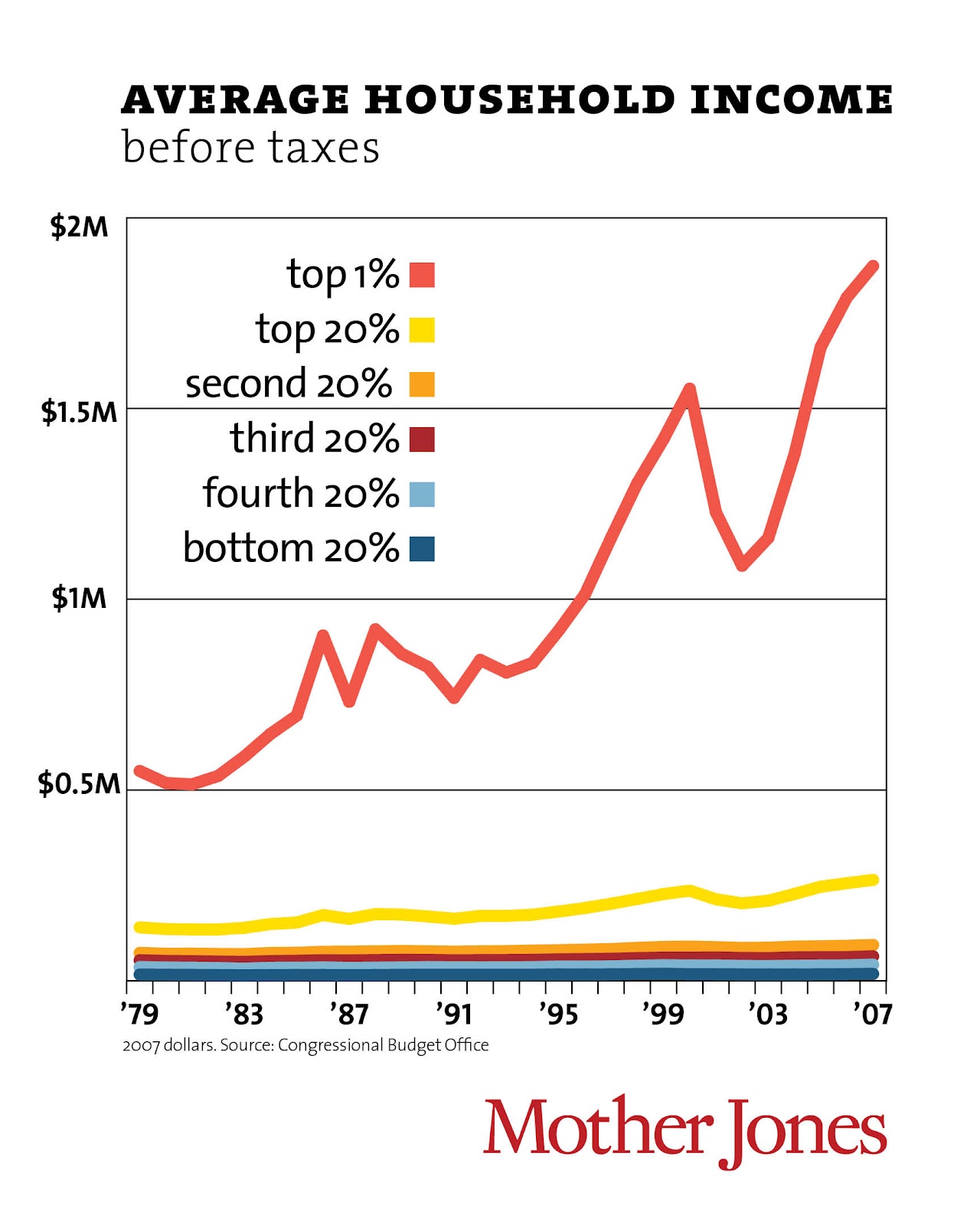
Now, every time someone like me or Ravitch pushes back on this, the inevitable response is that we are using poverty as an "excuse"; that we're not serious about making schools better. Nothing could be further from the truth -- we just want an agenda for school improvement that actually has evidence to back it up. And that would include getting more necessary resources to public schools, expanding social services, and dealing with the country's crushing income inequity.

But I never seem to hear folks like Jared Polis talk about poverty outside of school "reform." And I'm not alone in sensing this:
I’m not trying to erect another straw man – there are many substantive, meaningful discussions going on, and nobody thinks education is the only solution. Yet even as the recession decimates low-income families, the safety net continues to erode. And I sometimes feel like much of what passes for political rhetoric on strategies to fight this poverty – and justify these huge cuts in programs that do so – consists mostly of “we need to fix bad schools,” with only passing reference to any other type of program (see here, here, here, here, here and here). [emphasis mine]
Amen. Again, neither I nor Ravitch nor anyone on the "real reform" side is saying schools can't and shouldn't get better. But I find it more than a little convenient that very wealthy "liberal reformers," like Jared Polis, spend so much time and energy on unproven education schemes while barely mentioning income inequity.

GLBT rights and reproductive rights and the environment and gun rights and civil liberties are part of Jared Polis's agenda; good for him, these are important issues. But so are regressive taxation, manipulation of the markets, destruction of the social safety net, and the disgusting income inequity that has grown worse than at any time in modern history.

Wealthy "liberals" who do not want to talk about inequality have found a useful issue in education "reform." They can affect concern for the poor by pointing their fingers at teachers and their unions, deflecting the blame away from themselves. They can pretend that "college and career readiness" will lift the poor out of a system they themselves have benefitted from: a system that requires winners and losers.

I don't think Jared Polis wants to see anyone suffer. I don't think Jared Polis likes poverty. But I do think Jared Polis would rather not reflect on the possibility that maybe his wealth was acquired at the expense of the working poor and the shrinking middle class, and that maybe we need to reform our government, our economy, and our markets with far more urgency than we need to reform our public school system.

If wealthy, "liberal" reformers would finally start acknowledging this sate of affairs, maybe we could have a significant, substantive conversation about the future of this country -- and that would include education reform. It appears, however, that Jared Polis would rather just call the people who are trying to talk about education at a level beyond platitudes "evil".

How sad for you, Colorado.

Fighting "evil" for Colorado's 2nd.

ADDING: Jon Pelto has even more:
But back in 2008, Polis’ corporate connections were already an important part of his campaign operation.  But for $418,400 he raised through the national ACTBlue fundraising program, his remaining campaign funds came from a number of corporations that he owns, is connected with or willing to “invest” in his desire to become a congressman.  Leading the list of corporate donors was his own company, Jovian P4 ($55,980), SPS Studios ($14,800), Bow River Capital ($13,500), Jovian Holdings, another of his companies ($13,500), Intensity Ventures ($9,200) and Sandler Family Supporting Foundation ($9,200).
Other corporate donors giving to Jared Polis included Panthenon Resources ($6,900), Genesis Health Care ($6,600), Citigroup ($6,100), Laffer Assoc ($6,100), Citizen’s Energy ($5,200), Baraboo Growth ($4,600), Gillemont Sunset Ranch ($4,600), Gotham Capital Investment Partnership ($4,600), HNTB Corp. ($4,600), Jove Partners ($4,600), KSI Corp. ($4,600), MDC Holdings ($4,600), Najafi Companies ($4,600), Palo Alto Investments ($4,600), Pancil ($4,600), PrimeCap Finance ($4,600), Pritzker Group ($4,600), Provide Comerce Inc. ($4,600), Roche Group, ($4,600), Space X ($4,600), Tantum Investment Management ($4,600), Valor Equity Partners ($4,600) and WKM Group ($4,600).
The more you look at Jared Polis’ campaign finance reports and his approach to politics, the more questions rise to the surface.
Real man of the people, dontcha know...

Saturday, September 21, 2013

They Only Win When You Give Up

This is depressing:
When it came time yesterday for the question-and-answer session at state Education Commissioner Chris Cerf’s now-annual convocation with school superintendents, there was an awkward moment: nobody stepped to the microphone.
“Oh, I know you have questions,” Cerf said wryly, aware of the challenges facing school leaders and their districts in a momentous year of change.
And while a few school superintendents did ultimately wander forward, the hesitation spoke to a different tenor – some would call it calm, others resignation -- that is coming over this group in the fourth year of Gov. Chris Christie’s tenure and the third year for his education commissioner.
Compared with previous convocations at which tensions were high and questions were plentiful, the more than 300 school leaders gathered yesterday at Jackson Liberty High School appeared to be getting used to the new world order under Cerf and his boss.
Gary McCartney, the South Brunswick superintendent and president of the state’s superintendents group, which hosted the event, said he saw the three years of convocations with Cerf as a period of evolution.
“I think people are beginning to assimilate,” he said. “In the first year, it was kicking and screaming, hoping (the initiatives) would go away. The second was wringing your hands and whining, thinking they would go away. Now you say, I don’t have any more tantrums, I think we’re going to do this.” [emphasis mine]
With all due respect to Dr. McCartney and the other fine public servants at this convention who serve New Jersey's children, this is the wrong attitude to take at this critical juncture.

Dr. McCartney has a long and distinguished career as an educator and school leader. He, and the vast majority of New Jersey's superintendents, have forgotten more about public education than Chris Cerf and his Broad-paid interns fellows ever knew. So it's not "kicking and screaming" to challenge the highly questionable policies that have been foisted on to New Jersey's excellent public schools; in fact, I would say that these school leaders not only have the right to challenge the nonsense Chris Christie is pushing, they have a duty to stand up and resist it.

The primary function of this blog over the past three years has been to catalog the many sins Christie and Cerf have committed against New Jersey's public schools, including:

I've known several superintendents in New Jersey over the years, and I've worked for some exceptional ones. In the main, these are good people who truly care about the students and staff in their charge. I certainly appreciate that they might feel they are in an impossible position, and that they should just calm the waters, try to get along, and wait out the end of the Christie regime when, hopefully, some sanity will return to our state.

But our school leaders have got to understand that they are not powerless -- far from it. New Jersey's superintendents know Christie and Cerf have been bad for their schools, bad for their staffs, and bad for their students. They ought to stand up and say so -- politely, respectfully, but loudly and clearly. 

People will listen.


Accountability begins at home.

Thursday, September 19, 2013

The Shafting Of the American Teacher

Well, isn't this just lovely:

New Jersey teachers are returning to their classrooms this month with smaller pay increases than in previous years.
The state schools boards association said the average pay increase in settled contracts as of this past spring was about 2.25 percent for the 2013-14 school year. That’s down from 2.37 percent last year and half of the average pay hike of almost 4.5 percent five years ago, according to the association. [emphasis mine]
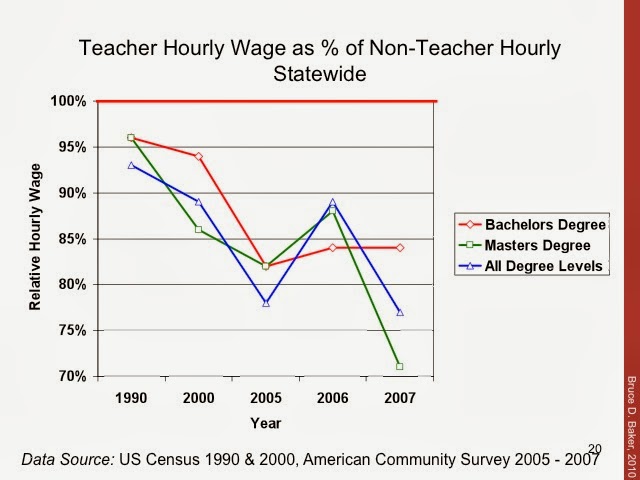
Ah, the good old days of 4.5% pay raises... when everyone else was getting more than that! The truth is that teacher pay in New Jersey has historically never kept pace with the rest of the workforce:


Look at that: less than 80% of the hourly wage of all statewide workers, down from about 93% back in 1990, before the jihad against educators began. The truth is that teachers have never enjoyed "big" raises:
Meanwhile, a look at data from several decades shows that while average teacher pay is higher than the average of all workers salaries -- everyone from landscapers to surgeons, for example -- it grew at a slower rate than all workers' pay grew.
Teachers average pay rose nearly 150 percent between 1985 and 2008.
The average wage for all workers in the state in 1985 was $21,107, according to state Department of Labor and Workforce Development data. The average pay for all workers in 2008, the last year currently available, was $55,282, an increase of 162 percent.
Overall, the rate of inflation over that same time period was 122 percent for an area including New York, Northern New Jersey and Pennsylvania. 
And Jersey, believe it or not, is one of the better states for teacher pay (of course, it's also one of the more expensive states in which to live). In North Carolina, the average teacher makes $45,933. If a that teacher tried to raise a family of five on that salary, they'd qualify for reduced price school lunches.

I should also point out that New Jersey teachers are paying more into their pensions and health insurance. This is Year 3 of the Pen-Ben law, and teacher contributions to health insurance at the same salary level are 50% higher this year than last. Pension contributions went up as well (and there's no plan in sight for how the state will meet the $5 billion pension obligation it will have in a few short years). So take home pay for New Jersey's teachers is actually decreasing, even when you add in the meager raises we are now getting.

Again: it's like this all over the country:
At the moment, the average teacher’s pay is on par with that of a toll taker or bartender. Teachers make 14 percent less than professionals in other occupations that require similar levels of education. In real terms, teachers’ salaries have declined for 30 years. The average starting salary is $39,000; the average ending salary — after 25 years in the profession — is $67,000. This prices teachers out of home ownership in 32 metropolitan areas, and makes raising a family on one salary near impossible.
The response to all this from the reformy right has been to point to merit pay. "Just pay the great teachers more!" they shout, neglecting to think the idea through: if every child deserves a great teacher, won't we have to pay every teacher more?

Given the meager merit pay raises in Washington and Newark, there's no reason to believe these schemes will lead to broad wage increases for teachers. Which means that teaching is increasingly becoming a dead-end, low-paid job with eroding benefits, little prestige, and capricious evaluation systems.

I, like millions of other educators across the country, love to teach. But I, like millions of other educators across the country, love my family even more.

Are we really going to ask teachers to choose between their careers and their families' financial well-being?


Wednesday, September 18, 2013

@jaredpolis: America's Worst Congressperson

What a schmuck:


Yes, 75 year old Diane Ravitch -- grandmother, author, and historian -- is "evil" in the eyes of this sitting member of Congress. Aren't you proud, Colorado?

This empty suit is the 7th wealthiest member of Congress. But Polis is really just another phony Democrat who pushes idiocy like Race To The Top so he doesn't have to have a serious conversation about income inequity. It's all part of the hard work of the rich and powerful, slaving away to protect their big piles of lucre from the hordes storming the gates of Versailles. "Let them eat charter school cake!" says Le Comte de Jared.

It's a very interesting dynamic we have going on right now in this country when it comes to economic justice. Folks like Polis have no problem with political, media, and financial systems that allow pirates to accumulate obscene amounts of booty -- so long as they get a chance to get in on the action. To them, social "progress" is a billionaire who's black, or gay, or female.

It never seems to occur to them, however, that someone needs to edge their perfectly manicured lawns. Someone needs to bus their salad plates at their favorite five-star eateries. Someone needs to pour the asphalt on the highways their limos cruise over. And maybe those people deserve health care and decent wages and dignified retirements that last longer than a few minutes between the time they stop working and the time they keel over from exhaustion.

Charter schools will do nothing -- nothing -- to help the people who do the hard, honest work that is demanded by our capitalist society. Maybe Jared Polis thinks charter schools are so awesome because they might give a rare poor kid from the inner city a chance to grow up and become an obscenely wealthy a-hole like him.

But that's not the real problem, is it?


Hey, stop it with the facts and stuff! Can't you see I'm trying to put on a patina of liberalism here?!


Tuesday, September 17, 2013

Ravitch Kicks Rhee's Book-Selling Tail

You'll remember earlier this year when Michelle Rhee's auto-hagiography, Radical, was published. I tracked the sales for a while on Amazon; maybe I missed a higher number, but this was the best sales rank for Rhee that I could find, a little less than three weeks after her book was released:


As I wrote at the time:
According to Amazon.com, Radical was released on February 5, 2013, almost three weeks ago. In that time, Rhee has been on what must be any author's dream book tour: The Daily Show, This Week, Charlie Rose, and many other outlets. She's been treated very gently, despite the cheating scandal that surrounds her and her mediocre record running Washington, D. C.'s schools. Given the extent of her book tour and it's fawning nature, you would think that Radical would be flying off of the shelves.
It didn't. In contrast, Diane Ravitch's Reign of Error was released to the public today. How's it doing on Amazon?


As far as I know, Diane hasn't done any national television; certainly, nothing on the level of the shows Rhee appeared on. And yet, after one day, Ravitch is kicking Rhee's tail in the book-selling game.

Aside from my obvious glee in watching Diane soar where Rhee crashed, I bring this up to make a larger point:

Micheel Rhee does not lead a "grassroots" effort. Her wealthy backers bought her a place in the education reform debate -- a place she didn't earn through achievements, nor by speaking for parents, teachers, or students. 

The anemic sales of Radical are proof that Michelle Rhee's grassroots support is nonexistent. So it's time for the press to stop giving Rhee an outsized place in the media, and to start giving Diane Ravitch and those like her a chance to make their case.

America has voted: more of this...

...and less of this.

ADDING: Hey, some crazy music teacher/blogger wrote a review of Reign of Error for the NEA blog EdVotes.

Monday, September 16, 2013

Chicago Mayor Emanuel Closes New School Before It Opens! [parody]

CHICAGO -- Rahm Emanuel has become the first big city mayor to close a school before it has even been built.

"When I announced I was building this new [expletive deleted] school yesterday, I thought you [expletive deleted] in the press would leave me alone!" yelled Emanuel, shouting in front of a group of parents gathered in the Far Southeast Side.

"Then the [expletive deleted] Tribune has to go remind everyone the [expletive deleted] school site is contaminated!" screamed Emanuel. "'Fast Eddie' Vrdolyak didn't say dog [gross expletive deleted] about that to me, the [particularly nasty and personal expletive deleted]!"

At Emanuel's press conference yesterday, neighborhood parents -- to whom Emanuel would not speak -- wondered why the mayor wouldn't commit to fixing the current local elementary school, Gallistel:
"Because of (a lack of) air conditioning, they're not learning properly," said Robert Veloz, who has three grandchildren at Gallistel. "We need to invest money here."
Martha and Isaias Posada, who have two daughters at Gallistel, said through an interpreter that they were concerned about contamination at the new school and not sure whether they'd send their younger child there. At the same time, they worried about the aging facilities at Gallistel. Their older daughter, fifth-grader Yesenia Posada, said it was sometimes 100 degrees in her classrooms.
Today, when asked about Gallistel, Emanuel said: "[expletive deleted] it -- I'll close that one, too! And I'll close the nearest school down the [expletive deleted] street! [Completely unnecessary expletive deleted], I closed fifty [expletive deleted] schools this year already, and I'll close every [expletive deleted] school in this [expletive deleted] city if I have to, 'cause that's what I do, you [unbelievably offensive and disgusting expletive deleted]!"

When asked about his 19% approval rating, Emanuel became uncharacteristically silent.

[Expletive deleted] you, Chicago!


(You guys know this a parody, right? And halfway through writing I realized I was stealing from Gary Trudeau. Ah, [expletive deleted] it...)

Friday, September 13, 2013

Hilarious Ode to Charlotte Danielson!

If you are a teacher, trust me on this one:


Danielson, oh Danielson,
I still hear your domains calling,
My data's down, my numbers falling,
I became a "one"
When I met Danielson.


Based on Glen Campbell's "Galveston"; how these guys came up with that choice I have no idea, but well done, folks!

My sense is that Charlotte Danielson is a sincere educator who wants to make schools and teachers better. But I must have missed the vote when we all decided she has the last word on what works in the classroom.

And it appears even she is beginning to have doubts about the teacher evaluation nightmare that is unfolding...

Multiple measures... multiple measures...

Thursday, September 12, 2013

On the New TFA Study: People, Calm Down!

I really don't have time to take a long, hard look at the new Teach For America study, which "confirms" that TFA "works" because its randomized design is the "gold standard," and anyone who doubts this is "quibbling."

There's been some good reporting on this: start with Dana Goldstein and Stephanie Simon, two journalists who regularly stop and think for a minute before they write. Would that all education writers follow the same advice; they might realize that...

- Effect sizes matter. The study shows a difference of .13 standard deviations in high school math and .06 standard deviations in middle school math. That is equivalent to moving a student from the 27th percentile to the 30th. The study uses the "x months of learning" conversion to say that's 2.6 months of learning; I find that to be misleading at best. Having four TFA teachers in a row isn't going to mean that a student will take calculus in their senior year instead of pre-calculus: these effects aren't necessarily cumulative.

What really should be reported is how many more questions the TFA students got right on the final tests. And it can't be many when an effect size is that small. Statistically significant? Sure. But practically significant? Come on. And I'm not even going to deal with the scaling problems here...

In addition, TFAers come from elite schools, which means they generally have good test-taking abilities. Are they able to impart those abilities on to their students? And is that "real" learning, or simply learning how to beat the system?

In any case, the results here seem like a great candidate for a treatment from the Mountain-Out-Of-A-Molehill-INATOR: there's just not that much here to get excited about.

- Some randomness isn't full randomness. OK, so the kids are randomly assigned -- but the teachers weren't. The TFAers aren't going up against the entire population of "regular" math teachers; they are matched only with those teachers who:
  • Teach the same subject,
  • In the same school,
  • To which only TFAers are assigned.
That is a very, very limited control group from which to draw broad conclusions about the effectiveness of TFA. There is plenty of reason to suspect that many districts do not distribute teachers across their schools equally; and that's not even addressing the distribution between districts. 

So the students may be randomly assigned, but the teachers in the control group most certainly are not. That is a big hit to the generalizability of this study. And speaking of those teachers...

- Heterogeneity of the control group. The study tries to account for some differences between the control group teachers, but it is a very limited description. That's not a criticism; it's simply pointing out the limitations of the study. Colleges are reported dichotomously as "selective" or "not selective," as if there isn't a whole world of difference between programs in "not selective" colleges (for example: state schools with scholars as faculty vs. crappy, on-line, for-profit "universities"). Interestingly, TFA teachers were more likely to have degrees in secondary math education than comparison teachers (18.8% vs. 15.9%).

I also found this telling: 70 percent of both the TFAers and the comparison teachers had 20 or fewer days of student teaching in math. That says as much, to me, about the quality of training of the comparison teachers as it does about the TFA group.

Again, I just don't have the time to look at this deeply (besides, there are people who vet these things really well, like NEPC -- I'll wait for their update). But even a cursory look says that the policy implications of this study are limited.

Were I a principal at one of these schools, would I want to give TFAers preference in making my hiring decisions? Would I want the power to be able to fire my veterans and bring in TFAers? Based on the small effect size, I'd be far more concerned about how changing personnel policies to give TFA preference would affect the qualifications of the rest of my hiring pool and the morale of my current staff.

So maybe there's another question worth asking: is staffing the schools that TFA serves with inexperienced, barely trained neophytes who provide only marginally more value than current staff really the best we can do for the deserving students who attend these schools?

In any case, my advice to those who are leaping to praise TFA on the basis of this study is to calm down. TFA is not working miracles, it's not a viable long-term solution, and its role in staffing charter schools is causing some very serious issues for urban school districts. Further, it's morphing into a political organization, and its role in big money urban renewal deals can't possibly be justified by a study that is so lacking in generalizability.

TFA is very good at tooting their own horn. But this is a little tune with a limited range; they're going to have to do better to justify the outsized place they taken in the education "reform" debate.


1) Mathematica TFA study does not say much about TFA writ large
The sample is large and covers an adequate number of students, schools and states. However, there are clearly some issues in the TFA sample that calls into question whether it really represents TFA and the profession more broadly.
The sample only contains secondary math teachers. However, in most communities, the majority of TFA teachers teach elementary, not secondary (See Houston example below).
The sample is heavily weight toward middle school, 75% of the classroom matches were middle school. Middle school teachers are much rarer in TFA assignments in districts like Houston (See below).
Not only is the sample secondary, but it is focused specifically on math teachers in middle and high school.
Although there is of course variation by site, relatively few TFA teachers teach secondary math. For example, around82% of TFA teachers in Houston teach subjects other than secondary math. 
And so on. My fav part?
In sum, you will be a better airline pilot (teacher) if:
  • You do not have ongoing pilot training, it will hurt your flying skills.
  • You do not study to become a pilot before piloting a plane. Just rev the engines. Wohoooooooo.
  • Using a flight simulator to test your ability to fly a plane before hand will have no relationship to your ability to fly a plane.
Boeing 777 Crashes At San Francisco Airport
Oh, my...
 

Monday, September 9, 2013

Preview: Short Excerpt from @DianeRavitch's "Reign Of Error"

I wrote a review of Diane Ravitch's new book, Reign of Error, this weekend. I was honored to receive an advance copy, and I'll let you know when and where my review appears. Diane's book is available to the public September 17th.

As part of the review, I transcribed a paragraph:
“But the wounds caused by centuries of slavery, segregation, and discrimination cannot be healed by testing, standards, accountability, merit pay, and choice. Even if test scores go up in a public or charter school, the structural inequity of society and systematic inequities in our schools remain undisturbed. For every “miracle” school celebrated by the media, there are scores of “Dumpster schools,” where the low-performing students are unceremoniously hidden away. This is not school reform, nor is it social reform. It is social neglect. It is a purposeful abandonment of public responsibility to address deep-seated problems that only public policy can overcome.”
Imagine another 350 pages or so just as well-written, just as fearless, just as dead-on accurate. That's Reign of Error.

Trust me on this one: pre-order it now.