I will protect your pensions. Nothing about your pension is going to change when I am governor. - Chris Christie, "An Open Letter to the Teachers of NJ" October, 2009

Friday, March 11, 2016

The Myth of the Heroic Charter School - Part II

Here's Part I of this series.

Here's Part II.

Here's Part III.

Here's Part IV.

And finally, Part V.


Since I last posted in his series, we've had some very disturbing news about Newark's schools. Bob Braun, the best reporter covering Newark, broke the story that lead has been found in the water supplies of 30 different K-12 schools in Newark.

I have to wonder: what would happen if the same story broke in Millburn or Livingston, two affluent suburbs in the same county as Newark? Would any of the parents in those affluent communities have been satisfied with the answer: "Hey, it's only a fraction of the contamination found in Flint"?

I ask because this series started in response to a piece on Campbell Brown's reformy "news" outlet, The 74, written by Stephen Chiger, the "Director of Literacy" for Uncommon Schools:
The thing is, there are schools out there right now — as you read this and as I write it — that are giving lie to the implication that school improvement needs to wait for the country to heal poverty. 
We can’t wait, and we don’t have to. 
Take the most recent PARCC exams in New Jersey. About 41% of the state’s 11th graders met or exceeded expectations on the test. 
In Essex County, high-income Millburn High School (2.2% economically disadvantaged) saw 57% of students scoring proficient or advanced on the assessment. The juniors at Livingston High School (1.5 % economically disadvantaged) earned 56.5%. 
A few miles away, the juniors at Newark-based North Star Academy (83.7% economically disadvantaged) earned an 80.6% pass rate. 
The school achieved it through more systems and strategies than I could possibly recount here. The good news is that I don’t have to. 
Uncommon Schools, which manages North Star, publishes books — and books and books – to share its practices. It regularly films teachers to “show” and not just “tell.” It opens its doors to hundreds of visitors every year. It runs professional development for external audiences and sells trainings so they can turn-key them locally. 
And, there’s good evidence it’s working. [emphasis mine]

Now, any fair reading of this piece would lead us to conclude that Chiger attributes the "success" of North Star to its "systems and strategies." But perhaps it's worth pointing out that, according to Braun, only one charter school in Newark has been affected by high lead levels, and only because that school is co-located in a public school building.

As I've noted many times, it seems that we never have enough money to renovate urban public district schools, let alone build brand new ones. But there always seems to be enough money to build new charter schools.

In Camden, State Superintendent Paymon Rouhanifard really, really, wishes he could get the financing to fix his city's crumbling school infrastructure. But the only way he can, apparently, is to turn the schools over to private charter operators, who somehow seem to have access to capital his district does not. And other well-connected charter operators always manage to get that Wall Street love when they need some cash to expand.

In Newark, the schools have been crumbling for years. But the charters are "held harmless" in their funding, while the district schools struggle to maintain a dilapidated infrastructure. Some charters even get brand new facilities with gobs of tax incentives attached to their financing, with the added bonus of acquiring housing for their teachers and "tutors."

In Paterson, rodent feces adorn the textbooks of children.


The district faces an enormous fiscal crisis, yet charters -- including those associated with the Gulen movement -- are allowed to expand all over North Jersey without first addressing the finances of their host districts.

In addition to this: when a charter school educates fewer students with a special education need, or who don't speak English at home, or who aren't in the deepest level of economic disadvantage, that charter doesn't have to expend the same amount of resources as the hosting public district school that does serve those children. There is a resource advantage in enrolling the students who are the least expensive to educate.

When charter cheerleaders talk about the "successes" of a select number of charter chains, they usually attribute their test-based gains to things like "systems & strategies." But there never seems to be an acknowledgement of the obvious:

"Successful" charter schools owe their "success," in part, to having resource advantages over public schools.

Are the charter school students at Newark's Teachers Village in any danger of lead contamination while learning in their brand new school? How about the students at the brand new KIPP school in Camden at Lanning Square -- a school that was supposed to be a public, district school? What about North Star's students, who attend a five year old school?

If new schools are good for charter students, why aren't they good for all students?

I'll pick up this series from where I left off in Part I next.

Tuesday, March 8, 2016

Chris Christie: Charter School Blowhard

It figures: I start a series on Newark's North Star Academy and the myth of the "heroic" charter school (here's Part I - more to come), and the next day our prodigal governor decides to drop by North Star and deliver one of his patented, self-righteous fits against "special institutional interests":
"I'm going to continue to fight against the special institutional interests that say what we saw here this morning is not real," Christie said at a news conference in the Alexander Street Elementary School gymnasium, after students had answered math questions posed by their principal and applauded each other's correct answers.
Mirroring remarks from his State of the State address in January, Christie said Monday that his administration was "aggressively working to prioritize regulatory relief" for charter schools, looking at ways to create "greater flexibility" in teacher certification and make it easier for the schools to find facilities.
Christie declined to give details Monday on what his administration was doing to change charter school regulations. But he promised "there will be major changes."
The elementary school where Christie made his remarks was formerly a district school. It was taken over by Uncommon Schools' North Star Academy, which operates 11 schools in Newark, in 2014; since then, its students "are outperforming more students across the entire state," Christie said.
Asked whether Newark Mayor Ras Baraka, who opposes the expansion of charter schools in Newark, was among the "entrenched forces" the governor had criticized, Christie said: "I hope not. But if he chooses to be, we'll run him over, too."
So let's stop right there and correct a few things:

As I pointed out previously, Mayor Baraka has not been against charter schools or their eventual expansion. What he has consistently complained about, however, is how many charter school operators in New Jersey seem to get preferential treatment when it comes to finances. North Star is one of the Newark charters, for example, that has been a beneficiary of Christie's "hold harmless" policy, which has ensured that the governor's repeated refusal to follow the state's own law and adequately fund schools has had minimal impact on the charters.

For the last two years, while much of the rest if the state has seen large decreases in state aid, charter schools have been guaranteed that their per pupil rate of funding will not decrease. This has meant that Newark in particular has had to turn over more and more money to the charters while struggling to provide an adequate education for its public district students: students who are more likely to be limited English proficient, to have a special education need, or to be in the most economic disadvantage.

If Chris Christie really wanted to get Ras Baraka on his side regarding charter schools, he'd raise taxes on his wealthy patrons, stop throwing money at his Wall Street pals running the public employee pensions, and use the money to fully fund the state's schools. Even reining in funding of New Jersey districts that are over-aided would be a more credible plan than his call to expand charters.

Why? Many reasons:

- There is no proof New Jersey charters as a sector outperform district schools. Even the state's own (flawed) report on charter effectiveness, which they commissioned from CREDO, shows a minimal effect for the overall charter sector.

- The expansion of "high-performing" schools in Newark has done nothing to improve the overall performance of the district. Bruce Baker and I showed that a little while ago.

- The data we have indicates the "high-performing" charters in Newark spend more on administration and less on student services and classroom instruction. This only makes sense, as charters are redundant systems of school governance, unable to leverage economies of scale. I've shown this in particular with the vaunted KIPP/TEAM schools; I'll have more to say about Uncommon/North Star in a little bit.

- Many of the claims of "success" within the charter sector are overblown, undocumented, or statistically inept. I dealt previous with the claim Christie made, pushed by the reliably reformy Richard Whitmire, that Alexander crushed it on the PARCC. The truth is we don't have the data to verify this: the school's results were aggregated into the rest of the North Star network so we can't confirm them independently, we don't know how the school's demographics changed, we don't know what effect cutting loose all the 5th through 8th graders had... we just don't know.

You'd think Christie would task his DOE with finding this stuff out -- but that's not their job anymore, is it?

To compound this statistical madness, Christie kept saying that Alexander School was "failing" before it was taken over. But that is an idiotic claim if you don't take into account the student population characteristics of the school. And, no, I'm not guilty of setting "low expectations" when I make this obvious point; if I were, I'd be as guilty as Christie's own DOE, which developed Student Growth Percentiles and peer grouping in school reports explicitly to acknowledge this rather obvious truth.

As my research has pointed out repeatedly, Alexander was actually "beating the odds" before it became a target for charterization. Now, I'll be the first to point out that North Star almost always "beats the odds" in these similar sorts of analysis. But that's likely because they have advantages that public district schools do not, and can't be properly represented in statistical models:

- North Star hires a teaching corps with an inordinately high number of inexperienced and alternatively certified teachers (again, more in a bit). Experienced teachers cost more, but Uncommon/North Star would rather put its money into very high salaries for its senior employees. Hiring inexperienced teachers also allows North Star to pay them more to work longer hours, which allows the students more time to engage in what Uncommon's curricular guru, Doug Lemov, refers to as a "muscle memory" style of learning. (*cough* "test prep" *cough*)

- North Star has one of the highest student suspension rates in Newark.


There is little doubt this contributes to...

- North Star's very high cohort attrition rate:


Many kids who start at North Star don't necessarily stay there. And, by all appearances, the school doesn't do much "backfilling."

- Uncommon takes in a lot of outside money from philanthropic contributions: nearly $18 million in contributions and grants on their 2012 tax forms. Add that to the "hold harmless" provisions, the access Uncommon has to special financing for facilities, and their employment practices, and you've got a substantial financial advantage for the school.

Which makes Christie's bloviating even more obnoxious. Because if there's a lesson to be learned from schools like North Star, it's that money matters. If it's so important for North Star to be held harmless in funding, why isn't that true for the Newark Public Schools? Why isn't Christie pushing to get all schools the money they need?

The answer, of course, is that Chris Christie would rather return home to fight his perpetually stupid war against "special institutional interests" -- which, as we all know, means teachers unions -- than take up a fight for fair and adequate school funding. That fight, however, would take integrity and guts.

New Jersey made up its mind a while ago as to how much of either Chris Christie possesses. America got a look and came to the same conclusion. So no one should take anything Chris Christie has to say about education, and how he's "fighting" for our deserving urban students, seriously. As on all issues, this blowhard only cares about how he can make a political play with cynical attempts at policy making.

More on North Star and the Myth of the "Heroic" Charter coming soon...

Why isn't anyone buying my crap anymore?

ADDING: A blast from the past -- 2011:


Chris Christie has always loved visiting charter schools -- so long as they are the sorts that serve fewer disadvantaged children than their hosting public district schools.

I need to update this at some point...

Sunday, March 6, 2016

Sunday Night Music: James Brown

This might be the single best musical performance on TV, ever:


Can I go to the bridge?

I remember seeing this when I was in college, studying music, and thinking it was the best thing I had ever seen or heard. I'm not sure people understand just how great Letterman's band really was. Will Lee was particularly excellent that night.

But it's really Brown, at the peak of his powers, who steals the show. Michael Jackson, Prince, Bruno Mars, George Clinton... go down the list, they owe it all to James Brown. He was, and remains, without peer.

I'll try to get this back to making Sunday Night Music a regular thing. Good for the soul.

The Myth of the Heroic Charter School - Part I

Here's Part I of this series.

Here's Part II.

Here's Part III.

Here's Part IV.

And finally, Part V.


"Heroic" charter school stories are the stock-in-trade of the "reform" industry. These tales take the same basic form:
1) Present some a-contextual data point -- usually having to do with a score on some sort of standardized test -- as proof of a charter school's "success." 
2) Posit a causal relationship between the structure and/or practices of the charter school and the data point presented. 
3) Imply or state outright that the many factors outside of school classrooms that we know for a fact contribute to student outcomes can be overcome simply by following the model above.
There are two reasons these stories make me nuts. The first is the unwarranted braggadocio inherent in the genre: "We rock, you suck!" There's almost a twisted negative correlation between a charter school's leaders' humility and the unacknowledged factors -- attrition, extra funding, peer effects -- that contribute to its "success."

But there's another, more pernicious effect that comes from telling tall tales about charter "success": they keep us from having the conversation we need to have about American schools as engines of social replication.

Case in point:
I think it’s time that the narrative in our country began a fundamental shift – away from “How is it possible to succeed amid all these challenges?” to “How is it possible to remain failing when there are so many good solutions?” I don’t care how stubborn poverty is — failing schools can never be an acceptable status quo. 
So here’s another story the press hasn’t been quite so aggressive about covering. It’s about educators who — tired of the lone wolf Stand and Deliver mythology — decided to build something different, and to do it together. 
Instead of a “sorry, but,” it’s a story of “yes, and.”
Did it take better training and support for teachers? Yes, and — a character-building discipline system? Yes, and — a curriculum that challenges students to think at the highest levels? Yes, and — regular follow-up with students even when they are in college? Yes and...I think you get the idea.
 
The thing is, there are schools out there right now — as you read this and as I write it — that are giving lie to the implication that school improvement needs to wait for the country to heal poverty. 
We can’t wait, and we don’t have to. [emphasis mine]
This comes to us from Stephen Chiger, the "Director of Literacy" for Uncommon Schools. Uncommon is the charter chain where the current SecEd, John King, cut his reformy teeth. Uncommon's charters are the quintessential "no excuses" schools, boasting very high student suspension rates (in contradiction to current USDOE policy).

You'll note that Chiger has already taken care of points #2 and #3 from my list above. His schools get their gains from "better training and support for teachers." Those high suspension rates are part of a "character-building discipline system." His schools "challenge students to think at the highest levels." All we have to do is do what he and his colleagues are doing, and we can skip addressing poverty. Simple, right?

Before we continue, let me state the obvious for the willingly obtuse who look for any excuse possible to misread my work: yes, schools can and should improve in the absence of larger societal changes. Yes, children from disadvantage can achieve at high levels. Yes, there can be a place for "choice" in school systems. No one disputes any of this.

But, as I said above, when the authors of these stories cherry-pick their facts, they keep us from having the conversation we need to have:
Take the most recent PARCC exams in New Jersey. About 41% of the state’s 11th graders met or exceeded expectations on the test. 
In Essex County, high-income Millburn High School (2.2% economically disadvantaged) saw 57% of students scoring proficient or advanced on the assessment. The juniors at Livingston High School (1.5 % economically disadvantaged) earned 56.5%. 
A few miles away, the juniors at Newark-based North Star Academy (83.7% economically disadvantaged) earned an 80.6% pass rate. 
The school achieved it through more systems and strategies than I could possibly recount here. The good news is that I don’t have to. 
Uncommon Schools, which manages North Star, publishes books — and books and books – to share its practices. It regularly films teachers to “show” and not just “tell.” It opens its doors to hundreds of visitors every year. It runs professional development for external audiences and sells trainings so they can turn-key them locally. 
And, there’s good evidence it’s working. [emphasis mine]
Whoo, boy. Where to begin?

Let's start by acknowledging something my research work, and the work of Dr. Bruce Baker*, has acknowledged for some time: compared to the rest of the state, North Star does, indeed, "beat the odds" on test based outcomes. They are not nearly the standout you'd think they were from their reputation in the credulous press; many schools in NJ "beat the odds" regularly. But if we are to judge North Star simply by its test-based outcomes, we should acknowledge their performance is very solid.

The real question, however, has always been: "Why?"


This shows the "cohort attrition" for the Class of '16, the class referenced in Chiger's post. Livingston and Millburn are affluent communities with reputations for good schools; it's no wonder the size of each cohort remains stable as they travel from grade to grade. Newark, like most communities with large numbers of families in economic disadvantage, is prone to see more transience, and cohort shrinking due to a larger drop-out rate.

But as we have shown time and again, North Star has a particularly high cohort attrition rate. Clearly, they don't "backfill" -- bring in students to replace ones who've left -- much. Is this attrition selective? Are they counseling out the lower performers? We can't say for sure from the data, but we do have some clues:


I've shown this graph many times: as North Star's cohorts shrink, their test scores rise. No, this is not direct proof of selective attrition. Of course, neither is this:


North Star has a very high suspension rate -- quite typical for the Newark charter schools that enroll large proportions of black students (and not typical for the Newark district schools that enroll lower percentages of black students -- anyone OK with that?).

Again: the effects of attrition, lower enrollments of special education & LEP students, greater resources through philanthropic giving, "no excuses" discipline, etc. on student test outcomes at certain charter schools have been well-documented by me and others.

But what Chiger does here is something I've started to see creep into the rhetoric of the "reform" industry lately: a direct comparison between "successful" charter schools and suburban public schools.

For those of you not from Jersey, let me assure you that Chiger did not just pull Livingston and Millburn out of a hat. Livingston is the alma mater of Governor Christie, and Millburn is consistently rated as one of the top high schools in the nation. Considering the vast differences in the schools'  student populations, Chiger is setting his sights very high.

Which is fine... so long as we have an honest discussion about whether North Star is "giving lie to the implication that school improvement needs to wait for the country to heal poverty." Is it? Let's start by looking carefully at Chiger's data point:


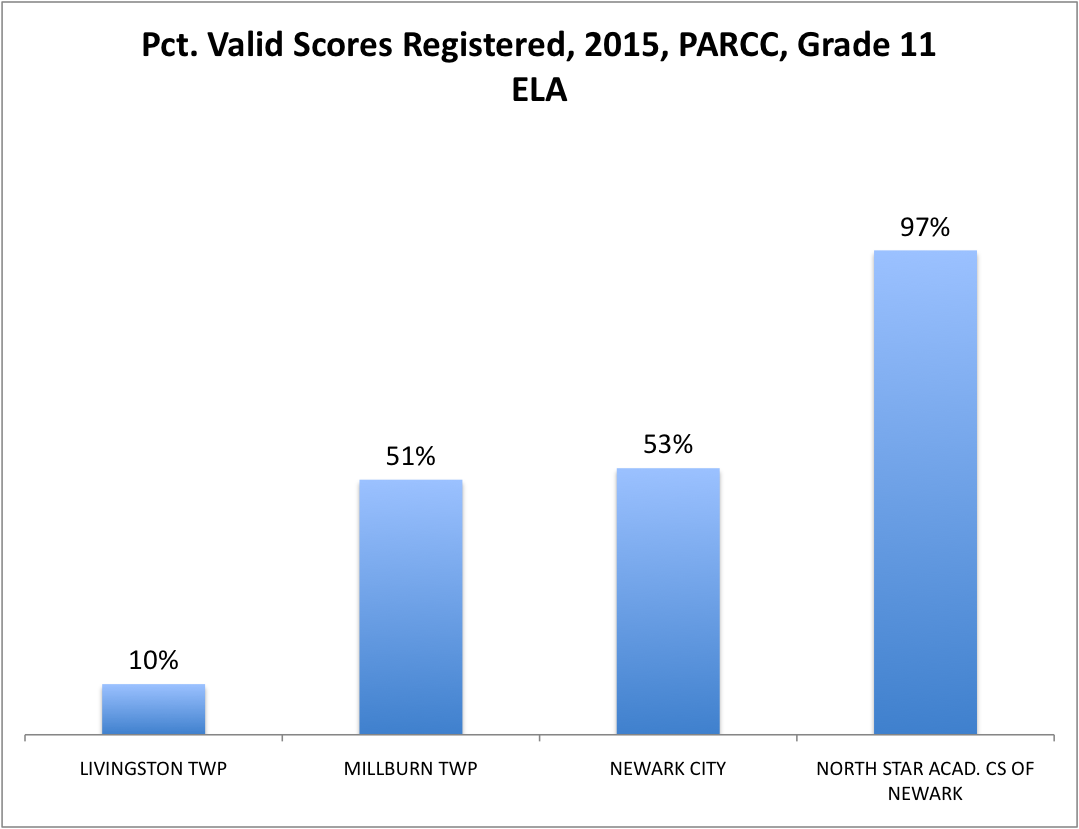
There is no doubt: North Star beat the wealthy 'burbs on the Grade 11 ELA test. But did every student at each school take the test?


Millburn and Livingston -- and Newark -- all had much lower rates of test participation than North Star.** We all heard the stories about high school students blowing off the tests; in fact, many who did take the test probably just filled in nonsense answers. Why? Because they knew it didn't matter.

The PARCC had zero effect on the grades or graduation status of high school juniors last year, which is why so many didn't even bother taking the test. But what happened when the juniors took a test that actually counted for something?


We don't have last year's SAT scores yet; these are from two years ago. But they make the point: when the test matters, the outcomes change.

Let me be very clear about something here: in no way do I think SAT scores are a reflection of the effectiveness of a school. SATs are highly correlated with socioeconomic status, and there is little reason to believe they are a valid instrument for assessing school performance. Which is exactly the point.

It is absurd to think that North Star, or any school that serves large proportions of disadvantaged students, can fully overcome the disadvantages of economic and social inequity that are reflected in educational outcomes.

I have nothing but respect for people, including those who work in charters, who teach disadvantaged children. Without question, we as a society have tended to set low expectations for children from traditionally disadvantaged communities, consigning them to the lower rungs of the economic ladder. We most certainly should be demanding better from our urban and poor rural schools. As I said above, we should always be demanding better of all schools.

But anyone who makes the case that reading Doug Lemov's book (more on that in a bit) is what we need to ameliorate the disadvantages urban students and schools face is telling a whopper. The advantage that affluent suburban schools and students enjoy is structural. It will not be wiped away by "choice." It will not be wiped away by "no excuses." It will not be wiped away by a "character-building discipline system" and "better training and support for teachers."

The structural inequities in our schooling system will only be addressed when we start having an honest conversation about what is really happening in and out of our schools. Poverty, segregation, and resource inequity do matter. But heroic charter school stories are designed to keep us from addressing this reality.

However, let's turn that notion on its head, and use Stephen Chiger's piece here to delve further into the issue. What is the reality of the difference between the schooling a Millburn student receives and that of a North Star student? Those PARCC participation rates and SAT scores give us a clue, but they are just the beginning.

Stand by...

Educational reforms cannot compensate for the ravages of society.
Jean Anyon (1941-2013)


* As always: Bruce is my advisor in the PhD program at Rutgers' GSE.

** I had to fudge this a bit, because North Star's test taker data was suppressed in the NJDOE files. The denominator for the North Star figure is the enrollment number for Grade 11 at the school. For the others, it's the registered student number from the assessment file itself. I think it's more than fair to assume that the differences here, which are very large, couldn't be explained by using two different but related data sources.

Sunday, February 21, 2016

Star-Ledger Editorial Page: Still Incoherent On "Choice"

I know I promised to back off on Tom Moran and the Star-Ledger Editorial Board this year; they have shown that, no matter what evidence is put in front of them, they will never change their charter school lovin' ways. But I just can't let the following pass without at least a quick comment, because it shows how utterly addled their thinking about school "choice" really is:

There is a controversy brewing in New Jersey over a health insurance plan devised by Horizon Blue Cross/Blue Shield, the state's largest health insurer. Three former governors have come out against the plan, called Omnia; they give a good introduction to the controversy in this open letter to Gov. Christie:
Horizon Blue Cross Blue Shield of New Jersey, the state's largest insurer, has rolled out a new insurance product — the OMNIA Health Alliance — that threatens to erode the bedrock of New Jersey's health care marketplace at the eventual peril, we believe, of dozens of hospitals and tens of thousands of health care consumers in New Jersey, especially the uninsured and the under-insured.
We urge you to examine OMNIA more closely and take swift and strong executive action. 
The state of New Jersey has always provided oversight of its insurance industries to protect consumers, and there is no more important and universal consumer in this state than the one who seeks health care, because everyone at every stage of life is entitled to quality health care from the provider of their choice.
Horizon's plan gives its insured members a monetary incentive to seek care at hospitals it considers more qualified than others based on non-transparent criteria it alone has selected and did not vet in any public forum.
Regrettably, patient preference was never considered by Horizon. Nor did its "quality" ratings of hospitals square with the reality that many, if not most, hospitals to which it failed to grant favored status within its network are widely acknowledged as among the best in the state for clinical care. 
Rather, in one fell swoop, New Jersey hospitals have been divided into "haves" and "have-nots." The "haves" are the state's largest health care systems and a small handful of independent hospitals chosen to fill in voids where those systems do not operate.
The "have-nots" are the segregated hospitals, many of which rely on the reimbursement of private insurers like Horizon to offset the costs to treat our neediest patients, the indigent who rely on charity care or Medicaid.
As a result, the viability of non-preferred hospitals is threatened and so, too, is consumer choice. [emphasis mine]
Everyone get this? Horizon is advantaging hospitals that serve less needy patients, and that's restricting "choice." And it's doing so using a system of rating hospitals that is not transparent.

Pretty bad, right? In today's editorial, Moran and the SLEB seem to think so:
New Jersey's dominant health insurance company, Horizon, is facing growing opposition to its Omnia plan — and for good reason.
The plan presents a threat to some of the state's best hospitals, especially those serving more than their share of poor patients. Catholic hospitals are at special risk.
Horizon is doing all this behind closed doors. Worse, there is good reason to believe that the company is picking winners and losers based on its self-interest, rather than the public good it is expected to protect as a non-profit.
[...] 
Here's the problem: It is closing this network to many of the state's best hospitals.
It is scoring them in secret, and refusing to release those findings. The losing hospitals are placed in Tier 2, where patients will not receive the same discounts.
It's not hard to see how this will play out: Patients will flock to Tier 1 hospitals, drain huge streams of revenue from Tier 2 hospitals. Some of them will likely close, and most will be forced to scale back on charitable services, according to several hospital executives and legislators.
You might think Horizon would pick the best hospitals for its Tier 1 network. But the opposite seems to be true. On average, Tier 2 hospitals are ranked higher than Tier 1 by the Leapfrog Group, which produces the most respected national rankings. [emphasis mine]

The SLEB is shocked -- shocked, I say! -- that Horizon would create incentives to drive customers to favored hospitals that do not have a record of performing any better than others that will likely close when they are denied funding. The SLEB finds it "reckless"* that the system by which Horizon determines a hospital's efficiency is not subject to transparency. They find it completely unfair that hospitals that serve the most disadvantaged patients will suffer because funds will be diverted to preferred hospitals -- again, which have not been shown to do a better job treating patients.

(Regular readers know what's coming next...)

Why, then, don't Tom Moran and the charter-loving Star-Ledger Editorial Board find it "reckless" to promote a system of urban schooling that drives students toward charter schools, which are "held harmless" in funding but have never been shown to perform better on average and are judged by evaluation systems that are not transparent and contradicted by the state's own data?

The SLEB is terribly concerned that hospitals which serve the neediest patients are going to be closed. Why don't they care, then, that New Jersey's charters are not enrolling equivalent populations of special education, Limited English Proficient, and free lunch-eligible students?


In Newark, public district schools were closed, "renewed," or covered to charters, all while the charters continued to expand. But those district schools were enrolling more economically disadvantaged students. Why doesn't the SLEB care about this if they care so much about the same thing happening in hospitals?

The charter schools in Newark and elsewhere have been "held harmless" from funding cuts that have devastated public district schools -- again, even as they enroll less needy students. This year, Christie is going to pitch in more in state aid to those districts, but that aid will flow straight to the charters: public district schools will continue to be grossly underfunded. Where is the SLEB's concern over this if they care so much about unequal incentives for hospitals?

The NJDOE rates schools in a way that punishes schools that serve students with greater needs. Newark (and Camden -- more soon) rated its schools as part of its One Newark plan, but the ratings were clearly biased against schools that enroll more black, special needs, and free lunch-eligible students. Why doesn't the SLEB care about this if they care about hospitals getting biased ratings because of who they treat?

The answer is obvious: Tom Moran and his Editorial Board have made up their minds thanks to a constant stream of propaganda foisted on them by the New Jersey charter industry. They are so enthralled by the easily digestible talking points fed to them that they can't even see the screaming contradictions between their stance on charters and their stance on Omnia.

Once again: I am not against charter schools per se. There is a way to offer "choice" that does not create problems for public district schools. But when chartering is done improperly -- as it is in New Jersey and so many other places -- it fosters segregated schools with redundant systems of governance that promote bad behaviors.

If the Star-Ledger's Editorial Board could get its head out of the sand, it might come to understand this.

"Charter school problems? What are those?"


* In the headline.

Monday, February 15, 2016

Only You Can Stop Data Abuse: Red Bank, NJ Edition

Data abuse in eduction policy has got to stop.

I freely admit that there can be different, equally valid ways of interpreting data. I am the last person to say a data analysis is always "proof" of a particular point someone wants to make. I am leery of the use of overly complicated statistical methods when simpler descriptive methods may be better.

But there is no excuse when a school "leader" misuses data to justify his or her practices and policies -- particularly when they do so at the expense of others. 

I'm cynical enough to know politicians and media pundits can and will do this all the time; however, when someone in a position of authority at a school or a district or a state agency or even the USDOE abuses data to make themselves look better and others look worse, it's completely unacceptable.

We are told over and over again by those in positions of influence that we have entered an era of "data-driven instruction." Well, if that's true, a leader is just as derelict in his duty when he misuses data as he is when he misapplies educational practices within the bounds of his authority.

This particularly irks me because we are seeing more "alternative" programs like Relay Graduate School of Education or the Broad Superintendent's Academy or SUPES that appear, to me, to have little interest in developing future educational leaders as good consumers of research and data. I'm not saying university-based programs don't often have flaws when it comes to training their students how to use data. I'm not saying that good training is a guarantee of future best practices.

But you can't expect America's students to engage in "rigorous" thinking when the leaders of their schools and their districts and their educational agencies brazenly misuse data. We have an obligation to model the sort of thinking we expect from our students; too often, we don't.

For example:

I've already written about the Red Bank Charter School in New Jersey. RBCS is a segregated school compared to its host district, which is a shame because the area, in my opinion, is ripe for a type of school consolidation which could lead to a truly integrated school district.

RBCS is applying for an expansion in its number of seats; supporters of the local school district are concerned the expansion will cause real harm to their district. But the charter justifies its application, in part, by claiming it is "outperforming" the Red Bank Borough Public Schools. RedBankGreen, the area's hyperlocal (which has done an excellent job covering the controversy), quotes the charter's officials:
The charter school officials reiterated their contention that the school outshines the district academically. “We are required outperform” by state law, [RBCS Principal and Superintendent Meredith] Pennotti said. “If we don’t, we’re put on probation or closed.”
Pennotti said the recently released PARCC test results demonstrate that the charter school eclipses the district schools, even taking into account the added challenges the district faces because a significant percent of its students haven’t learned English at home. She declined to immediately offer specifics, however, and said details would be included in a letter being sent to school parents Wednesday.(UPDATE: here’s the letter: RBCS_ParentNotice_PARCCScores) [emphasis mine]
Now, I don't know what the NJDOE told Pennotti, but I can assure you there is nothing in the state's charter school law that says a charter must outperform its host district. Yes, the charter's and district schools' test-based outcomes are compared in the charter's "performance framework." But even the state acknowledges something everyone in education knows (or should know):

You can't compare school outcomes without controlling for student population differences.

Even the NJDOE, which has engaged in some seriously awful data abuse over the years (things do seem to have improved somewhat lately), knows it makes no sense to compare a school with very few children in poverty to a school with many children in poverty. That's why they have peer groups (faulty as they are) for their school performance reports. That's why they developed SGPs (even if those don't fully control for those student differences).

Again, I don't know what the NJDOE told Pennotti, but she, as a school leader, should understand that simply comparing test-based outcomes without acknowledging student differences is just not warranted. In fact, she herself acknowledges this in her quote: she admits it's not fair to compare RBCS with RBBPS without "taking into account" student differences.

But then what does she do? If you click the link to the charter's letter to its parents, you'll find this:


I'm sorry if this is coming across like I'm picking on a mom-and-pop charter school. As I said before: I have no doubt that RBCS is full of dedicated teachers and staff, working hard on behalf of their deserving children. In the absence of proof to the contrary, I happily accept that RBCS is doing terrific things for its students.

But when a charter that serves a fundamentally different student population compared to its host district then beats up on that host for having lower test scores, that's just unacceptable.


When I compared the test-based outcomes of RBCS to RBBPS in my last post, I used a simple regression model to adjust for student characteristics. We can argue about the validity of the model, and that's fine; I'd never claim that one school was "better" than another based on test scores anyway, even if they are adjusted. What I will contend, however, is that if you don't even try to adjust for student differences, you're not playing fair.

When I did my original post, the latest test results from the PARCC had not been released. Here are some results from a simple regression model* using this new data and the entire state as a sample. We'll start with the most generous comparison for RBCS, Grade 4 English Language Arts (ELA):


Again: this is the most generous comparison out of the 11 that I've run. Does it look like RBCS is substantially outperforming RBBPS to you?

Here's the least generous comparison -- Grade 8 ELA:


Again: this in no way "proves" that RBBPS does a "better" job with its Grade 8 students than RBCS. What it does show, however, is that when controlling for student differences, there is no evidence RBCS "outperforms" its host district.

I've put the rest of these below with some explanation. And let me be clear about something else:

I don't expect RBCS to run this sort of analysis (although I do expect it from NJDOE when they make a decision about the expansion -- that's their job). I don't expect RBCS not to tout its successes. I don't expect any charter not to be proud of what it does. It's perfectly fine to be proud of your test scores and proficiency rates -- within proper context.

But when you use these test scores to pump yourself up at the expense of schools that are educating a fundamentally different population than your school, I lose all patience. It's an abuse of data and, frankly, an abuse of authority. It shows a lack of rigor and a disregard for the hard work of your colleagues in the public district schools. It's self-promotion at the expense of people who are doing a job you don't do.

Stop it. Now.


*ADDING: Here are the other regressions. The model uses PARCC mean scale scores as the dependent variable with two predictors: the school's percentage of free and reduced-price lunch students, and a three-year average of its special education percentage (I used that because I don't have 2014-15 special education data).

I didn't include Algebra 1 or Grade 8 math scores because students could take either, depending on where they are placed, in 8th Grade. The number of RBCS Algebra 1 test takers is so small it was suppressed in the data.

I plot the adjusted score against FRPL percentage to give the chart a little more context. I did run a model with the percentage of Limited English Proficient students at the school, but it was not a consistently significant predictor, so I left it out; that would likely change if we adjusted the sampling frame or the test outcome.

Again: the point here isn't to "prove" one school is better than another. The real question is: does RBCS consistently "outperform" RBBPS when "taking into account" differences in student populations? Clearly, the answer is: "no."

Caveat regressor.


Saturday, February 13, 2016

NJ Teachers Should Refuse To Be The SOLE Solution To the Pension Mess

I'm guessing that New Jersey's pension "reformers" are thinking the same thing: now that Chris Christie's absurd run for the White House is over, they should make their push to screw public employees out of their pensions now, rather than later when we are nearly certain to have a Democratic governor.

Hence the crush of op-eds by folks like Tom Byrne, a member of Christie's pension commission. Byrne is very, very sorry he has to shaft middle-class workers out of the benefits they are owed on a pension plan they were forced to participate in -- but, alas, there just isn't any choice:
Benefit levels are far higher for New Jersey public employees than is common in the private sector. It is the Obama administration, not Republicans, that has said health benefits at the New Jersey level should be subject to a luxury tax.
So there are two paths.

  1. Ask taxpayers to continue subsidizing a level of health benefits that even the Obama administration says is too rich.
  1. Put those benefits at or near the highest level specified under Obamacare, and use those savings to fill the hole in the pension funds. 
Certain Democrats say "just make the payments." But when the governor asked a joint session of the legislature for a show of hands on who was willing to vote for higher taxes in order to do so, not a hand went up.  
It is fair enough to say that neither the governor nor legislative leaders should have signed a 2011 deal that was premised on unrealistic revenue projections.  Let's not compound that mistake this time with a constitutional straitjacket and more unrealistic revenue assumptions.  
Delay may allow politicians to posture and build alliances. But until they deal with the facts as they are, rather than as we wish they were, it is a grave disservice to public employees who have played by the rules and deserve a secure pension. 
The commission's plan essentially comes down to this: make public employees pay more for their health benefits, and then take that money and put it into the pensions. Then the state should get out of the pension business and let the local districts offer retirement benefits.

In other words: the public workers, who have been the only ones who have made any sacrifice to shore up the pension system, should be the ones to bear all the cost of "fixing" it.

Well, screw that.

I've been teaching in New Jersey for 11 years, and during that time, I have seen both my mandatory payments into the pension and my premium payments for health insurance skyrocket. We public workers were told repeatedly that the Pen-Ben reforms of 2011, which lead to those increases, would "save" our pensions. At the same time, under Christie, taxes have gone down for millionaires while there have been billions of dollars of corporate tax giveaways.

In addition, the people managing the pensions have been making piles of money from the fees they collect:
New Jersey’s pension system spent $701.4 million during the last fiscal year on fees, expenses and performances bonuses for alternative investments, including on its money-losing hedge funds, according to the head of the state’s largest labor union.
AFL-CIO president Charles Wowkanech said that figure will be included in the pension fund’s annual report, which may not be released for several seeks. He said the fund spent $375 million on management fees and expenses for the alternative funds, as well as $328.4 million on performance bonuses for those managers.
Combined, the costs represent a 14 percent increase from the 2014 fiscal year, when the pension fund spent $615.9 million on alteratives management.
Keep in mind that Tom Byrne is a Wall Street type who oversees the investment of the pension. Apparently, when it's my money, Byrne is happy to reward folks whatever he thinks they deserve. He actually compares the outrageously high fees these investment managers get to paying Derek Jeter a large salary because he was good shortstop.

What funny about this is that Byrne believes that market incentives work for hedge fund managers and baseball players, but not for public employees. In his world, cutting the compensation of investment managers will get you less talented people -- but cutting the compensation of teachers will somehow have no effect on who chooses to enter the profession.

As I've shown many, many times, teachers most certainly do suffer a wage penalty for teaching. Public employees in New Jersey are not overpaid, and their pension benefits are comparatively modest.

But Byrne's commission doesn't want you to know that: all they care to show is that public employee health benefits are generally better than those in the private sector. They don't want to consider that the total compensation package is the correct comparison, and that pensions and benefits are part of the incentive to bring qualified workers into public service.

You can't keep cutting wages and benefits for teachers and other public employees and expect the same quality of workers to enter public service.

This idea so obvious that even Byrne knows it -- he just refuses to apply it to public workers, saving incentives instead for the Yankees and Wall Street.

All this said: do I think we can tax our way out of this? Almost certainly not. But you can't continue to ask public employees to bear the sole responsibility for getting the pension back on to a stable footing, and you can't expect public employees to simply keep shelling out more money for health care costs without doing something to bring those costs down.

So, before we public employees allow one more cent to be taken out of our paychecks, it's time for us to start seeing some other folks put some skin in the game:

- The millionaire's tax need to be reinstated -- any proposal that doesn't include it is a non-starter. Yes, I know it isn't nearly enough to fix this mess, but all the givebacks public employees have made haven't been enough either. We took the first step; it's time for the wealthiest people in the state to start doing the same.

And I don't want to hear any more about out-state migration. What makes anyone think that's going to happen, but people leaving public service when their compensation is cut isn't likely? You can't have it both ways, folks.

- The pension management fees must be contained. It's simply outrageous to ask a teacher to continue to sacrifice while hedge fund managers take billions out of the system. If the people who run the pension can't negotiate tough deals with Wall Street, they should be replaced by people who can.

- It's well past time to negotiate hard with the for-profit hospitals, the drug companies, and the private health insurers. Benefit "reform" shouldn't just mean "public employees pay more"; it should include workers getting more bang for their health care buck. Say what you will about Bernie Sanders, at least he's been able to get the idea that America way overpays for health care into the conversation. We should be heeding that notion locally.

The state has a great big pool of workers; it should be able to negotiate hard with heath care providers. They can still make lots of money -- just not as much as they've been making. If that's unacceptable, too bad.

If, and only if, public employees start seeing some real shared sacrifice from the wealthy interests that have done very well for themselves over the past decade, we can then have a further conversation about paying more for health care and stabilizing the pensions. But that day, so far as I'm concerned, is not yet here.

Over and over again, New Jersey's public workers have made concessions to fix the pension mess. Don't ask us to make any more unless and until the wealthiest among us make some sacrifices as well.

No more.


Friday, February 12, 2016

"Success"

Looks like Eva Moskowitz has yet another p.r. disaster to contend with, courtesy of the New York Times: a one-minute video of a Success Academy teacher ripping into her first grade student because... well, honestly, I can't tell. Clearly, the girl in the video gets something wrong on her math problem -- but it's also clear this burst of anger from the teacher was a long time coming.

Of course, what Charlotte Dial does in this video is really horrible teaching; even she admits that. If Success Academy knew that she had behaved this way even once, they should have intervened and let her know in no uncertain terms how unacceptable what she did was. And if she did it again, she should have been removed from the classroom.

The fact that Dial is white and the student is black makes this especially troubling. I'm all for teachers being authoritative, but too many students of color are living a school experience where they are dehumanized by teachers of a different race. To be clear: I don't think this is confined just to "no excuses" charter schools; we've seen far too many examples of bad behavior against students of color in public district schools to pretend that it's only the charters that are guilty of perpetuating a hidden curriculum.

That said, I'm not about to say, on the basis of a one-minute video, that Dial should be fired immediately. If any teacher tells you that they've never said anything to a student that they later regretted, they're either lying, deluded, or a living saint.

Teaching is hard, frustrating work -- especially if you actually give a damn about your students. You have to make all sorts of snap decisions, and it's impossible to get them all perfectly right. And teachers are human beings who have personal worries and woes. You try to leave them at the door of the school, but you're only human, so sometimes something regrettable happens. That doesn't excuse it -- but it also doesn't make sense to me to immediately force out a good teacher who may have just had a really bad day.

Of course, if the Times had put out multiple videos of Dial yelling at students like this, I'd be saying something else. And the fact that the teaching assistant was concerned enough about Dial's behavior that she recorded this also bothers me. So I don't think we know enough about all this other than to say this was a really bad moment and a great example of what not to do in the classroom. Let's see how it all plays out.

All that said...

This is not the first time we've heard about problems with classroom management and discipline at Success Academies. And yet Eva Moskowitz has been held up by many on the reformy side as an educational genius, and she's been very happy to play along.

Is Success Academy really the model we want for the education of urban children of color, many living in economic disadvantage? "Got to go" lists? High suspension rates? Teachers who rip up their students' work (according to one teacher in the Times story, it happens regularly at SA)? Test score fetishism? Churning faculty, many of whom are young, white, and not adequately trained? Chanting in the classrooms and marching in the halls?

Moskowitz's approach is premised on the idea that urban students of color need extraordinarily harsh discipline codes; she says so herself:
Suspensions convey the critical message to students and parents that certain behavior is inconsistent with being a member of the school community. Pretend suspensions, in which a student is allowed to remain in the school community, do not convey that message. Many students actually feed off the attention they get for misbehaving. Keeping these students in school encourages that misbehavior.
Proponents of lax discipline claim it would benefit minority students, who are suspended at higher rates than their white peers. But minority students are also the most likely to suffer the adverse consequences of lax discipline—that is, their education is disrupted by a chaotic school environment or by violence. 
As Leo Casey points out, Moskowitz is bucking a national trend away from harsh discipline practices that are clearly racial biased. Is it any wonder, then, that one of her star teachers ripped up a first grade child's work in her face? Isn't this behavior exactly aligned with Moskowitz's philosophy? Why are we the slightest bit surprised that a teacher is harsh with her students in a school whose leader embraces a "no excuses" pedagogy?

I've said it time and again, and I'll keep on saying it: urban "choice" is not the same as suburban choice. Success Academies' practices would never be tolerated in Chatham's or Scarsdale's or Winnetka's pubic schools. If you told parents there the only way to get their child into a safe, clean, well-appointed school was to give up their democratic local control of the school board and accept a "no excuses" discipline plan, you'd have a riot (probably one with lots of tasty hors d'oeuvres). Why, then, is it OK to force this "choice" on to parents of color living in cities?

One more thing:

Today we learned that Marylin Zuniga -- the Orange, NJ third grade teacher who was fired for having her students write get-well letters to Mumia Abu-Jamal -- will have her day in court. I wrote about Zuniga previously, but the best piece you'll read about her plight is from (who else?) Jose Vilson.

Jose and I have different takes on the appropriateness of the assignment; what we don't disagree on is that Zuniga got a raw deal, and her punishment was way out of proportion to whatever transgression she committed (if, indeed, she transgressed at all). Zuniga was cynically used by a group of outsiders to score political points; the support she got from so many Orange parents is proof enough of that.

It just so happens that word of Zuniga's case comes on the same day as the Times report on Success Academies. I think the comparison between the two is instructive. Here's what I want to know:

Why does a white teacher who yelled at a six year old black girl and ripped up her work in a humiliating tantrum get to return to work after a week and a half as an exemplar within her school...

While a young teacher of color who gave an admittedly controversial assignment had to be fired immediately? Especially given that she didn't have tenure and her contract could have simply not been renewed at the end of the year?

When it comes to students of color, it seems that our priorities are very, very warped.

I'm shocked! Shocked to find a teacher yelling at a student in a "no excuses" school!


ADDING: Moskowitz goes into crisis mode:
On Friday, after the New York Times published a video showing a Success Academy teacher lashing out at a first grader, Success CEO Eva Moskowitz again sought to portray the behavior as an isolated incident. But she also mounted a forceful defense of the network’s teachers and its methods, while criticizing the Times’ reporting as biased. 
“I’m tired of apologizing,” Moskowitz said at a press conference. Calling the video “an unfortunate moment,” she said, “Frustration is a human emotion. When you care about your students so much … and you want them to go to college and graduate, it can be frustrating.”
I guess "no excuses" only applies to the kids, huh?
Moskowitz said that Dial had been suspended and received an extra week of training. On Friday, she said she would not “throw Charlotte Dial under the bus.”
“She has helped hundreds of children thrive and be successful,” Moskowitz said, flanked by more than 150 Success teachers, administrators, and parents.
If what happened on the video was the only incident Moskowitz knew of, then OK -- I think this makes sense (although I have to wonder about what kind of "training" Dial got). But the NY Times metro editor who oversaw the story makes a good point:
Wendell Jamieson, the New York Times’s Metro editor, isn’t in a ground-yielding mood. “I reject Eva Moskowitz’s criticism of our coverage,” he says in a chat with the Erik Wemple Blog. In October, Taylor stung Success with a story about a “Got to Go” list of students one of the schools. According to the story, “school leaders and network staff members explicitly talked about suspending students or calling parents into frequent meetings as ways to force parents to fall in line or prompt them to withdraw their children.”
Nor does the school’s talk of anomalies and bad days impress Jamieson. “It seems impossible to me that the one time she did it there was a video camera there,” he says. Speaking of the students assembled in the classroom, Jamieson continued, “You can see a sort of in their body language an accepting that this is the way they are treated.” Even if it is an exception: “These are first graders. You can’t have a bad day like that with a 1st grader — I don’t care,” says the Metro editor. As the father of an elementary school girl, the Erik Wemple Blog endorses the no-abusive-eruptions-ever school of pedagogy. [emphasis mine]
Well, look -- it was shot on a phone (wasn't it?), so it's not like it's a surprise the assistant had a camera with her.

Still, it is awfully hard to think this happened only once; of course, having proof of that is another matter. As to never having a bad day: I agree it should never happen -- but it does happen. Getting teachers help first, however, seems to me to be a more appropriate response than mandatory firing. It is well within the realm of possibility that a teacher can get past a bad incident and still be productive. Of course, some things ought to get you fired immediately. This one comes right up to the line for me... your mileage may vary.

But that doesn't address the larger question: was Dial's behavior really that out of line with Success's practices? If not, then we're looking at a systemic problem, and not solely an individual one.

In a way, by treating Dial's actions as an outlier, Moskowitz is throwing her under a bus. She's refusing to take responsibility for what happened, just like the "got-to-go" list. She's refusing to look at her own possible culpability in the matter. Doesn't she feel any obligation to do so? Or is protecting the Success brand ultimately more important to her?

ADDING MORE: Also from the SA presser:
Natasha Shannon, the parent of three students in Success schools who attended, said she believes in Success’ mission, including the disciplinary policies.
“I think [discipline] is necessary,” she said. “People who don’t like it, they don’t have to send their children there.” [emphasis mine]
No, they just have to send their child to an underfunded, crumbling, large class-sized, segregated public school.

If SA works for Ms. Shannon, I'm happy for her. I've never criticized a parent for sending their child to a school like SA, and I never will. But her menu of "choices" would never be tolerated in a white, suburban public school district.

Isn't this a serious problem?

AND MORE: Professor Katz opines:
As is typical for Eva Moskowitz, the Success Academy leader lashed out at The New York Times in an email circulated to all of her employees where she claimed the newspaper has a “vendetta” against her and called her critics “haters” who are trying to “bully” the network.  While it may be desirable, even necessary, to deflate the self aggrandizing mythology of Success Academy by documenting reality, it is also important to remember that the charter network is not actually the illness.  It is merely an extreme rash that has broken on the surface.  Looking deeper, it is evident that much of our schooling today suffers from “Successification”.  Whether it is black and brown children subjected to zero tolerance policies that send them on a collision course with the criminal justice system or it is students terrified of making errors because their education has no time for learning from mistakes and genuine discovery, we are slowly building a school system where the worst priorities are granted full control.
It is time for a good, long, hard look in the mirror to see if Eva Moskowitz is staring back at us.
Yep.