I will protect your pensions. Nothing about your pension is going to change when I am governor. - Chris Christie, "An Open Letter to the Teachers of NJ" October, 2009

Saturday, June 13, 2015

America, Meet @GovChristie: Teacher Bashing Hypocrite

The Reading Zone points us to a video of Chris Christie out on the campaign trail doing what he does best: bashing teachers.


Q: Which do you regard as a bigger threat to the nation: ISIS, or our K-12 education system. 
CHRISTIE: (Laughs) Both.

America, meet Chris Christie: a man who will merrily compare public schools to terrorist groups.

We Jersey folks have become used to this: after all, Christie has compared teachers to drug dealers, told students their teachers don't care about their learning, and excoriated teachers for using pronouns to describe their students. No, I am not making this up.

There are three reasons Christie engages in such juvenile, unpresidential behavior. First, he has a personal beef with the New Jersey Education Association, the state's largest teacher union. The NJEA  has not backed down to his bullying, and that pisses him off to no end.

Second, Christie needs a scapegoat for his many, many failures as governor. He has a terrible job creation record, a terrible tax record, a terrible record of management, a terrible environmental record, a terrible public health record, and a terrible disaster recovery record. Plus Bridgegate. And the ARC tunnel. And our tanking credit rating. And housing. And his personal greed....

Chris Christie's record is quite clear: he is a truly horrible governor. I'll admit that, for once in my life, I am looking forward to an extended presidential primary season, just so I can watch all the other Republican candidates repeatedly recount his disastrous reign in Trenton.

Third -- and I do not say this lightly, but there is no other conclusion I can come to after watching the man closely for over five years -- there is something seriously wrong with Chris Christie:


I mean, what kind of a leader behaves this way? Heaven forbid the man ever obtains high office, but if he did: would he yell at hecklers while visiting a foreign country? Am I the only one terrified at the thought of a man this intemperate having his finger on the nuclear button?

America, Chris Christie is simply not qualified -- by his record, by his actions, or by his character -- to be the leader of the free world. We in Jersey know this, and it's increasingly clear that the rest of you know this as well. Still, because Christie is so self-deluded that he thinks he has a shot, you will be subjected to his incessant teacher bashing for the next year.

Let's, therefore, set the record straight:

- Christie talking point: We spend too much in urban districts like Newark, Camden, and Asbury Park, but those districts are "failing."

Reality: First, a-contextual complaints about school spending are idiotic on their face.

Even high school students understand that children growing up in poverty benefit from increased resources, and that a large and growing body of research shows that school finance reform can make a meaningful difference in student outcomes.

New Jersey consistently ranks as one of the best-performing statewide education systems in the nation. This is due, in part, to a commitment to school funding equity, which the evidence shows has helped lower-income and minority students to raise their performance on test-based measures. Unfortunately, New Jersey has backed away from its drive toward funding equity under Chris Christie, with increasingly disastrous results.

It's also worth pointing out here that the three examples Christie gives -- Camden, Newark, and Asbury Park -- are his responsibility. The state has controlled Newark's schools for two decades. Christie took over Camden's schools after the district had been under a state fiscal monitor for years. Asbury Park has also had a long-time fiscal monitor, who reports to the Christie administration.

If Chris Christie thinks Newark, Camden, and Asbury Park schools waste money, he should blame himself, because he is directly responsible for their management.

One final bit of screaming hypocrisy on Christie's part: even as he complains about spending in school districts with many at-risk children, he sends his own children to private schools that spend far in excess per pupil what those districts spend.

- Christie talking point: New Jersey community colleges have high remediation rates.

Reality: As I've said before, blaming K-12 education systems for community college remediation rates is ridiculous when the majority of students in community colleges have been out of high school for at least several years.

As Rowan's Eric Milou points out, the placement tests for community colleges set unrealistic standards. How well does anyone think Chris Christie himself would do right now on an Algebra II test, where he'd have to apply the quadratic equation and use logarithmic and exponential functions?

I must admit, Christie isn't the only one to engage in the college remediation nonsense. But that he would do so when he is the governor of one of the highest-performing states in the nation is incredible.

- Christie talking point: Schools haven't changed in 100 years, with teacher-directed instruction dominating classrooms.

Reality: This shows as well as anything how little Christie knows about how schools actually work. Teachers with high-quality training have known for years that student-centered instruction is an important counterbalance to teacher-centered instruction.

The only teachers who engage in rampant teacher-centered instruction appear to be those who receive low-quality training, like that found at the Relay "Graduate" School of Education, a program run by relatively inexperienced teachers, with no scholars of education on faculty, who tell their trainees to treat their students like trained seals.

Christie has allowed this style of "education" to proliferate in his state, even as he decries teacher-centered instruction. The mind boggles.

- Christie talking point: Schools days and years should be longer. The current system was built on the agrarian calendar, but kids should be in school longer these days.

Reality: Only the ignorant believe the agrarian calendar is the reason schools take a summer break.* And there is no evidence lengthening the school day improves learning, absent other factors.


Of course, Christie's own kids go to schools with shorter years than the public schools. But his kids get to partake of high-quality supplemental learning opportunities during the summer, full of sports and SAT prep and travel** and the like. Everyone else gets to sit in a classroom.

- Christie talking point: We don't have a longer school day because "the teachers union likes to be off four or five months a year. They like to get a full-time salary for a part-time job." 

Reality: Teachers make less than similarly credentialed workers. I know Christie is being fed data points generated by the conservative think-tank industry, but these reports are garbage (judge the arguments side-by-side for yourself if you think I'm wrong).

In any case, I find it laughable that Chris Christie wants teachers to work more hours for no more pay even as he gives away hundreds of millions of dollars in fees to hedge fund managers who underperform. Apparently, more money for inferior work is OK in some sectors of the economy, but not others.

As to having schools open during the summer: even if teachers worked more for no more pay, how would he come up with the money to air condition all of New Jersey's classrooms? Because I can guarantee you: if the AC ever broke down at the governor's office, Chris Christie would never walk through the door until it was fixed.

- Christie talking point: "In New Jersey, in the places where we spend the most money, we get the worst results."

Reality:


Depending on the measure, anywhere from one-half to three-quarters of the variation in test-based student outcomes can be explained by student poverty measures. But Chris Christie has done nothing to alleviate childhood poverty.

- Christie talking point: Charter schools are getting better results, because kids are spending more time in the classroom.

Reality: If children don't have good opportunities outside of schools for supplemental learning activities, they are certainly better off being in school for a longer period (they should be engaging in high-quality opportunities in a rich variety of learning domains). But that costs money. How do I know? Because the "successful" charter schools Christie lauds have shown this to be true:


North Star and TEAM/KIPP, two "successful" Newark charter schools, pay their teachers more than the neighboring public schools, even when accounting for experience. They are able to do so for three reasons:
  1. They rely on large amounts of philanthropic giving.
  2. They churn their staffs, so they only have very few teachers with relatively large amounts of experience.
  3. They educate a student population with fewer at-risk, limited English proficient, and special needs students; the special needs students they do educate have lower-cost needs.
Contrary to how some have mischaracterized my work, I do, indeed, think public schools have something to learn from North Star and TEAM/KIPP: money matters, and student populations matter. Because when you strip away the advantages in both of these factors, you find that these "high performing" charter schools are really quite average.

- Christie talking point: Every kid should have an iPad.

Reality: OK -- how are you going to pay for that? Or are you also going to blame the teachers union for a lack of technology in the classrooms?

- Christie talking point: We need to motivate our students.

Reality: Please explain to us, governor, how we can get more teachers capable of motivating students into our schools when you break your explicit promises to them? When you refuse to properly fund their pensions, in contradiction to your own law? When you continually insult them? When you refuse to allow them to have a say in their own profession? When you target experienced teachers of color working in urban schools repeatedly?

America, Chris Christie has done more damage to public schools and the teaching profession than any governor in the history of New Jersey. If you care about education, he is the worst possible man to put in the White House.

Remember this as he continues with his self-delusional bid for the presidency. Chris Christie is a failure on education, as he is with everything else.

Stop pointing out my record! I'm an awesome governor! Everyone loves me! If they don't, they're idiots!


* I know this is petty, but it really does bug me as a kid who grew up working on a farm: no one "tills the fields" in the summer. The planting is already done by then.

** OK, I need to be fair: that $30K trip to Jordan was during the spring. But his family does take extensive summer vacations

It's also worth pointing out that Christie's own Lt. Governor says 10 percent of the state's jobs depend on tourism. How would extending the school year, therefore, affect the Shore economy? Did Christie ever stop to ask such an obvious question?

Tuesday, June 9, 2015

NJ Supreme Court to NJ Public Workers: Screw You

I think I'll call Comcast later today and tell them I'm not paying my cable bill any more: I just can't afford it. Same with Verizon and my cell phone. Oh, and my mortgage company, too.

I mean, why should I? Sure, I may have signed contracts with all of them, and I may have already used their services, but the NJ Supreme Court today just confirmed that contracts in New Jersey don't mean squat:
The state Supreme Court ruled on Tuesday that Gov. Chris Christie can slash billions of dollars in contributions from New Jersey's troubled public employee pension system.
The court's ruling caps an intense fight for pension funding and deals a major blow to the state's labor unions, who challenged Christie's spending cuts. Christie had sought to dismantle the pension law, which he argued was unconstitutional.

READ: Key excerpts of decision

Judges split 5-2 reversing the lower court's ruling that ordered Christie had broken his own landmark pension law and had to work with the Legislature to comply with it. 
"That the state must get its financial house in order is plain. The need is compelling in respect of the state's ability to honor its compensation commitment to retired employees," the court said. "But this court cannot resolve that need in place of the political branches. They will have to deal with one another to forge a solution to the tenuous financial status of New Jersey's pension funding in a way that comports with the strictures of our constitution."
See, all you have to do is have a governor who is running for the Republican presidential nomination, and -- POOF! -- any worries about actually following the law are magically wiped away!

Of course, we public employees still have to meet our obligations under the law; we're not allowed, apparently, to say that we can't afford to make the increased pension payments that were the tradeoff for the state to enter into a contractual obligation regarding our pensions. At least, that's what Democrats like Senate President Steve Sweeney told us when they went around the state with Christie, telling us what a great deal they had brokered for us...

How's that working out now, Senator?

BTW, this paragraph from nj.com's article is total crap:
The administration's hope for a robust economic recovery didn't shake out, and the state didn't take in enough tax revenue to meet the payment schedule in the 2014, 2015 and so far, 2016 budgets.
Oh, please: there was never a plan to make these payments. The notion that pension payments would have been made if economic growth had been better is a fantasy. And, as I've pointed out numerous times, the press didn't seem to give a damn about where the money was going to come from back in 2013, when the issue should have been the core of the gubernatorial campaign.

The media and centrist Democrats failed to demand that Chris Christie come up with a plan to pay for pension reform; now, public employees are getting the shaft.

And now the Supreme Court plays along with the charade, pretending as if no one could have ever possibly foreseen that New Jersey would need to raise taxes to pay for this bill. Understand that the last budget the Legislature presented to Christie had the required payments included -- along with a tax increase. But, according to the court, Christie's political ambitions trump the state's need to meet its obligations.

The ruling, which I admit I've only scanned, is truly bizarre. Is the court really suggesting the state can default on its pension obligations if the public votes to do so? That the state can simply get out of their debts through an act of popular will? That the contracts clause of the federal Constitution can be freely ignored? That a teacher or a cop enters into an agreement with the state fully aware that the state can default on its retirement obligations to them at any moment?

If that's true, what's to stop the state from reneging on any of its debts? And why, then, would Wall Street ever think of doing business with us ever again? The implications of this argument are truly frightening.

From the decision:
Applying those principles here, the Legislature and Governor were without power, acting without voter approval, to transgress the Debt Limitation Clause and the corresponding Appropriations and other budget clauses of the State Constitution. The Legislature and Governor, as well as the many interested parties involved in the legislative process, may have included contractual words in Chapter 78, but those words, no matter their clarity, could not create an enforceable contract of the type asserted. Voter approval is required to render this a legally enforceable contractual agreement compelling appropriations of this size covering succeeding fiscal years; otherwise, this agreement is enforceable only as an agreement that is subject to appropriation, which under the Appropriations Clause renders it subject to the annual budgetary appropriations process. In that process, the payment may not be compelled by the Judiciary. The Legislature’s strong expression of intent remains clear in Chapter 78, but it does not bind future legislatures or governors in a manner that strips discretionary functions concerning appropriations that the State Constitution leaves to the legislative and executive branches. (pp. 49-53) [emphasis mine]
Again: if that's true, why should the state compel me to pay more and more into a pension system the court says can go into default anyway? Apparently, the court's answer is: "Because it's the law!"
In closing, to be clear, we are not declaring Chapter 78 unconstitutional, contrary to the dissent’s suggestion that the majority is “striking down,” “voiding,” or “invalidating” that statute. Chapter 78 remains in effect, as interpreted, unless the Legislature chooses to modify it. There is no need to address severability or the mutuality of obligations. Those considerations are for the political branches.
Oh, I see: we public employees still have to pay up, even if the state doesn't! 

Let's skip down to the dissent, written by Justice Barry Albin with concurrence from Chief Justice Stuart Rabner, two courageous and logical jurists:
Today, the majority strikes down a law -- Chapter 78, L.
2011, c. 78 -- vaunted by the Governor and Legislature as the solution to the State’s pension crisis. The decision strikes down the promise made to hundreds of thousands of public workers by the political branches of government that deferred wages earned for years of service would be funded during their retirement. The decision unfairly requires public workers to uphold their end of the law’s bargain -- increased weekly deductions from their paychecks to fund their future pensions -- while allowing the State to slip from its binding commitment to make commensurate contributions. Thus, public workers continue to pay into a system on its way to insolvency.


The Governor and Legislature cannot walk away from the contractual commitments they signed into law in Chapter 78. Their failure to make the required payments into the pension fund constitutes an impairment of their contract with public workers.
  
[...]
Never before, until today, has the Debt Limitation Clause been applied to the ordinary operating expenses of government, such as deferred compensation earned by public workers and payable as pension benefits. Indeed, this Court previously held that a statute requiring the State to make annual contributions to a pension fund is not a debt within the intendment of the Debt Limitation Clause. See City of Passaic v. Consol. Police & Firemen’s Pension Fund Comm’n, 18 N.J. 137, 147 (1955). Moreover, this Court has held that the Appropriations Clause cannot stand as a barrier to the enforcement of constitutional rights. In short, the majority’s contention that the Governor and Legislature’s contract with public workers is unenforceable under state law has no contemporary legal support.
I'm no lawyer, so I can't give an informed opinion on how precedent fails to uphold this decision. All I do know is that today, the NJ Supreme Court told every teacher, every cop, every firefighter, every clerk, every social worker, every secretary working in a state building, every analyst, every medical professional employed by the state, and all other New Jersey public workers:

Screw you.

And that begs a question: given today's ruling, what bright, talented young person would ever consider a career of public service in New Jersey?


h/t the excellent Drew Sheneman.


ADDING: The dissent is really worth reading:
The State knows how to draft a contract to limit its financial obligation. Many state contracts include language that the contractual terms are subject to appropriation by the Legislature. On the other hand, the State knows how to draft a binding public contract. In Spina, this Court set forth the conditions for the making of an enforceable legislative contract. The majority’s reading of the Appropriations Clause renders Spina a nullity. It also runs afoul of the Federal Contracts Clause. If the enforceability of a contract depends on the willingness of the Legislature to appropriate money in any particular year, then, by the majority’s logic, no contract is enforceable. That conclusion will come as a great surprise to many who count on the good faith and credit of the State in honoring its contractual commitments. The Appropriations Clause cannot stand as a barrier to the enforcement of federal or state constitutional rights, including contractual rights. See Brand, supra, 303 U.S. at 97-104, 58 S. Ct. at 444-48, 82 L. Ed. at 689-93; see also Abbott v. Burke (Abbott XXI), 206 N.J. 332, 363-64 (2011); N.J. Div. of Youth & Family Servs. v. D.C., 118 N.J. 388, 399-400 (1990).
Duh.

Saturday, June 6, 2015

"Partially Ineffective" and "Ineffective" Are NOT the Same Teacher Rating

So the first "report" came out about New Jersey's new teacher evaluation system, aka Operation Hindenburg. And guess who was on the TV talking about it?


Thanks to Briana Vannozzi for including me in her piece. There's much more to say, but I want to highlight one thing Vannozzi pointed to that several reporters have glossed over; here's a graph from the report:

The report itself (and most of the media reporting that has followed) talks about the approximately 3 percent of teachers who are Ineffective or Partially Ineffective. It then compares this number to the 0.8 percent of teachers found "not acceptable" under the previous system.

First of all: I have no idea where the state got this 0.8 percent figure. There is no documentation or data source cited in the report for this figure. The state does collect this information through its data systems, but I am unaware of any auditing that occurred to determine the validity and reliability of this figure.

Let's, however, assume it's correct; there is still no evidence that "not acceptable" in the old system is equivalent to "Ineffective or Partially Effective" in the new system.

And that's a problem.

Think about the term "Partially Effective"; yes, you are only doing things right some of the time, but not all of the time. If you were a total screw up, you'd be "Ineffective," and your administrators would either be applying a very intensive intervention or, more likely, showing you the door.

One of the myths that has been perpetuated by people who don't know how schools work is that teacher evaluations before "reform" were simple fine/not fine ratings with no differentiation. But that's simply not true: good principals in well-run districts always gave their teachers more feedback than a simple binary rating. Evaluation systems always included conversations with administrators about how a teacher could improve his or her practice. Teachers rated "acceptable" always had to have professional development plans designed to help with their continuing growth.

Undoubtedly, there were teachers deemed "acceptable" who were told that they were barely acceptable, and that they would have improve in order to avoid dismissal or tenure charges. As I wrote back in 2011:
Is there a way to get this benefit without eliminating tenure? You bet: streamline the dismissal process. Cap the time for a dismissal and appeals at 90 days. Send the cases to arbitrators who specialize in teacher dismissals. You'll cap costs and make it much easier to dismiss these hypothetical "bad" teachers.

Still, most agreed that the small numbers of tenure charges filed with the state are really only a fraction of the cases of low-performing teachers for whom the formal filing is a last resort, a vast majority of them eased out of the classroom as the complaints mount.
'You don’t see these statistics, but I would say that hundreds of teachers who receive the first tenure charges resign,” said Eugene Liss, general counsel to the Newark Teachers Union. "Maybe the case didn’t go all the way to Trenton, but many who sit with us, they end up leaving the profession."
Newark has a system in which teachers receiving unsatisfactory ratings are required to undergo additional training through Seton Hall University. Last year, it was 90 teachers, all but 12 of whom returned to the classroom, he said. Those 12 all resigned, none by tenure charges.

The plain fact is that any of the advantages of eliminating tenure could be gained by making a few simple changes to the system. And all of the advantages to keeping tenure cannot be replicated through other policies.
Again, the idea that all "acceptable" teachers were treated the same is a myth. So we really don't know if AchieveNJ is identifying more "bad" teachers than the old system.

Let's be blunt: this report is really a commercial the NJDOE made for itself, not a serious program evaluation. There are many things we still don't know about AchieveNJ, and I believe the only way to really evaluate the program is to turn the data over to an outside source and let them conduct a proper assessment.

Until then, let's all agree on one thing: the number of truly "bad" teachers in New Jersey is quite small. Most are probably working outside of "tested" areas -- math and language arts. Many may not even be teachers, but instead student support personnel. I'm all for requiring remediation for these folks; if that doesn't take, they should be dismissed.

But let's finally put to rest the notion that hordes of "bad" teachers roaming the halls of New Jersey's schools should be our primary concern in state education policy. We've got much larger issues to address.

It always seems to come down to this, doesn't it?

Tuesday, June 2, 2015

The Star-Ledger Editorial Board Continues To Make Stuff Up

UPDATE: Trust me, you need to read what Bob Braun, who spent decades at the Star-Ledger, has to say about all this.


I don't care if you are a news reporter or an opinion columnist: if you write for a newspaper, your first priority is getting your facts correct.

And yet, once again, the Star-Ledger's editorial board just makes stuff up:
Especially in larger districts like Newark, which lose hundreds of students each year and therefore need fewer teachers, seniority is a major impediment to a school's ability to hang on to the best people.  
We see the repercussions every time a standout teacher gets a pink slip — like the "Teacher of the Year" for the Sacramento City Unified School District, or New Jersey's own Christina Passwater, an award-winning literacy teacher at Whittier Elementary School in Camden. [emphasis mine]
Is it true? Was an award-winning teacher really let go by the Camden City Public Schools? When I first read this, it didn't smell right; claims that seniority ends the careers of dedicated teachers quite often turn out to be exaggerated when you start looking at the facts.

So I did what Tom Moran, head of the S-L's Editorial Board, should have done before he put this into print: I checked out the truth of the claim.

It took maybe a total of 15 minutes of my time. I emailed the offices of the NJEA (of which I am a member) and asked if they could find out if Passwater was still teaching in Camden. A few back-and-forths later, I learned the truth:

Christina Passwater is currently teaching in Camden, and is looking forward to teaching there again next year. The Star-Ledger editorial page got her story completely wrong.

So how did Tom Moran, or whoever else wrote this unsigned piece, screw up? If you look further down the editorial, you'll find a link to a piece by John Mooney for NJ Spotlight.* In that post from May 13, 2014, Mooney interviewed Passwater after large cuts in staff were announced.

But here's the problem: the Renaissance charter schools, which were supposed to be draining students from Camden, didn't meet their enrollment projections. Which means that CCPS likely had to retain staff they thought they would let go. Sure enough, Passwater got a call during the summer letting her know the district needed her to return.

Now, some might think Moran and his crew made an honest mistake here. But I don't, and for two reasons:

1) The editorial page of the state's largest newspaper should confirm every "fact" it prints. It's lazy and sloppy and amateurish not to, especially when you're printing the name of a private citizen. You would think a group of people who are obsessed with "bad" teachers would take a little more pride and care in their own work.

2) This is part of a pattern; it's yet another example of the Star-Ledger editorial board's indifference toward accuracy in their education "journalism." Once, when bemoaning the alleged poor performance of Camden's schools, the board cited the low proficiency rates of Camden Street School. Too bad that school is in Newark. To this day, you can go on-line and read the article which remains uncorrected.

That editorial also neglected to mention that Camden Street, at the time, served large numbers of students with significant learning disabilities, including autism, behavioral disabilities, and cognitive impairments. Did anyone at the SLEB bother to look at the data? Did they bother to look at the school's website, which clearly stated its mission? Did they even think to pick up the freakin' phone and talk to someone at the school about its students?

The SLEB once called the teachers in Newark's NEWCaucus "liars" for publishing what turned out to be a completely accurate analysis of the 2012 teachers contract. Moran has repeatedly declared his favored charter schools have equivalent populations to district schools when that clearly is not the case. He has made claims about student demographics in Hoboken that are simply not accurate. He gave an anti-tenure superintendent space in his paper to tell stories about her district that members of her own board declared were not true. That might be defensible if he acknowledged the other side of the story... but, of course, he never did.

Let me be clear: I don't think Moran and his editorial board deliberately make stuff up. I think, instead, that they just don't give a s***. 

As their last exchange with Bruce Baker (and me) proves, Moran and his fellow opinion makers are intellectually lazy. They like their facts pre-chewed; they consider their job to be regurgitating opinions that reformy types have spoon-fed to them. And if they screw up and get something that is easily verifiable wrong...

Well, who cares? We're only talking about schools for children of color, many living in disadvantage, right? So what if the facts of your case are completely wrong? It's not like it matters...

Except it does. It matters a lot. Which is why Tom Moran and his staff should be ashamed of their negligent, ignorant blatherings on education, and why Moran's whines about "tone" should be mocked or, ideally, ignored.

The Star-Ledger Editorial Board:
Ignoring the facts is what we do!


ADDING: You'll notice that the SLEB couldn't even be bothered to find out the name of the Sacramento "Teacher of the Year" they use as an example of the evils of seniority. Almost certainly, it's Michelle Apperson, who garnered a fair bit of attention back in the spring of 2012 when she was laid off.

Now, school websites are not the most reliable source of updated information. But if you go to the site for Apperson's school, Sutterville Elementary, you'll see that she is still listed as a faculty member for 2013-14. Maybe you want to check this one out too, Tom...

Apperson's district tried to shuffle the blame for her dismissal on to the seniority system. In truth, she was a given a layoff notice because of severe school budget cuts in California.

But, hey, the SLEB thinks districts like Newark have all the money they could possibly need. The $7 billion in accumulated underfunding of New Jersey's schools just doesn't excite the SLEB like giving senior teachers a good, swift kick in the teeth.


* Full disclosure: I write regularly for NJ Spotlight, and John is my editor.

Sunday, May 31, 2015

Why the Common Core Debate Is (Mostly) Pointless

Since I've already dealt with the screaming hypocrisy of Chris Christie when it comes to his "concerns" about the Common Core State Standards, let's move on to a more substantive question:

Is the Common Core good for New Jersey? Or, for that matter, any state?

One thing that strikes me about Common Core defenders is how absolutely certain they are that these new standards are just so freakin' awesome. They'll tell you our students are behind the rest of the world (even though they're not), and that we have an "achievement gap" (which they should properly call a "testing gap"), and that 21st Century jobs require "critical thinking" (which is an absurdly oversimplified description of how our economy interacts with education).

They'll tell you that the Common Core will force schools to make their students "college and career ready" (a useless, phony phrase), and that they emphasize "authentic learning" (depending on how you define "authentic"), and that Common Core is great because teachers were closely involved in its development (rubbish).

To be fair: there are some very well-informed and intelligent people who are promoting the Common Core. They have a serious case to make for the standards. I am happy to listen to them and consider their arguments.

But most of the defenders of the Common Core in the media seem to live at the top of Mount Stupid:


The reason yours truly has not engaged much in much discussion of the Common Core is that I have been teaching long enough and have enough high-quality training to know that I'm not the guy to lead the discussion. 

Granted, I have my doubts. I think the single-year grade bands are a bad idea: they wouldn't work in arts education, and they probably won't work in math and language arts, particularly in the early years, when children vary wildly in their cognitive abilities (let alone their actual chronological ages).

I also question some specifics: why is pi introduced in Grade 7? Seems late to me: our school used to have "Pi Day" every March 14 (3/14 -- get it?), and Grade 5 seems like the perfect time to introduce the concepts of irrationality and infinity, which are closely tied to pi.

But again: if you want an expert opinion, I'm not the guy to ask. Unfortunately, we are surrounded by self-impressed ninnies who have planted their flags atop the summit of Mount Stupid. They appear to believe that just because Bill Gates gave them money to write a blog, or because they run the op-ed page of a newspaper, that somehow they are perfectly well qualified to tell the rest of us slobs that the Common Core is going to save America from certain doom at the hands of Singapore.

To be clear: this ignorance is not, by any means, confined to CCSS defenders. Core-spiracy nonsense has become an integral part of right-wing rhetoric leading into the next election. But only foolish editorial writers would think that the legitimate criticisms of the Common Core were similarly driven by left-wing politics. 

There are some very serious, very knowledgable people who think the CCSS is developmentally inappropriate. As a non-expert who still has a better-than-average understanding of math and language arts curriculum, I tend to side with these people. But I do not dismiss the serious proponents of CCSS out-of-turn as a bunch of whatever-wing hacks. I am ready and willing to listen to a meaningful, substantive debate...

And then remark -- as someone who does have considerable expertise in education policy -- that the debate about the Common Core is, at this time, largely pointless.

Folks, here's what I can tell you I know for sure:

- Poverty affects school outcomes, and we have a sickeningly large number of children in poverty.

- Our schools are highly segregated, by both race and socio-economic status. This negatively affects educational outcomes.

- Providing adequate funding to schools will likely not completely close the testing gap, but it can go a long way toward helping to equalize educational outcomes.

- And yet schools remain inadequately and inequitably funded.

I don't want to completely dismiss the debate about CCSS, or any learning standards, or the importance of curriculum development. The goals we set for students are important. How we teach makes a difference, and we can improve the quality of teaching.

But let's get real: if you had to make a list of the things that need to be done to improve the educational outcomes of students, rewriting the standards would be near the bottom.

Does anyone really believe that the most pressing need for a child living in food insecurity and attending an inadequately funded school is to make sure her state's standards are aligned with those in other states? That it's critically important to make sure her state's old standards are replaced with the CCSS, even if her school building is crumbling around her? That, if she has a special education need, the sequence of standards that may be developmentally inappropriate for her anyway is as urgent an issue as whether or not she gets critical services in a timely manner?

What does a new set of standards do to ameliorate the segregation that is growing worse in our urban schools, thanks to "choice" policies that are often promoted by the same folks who tout the CCSS? How does Common Core help to reduce the narrowing of the curriculum that has followed from a decade of high-stakes testing (and, likely, inadequate funding)? Where is any evidence that Common Core makes the teaching profession more attractive -- especially for young, talented people of color, who are desperately needed in our schools?

Again: I'm not saying standards aren't relevant. But the inordinate attention we've given to this debate is like worrying about tire pressure when the engine's on fire. Yes, the pressure's important... but there are more immediate concerns.

The mandarins of our media who are obsessed with Common Core clearly don't understand the serious debate over the standards. But even worse: they substitute a shallow focus on the CCSS for a meaningful exploration of the impacts of segregation, poverty, and inadequate funding on our nation's schools.

They need to get off of Mount Stupid and get their priorities straight.

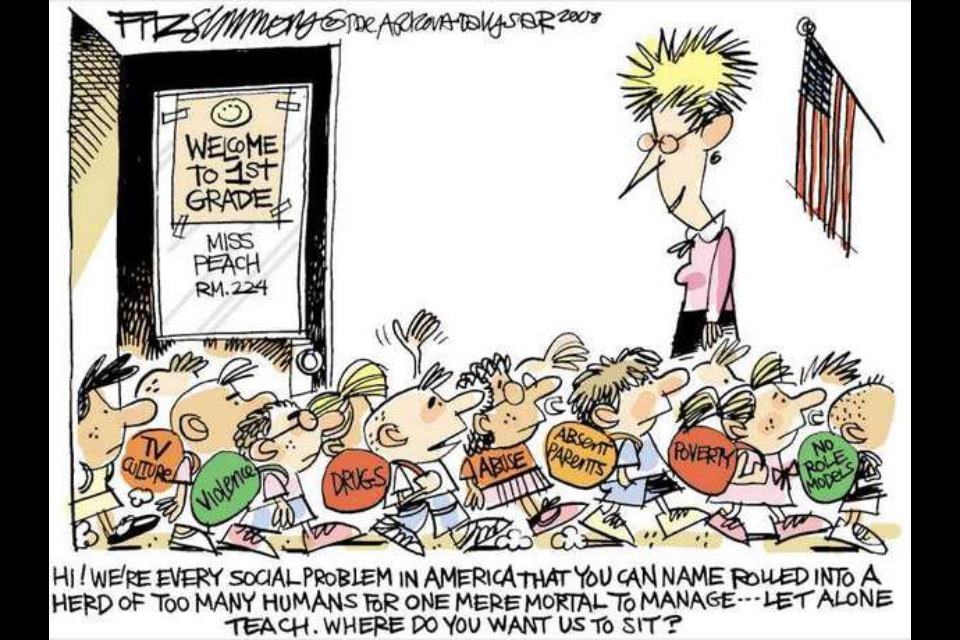
"Poorly aligned standards" is not on one of the backpacks here.

Thursday, May 28, 2015

The Screaming Hypocrisy of @GovChristie On Education

Chris Christie has never made a serious education policy proposal in his career. 

So let's not pretend for a second he's started now:
And so, today, I am directing the Commissioner of Education, David Hespe, to begin immediately to assemble a group of parents and educators to consider developing New Jersey educational standards – New Jersey College and Career Readiness Standards. 
I want New Jersey parents and teachers to be the driving force behind the establishment of these new standards. I want New Jersey business partners, New Jersey school administrators, and New Jersey school boards to work together in this important effort. 
I have heard from far too many people – teachers and parents from across the state – that the Common Core standards were not developed by New Jersey educators and parents.  As a result, the buy-in from both communities has not been what we need for maximum achievement. I agree. It is time to have standards that are even higher and come directly from our communities. 
And, in my view, this new era can be even greater by adopting new standards right here in New Jersey – not 200 miles away on the banks of the Potomac River.
Where do I even begin?

- "Not developed by New Jersey educators..." When did Chris Christie ever care what teachers think about anything? When he put together his Educator Effectiveness Task Force, he included only one working teacher, and no members of the largest teachers union in the state, the New Jersey Education Association.

The task force issued a report so incoherent and so unworkable it has led to the current, disastrous teacher evaluation system I call Operation Hindenburg. Had Christie actually bothered to include us teachers in his plans, he may have developed something that could have helped schools and students. Instead, he has set the state up for a lawsuit the first time a teacher is fired, because the current system is innumerate.

No politician in the history of New Jersey has listened less to teachers than Chris Christie. It's absurd that he pretends that he wants educators to be involved in any aspect of education policy.

- "The buy-in from both communities has not been what we need..." Buy-in from teachers?! Is he insane?!

This is a man who compared us to drug dealers, told us we were greedy, told our students we didn't care about their learning, and said we only care about having summers off. Now he worries we haven't had "buy-in"?!

No politician in the history of New Jersey has done more to demonize and denigrate the teaching profession than Chris Christie. The thought that he is suddenly concerned that we haven't had enough "buy-in" is laughable.

- "...and come directly from our communities." Maybe Christie was on another one of his many, many, many, many out-of-state trips and he missed it, but the largest student protest this state has ever seen happened in Newark this week, literally shutting down access to and from the city. Why?

Because the good people of Newark -- as in Paterson, Jersey City, and Camden -- have been completely disenfranchised when it comes to the governance of their schools. Just today, Mayor Ras Baraka demanded the removal of the hugely unpopular State Superintendent in Newark, Cami Anderson, based on her incompetence, mismanagement, and record of failure.

This egregious disdain for democracy and self-rule is blatantly racist:


It's worth noting, however, that local districts across the state have had to deal with Christie's meddling for years. The imposition of the onerous PARCC exams this year was a huge unfunded mandate, as was the previously mentioned new teacher evaluation system. Now Christie wants to shirk his responsibility to fund teacher pensions and force local districts to make up for his own inability to balance New Jersey' books.

No politician in the history of New Jersey has done more to destroy local control of schools than Chris Christie. The man who personally appointed Cami Anderson and took over Camden's schools has no business pretending he cares about what "our communities" think.

- "It is time to have standards that are even higher..." But who cares about having higher standards if you aren't willing to pay what it costs to achieve them?

New Jersey's intensely segregated schools have thousands of students living in poverty, or who don't speak English at home, or who have special eduction disabilities. The state itself passed a law, after great debate, that dictates the costs of educating children with these special needs. Yet every year, Chris Christie has refused to fund this law, with profound consequences

As of now, New Jersey schools are a collective $7 billion behind what the law itself says they need to adequately educate our children.  But Christie refuses to collect the revenues necessary to fund this law, wasting funds instead on fruitless tax gifts for corporations that have done nothing to improve our state's economy.

No politician in the history of New Jersey has done as much damage to the finances of our schools as Chris Christie. It is sickening to watch him call for higher standards when he refuses to do his job and fund our schools properly.

I'll get to the Common Core stuff in a bit. For right now, though, take a minute and think about how utterly hollow Chris Christie's words are. Think back on his previously education proposals, and how they were nothing but naked political ploys, utterly devoid of substance.

America, take it from those of us living in Jersey: this man doesn't care one whit about the Common Core, or education standards, or anything having to do with school policies. Chris Christie's sole interest in education policy is in its worth as a political tool: a tool to diminish the strength of unions, demonize public workers, and shift the focus off of his own many, many failures as governor.

When the Bridgegate scandal blew open, Christie decided to unveil a useless initiative to lengthen the school day and year, hoping to get the press talking about anything other than his out-of-control staff. It never went anywhere -- and why would it? Once it had served its purpose as a distraction, it went away.

There is a serious debate to be had about the Common Core -- but Chris Christie really couldn't care less about the issue. So long as he harbors delusions of gaining of national office, this man will use New Jersey's education system in any way he thinks will gain him political points.

In a sane world, anything Chris Christie says about education policy would be ignored.


Sunday, May 24, 2015

Standardized Tests: Symptoms, Not Causes

Let's talk about tests for a bit:

All Standardized tests, by design, yield "normal" or bell curve distributions:


You sometimes hear quanty folks say: "God loves the normal distribution." In this case, however, man is creating God in his own image, because the tests are designed to yield this distribution of scores.


In a normal distribution, most students get average scores: that's why the highest point in the curve is in the middle. As we move to the right from the middle, the test scores go up, but fewer and fewer students get those higher scores. Likewise, as we move to the left from the center, fewer students get the lowest scores.

How does this happen? Well, to start, and as testing expert Daniel Koretz has explained, we only test students on what we reasonably expect them to be able to do. We don't test fourth graders on trigonometry because we know most of them can't solve those kind of problems and wouldn't be able to even if we drilled them on it repeatedly. Similarly, we don't test high school juniors on adding one-digit numbers because we know that would be too easy.

Are there fourth graders that know the difference between a sine and a cosine? Are there juniors who can't add 5 and 4? Of course there are, but we know they are far away from the norm; we don't set our standards based on these outliers. Because we like to see ourselves as normally distributed, we create standards and tests that give us normal distributions. 

This can't be stressed enough in the testing debates: we design tests not based on objective criteria, but on socially constructed frameworks that assume some of us are above average, some of us are below, and most of us are in the middle.

Now, sometimes we design a test that is "too hard" or "too easy." What does that mean?


Here's a test where many students got high grades; it's skewed negative, meaning many students got grades close to the top of the test's scale. In fact, the "right tail" of the curve is cut off: a good number of students got the highest grade possible. This is a "ceiling effect," and many people, including the NJDOE and other authorities in education, do not like this distribution. They think the test is "too easy," because they assume that students must be normally distributed.

Hence the shift to tests like the PARCC, which reformy folk say is testing "higher order thinking" and "real world problem solving" and so on. Frankly, if you can find a real world situation where people use phrases like "constant of proportionality," I'd be surprised. What's really going on is that the questions are more difficult so the test can lose its skewness and return a normal distribution. 

The irony here is that the promoters of standardized testing are using an argument against inequity to insist on the continued use of these tests (if not their expansion), and to shame those who are opting their children out of these tests as perpetuators of race and class injustices. 

We'll leave aside the point for the moment that these same people also refuse to actually provide the funds the law -- based on a large and growing body of empirical research -- says are needed to equalize the test-based goals they've set out. 

Instead, let's look at the logic of their argument. Somehow, everyone has to be "college and career ready" (as if that is an objective criterion), and we're going to insist that everyone perform at the highest possible levels. But we're going to use a test that forces a normal distribution; and if that test actually shows that many students are meeting a high standard, we'll declare the test "too easy," and redesign it so we get back the bell curve we crave.

Does everyone see the problem here? We're insisting that all children demonstrate high performance on a test that, by design, only allows a few children to demonstrate high performance.

This is where "proficiency rates" enter the conversation:* 


All a proficiency rate does is set the cut point along the normal distribution. Where the rate is set is entirely up to whomever has the power to set it; it can be as low or as high as they like.

But what usually happens is that proficiency is determined by another test that -- surprise! -- yields a normal distribution. And that test -- say, the SAT -- is tied to some other normalized standard, like college freshman GPA. Why do I say that's normalized? Because even the reformiest of the reformy admit not everyone can or should go to college, and college standards are determined, like those in K-12 schools, by what we reasonably expect the average college student do be able to do. It's all normalized.

This is a fundamental contradiction inherent in the arguments for standardized testing as necessary prerequisites for addressing inequitable outcomes in education. Standardized tests, by design, give us bell curves, and reformy types insist we change them if too many students are getting high scores. But then they moan that not enough students are above average!

Further: they fail to see what the tests are really measuring:


The correlation between socio-economic status and test scores is absolutely iron-clad. Does anyone think eliminating the ceiling effect is going to change this? Granted, there is likely a ceiling on how income effects test scores: a kid in a family making $300K a year probably isn't at much, if any, disadvantage compared to a kid in a family making $500K.

But the wealthy have always enjoyed an advantage in our false meritocracy. The biases in the tests themselves, coupled with the inequitable distribution of resources available for schools, all but guarantee the majority of the variation in test scores will be explained by class.

The neo-liberal view appears to be that this is inevitable and just, so long as we decouple these inequities from race. If we can get some more students of color into elite schools, and create a few more black and brown millionaires and billionaires, everything will be "fair." The owners of the country can then sleep soundly at night, content that they may be classists, but they aren't racists.

I'm all for social mobility, but increasing it isn't the same as decreasing inequity. There are millions of people in this country doing difficult, necessary jobs. It's wrong to consign people of color to these jobs through a system of social reproduction in our schools. But it's also wrong to pretend that we have a system where everybody can be above average, and in doing so can make a better life for themselves.

So long as we keep making bell curves, somebody has to be on the left side. Somebody has to do the work that needs to get done. But there's no reason those decent, hardworking people shouldn't have good wages and good medical care and good housing and disposable income and workplace rights and time to spend raising their children.

Yes, their children should have the same opportunities to move to the right side of the bell curve. But if they do, somebody is going to have to take their place. Maybe if the consequences for being on the left side of the bell curve weren't so dire, affluent people wouldn't be as obsessed with maintaining the advantages they enjoy in keeping their children on the right side. Maybe they would stop pushing their children to the breaking point just to stay ahead of the pack:


Maybe we'd allow children to become themselves and realize their full potentials, free of the fear that their "failure" will inevitably banish them to a life of toil and misery. Maybe we'd start to see schooling not as preparation for a life of stepping on our fellow citizens, and instead as a process by which we become a people who balance our own self-interest with caring for our fellow citizens.

And then maybe we wouldn't feel the need to make these bell curves at all.


* UPDATE: Hey, I got it to loop!

** UPDATE 2: Sometimes you can look at something a hundred times and you never really see it. Thanks to MFortun in the comments for pointing out my axis titles were backwards!

Friday, May 22, 2015

PARCC Comes Off the Rails

The PARCC cheerleaders' arguments for their beloved test are crumbling to dust:
Washington, DC (May 21, 2015) — The PARCC Governing Board, made up of the state education commissioners and superintendents, voted Wednesday to consolidate the two testing windows into one and to reduce total test time by about 90 minutes beginning in the 2015-16 school year.  The vote came in response to school district and teacher feedback during the first year of testing and a careful review of the test design.
The changes will improve and simplify test administration for schools, teachers and students, without diminishing the goal of the assessment—to ensure every student in every school is being taught what they need to know order to be successful in the next school year and, ultimately, in college or career. 
[Skipping Hanna Skandera's useless propaganda... -- JJ]
This year’s PARCC testing was done in two parts—the performance based testing conducted in early spring and the end-of-year testing conducted in late spring, closer to end of the school year. Five million students in 11 states and the District of Columbia completed the PARCC assessments this year.  
On May 20, 2015 the PARCC governing board voted to:
  • Reduce the testing time for students by about 90 minutes overall (60 minutes in mathematics; 30 minutes in English language arts) and create more uniformity of test unit times.
     
  • Consolidate the two testing windows in mathematics and English language arts/literacy (which includes reading and writing) into one.
    • ​The single testing window will simplify administration of the test for states and schools that experienced challenges with scheduling two testing windows.
    • The testing window will be up to 30 days and will extend from roughly the 75% mark to the 90% mark of the school year. Most schools will complete testing in one to two weeks during that window.
  • ​Reduce the number of test units by two or three for all students.
Yes, the PARCC is so much better than those awful, old, state-level standardized tests -- so much better that the PARCC Board is changing it after only one year!

It seems like only yesterday -- no wait, it really was only yesterday! -- that the PARCC folks were telling us that "PARCC assessments are designed to provide parents and teachers with a far greater level of informative and useful data to help improve student instruction."

NJDOE's head PARCC cheerleader, Assistant Education Commissioner Bari Erlichson, told us this last year:
Along with the more detailed reports for parents, teachers for the first time will have access to a database showing the specific skill students were tested on in each question and how many of their students answered the question correctly, Erlichson said. [emphasis mine]
Well, that database is going to be a lot smaller now, isn't it? Are there enough questions left to break down each "specific skill"? Or are some of these skills being dropped? Who knows? All that matters, apparently, is that hopefully the "hysterical" moms who dislike the PARCC and what it is doing to their children's schools will stop complaining and Pearson won't lose another contract...

The entire point of a standardized test is that it is standardized. Every time you change it, you not only introduce error when making a comparison from year-to-year; you also tamper with the comparative validity of the test. Can we truly say that a test that is considerably shorter and only given in one window of time is measuring the same things as the earlier, longer version of the PARCC?

I can't believe that anyone would accept the argument that two different versions of this test should be used concurrently for high-stakes accountability measures, like school interventions or teacher evaluations. If any state agency plows ahead with accountability systems based on two versions of PARCC (and maybe the old state test PARCC replaced), they are going to face a lawsuit the first time a teacher is fired based on test results. And that teacher will win.

The PARCC madness of the past couple of years reminds me of the push for charter schools in suburban areas. Here in New Jersey, our DOE pulled back from its plan to bring "choice" to the 'burbs when parents -- who were a large part of Chris Christie's political base -- decided they didn't much care for boutique charters coming into their school districts and draining funds.

But their push still allowed for charter expansion in the cities, no matter the damage that caused. Districts like Newark and Camden are seeing their systems decimated; Hoboken is facing an existential threat. Charter cheerleaders lost the 'burbs, but they've made it impossible to seriously consider a pull-back on the sector as a whole (at least in the short term).

The PARCC has followed a parallel course: overreaching, the original plan was to have three (and possibly four) administrations of the PARCC throughout the year, and even expand testing to other curricular areas. Now the PARCC cheerleaders are pulling back...

Except they've managed to introduce the test into the high schools, a radical change. Even though it was never required by No Child Left Behind, we're now testing kids in math and language arts from Grade 3 to Grade 11. The PARCC people can afford to beat a strategic retreat, because they've managed to introduce themselves into schools where mandatory statewide testing was previously limited to Grade 9 biology and a high school exit exam. If you're playing the long game, pulling back a few minutes of the current tests is an acceptable, temporary loss.

As I've said before, limited testing has its place if used appropriately. But the high school exams have struck me as the worst part of all this testing madness. No one has ever shown that standardized end-of-course testing improves instruction in high school, and states that have it, like Tennessee, trail far behind states like New Jersey that had, until recently, eschewed the practice.

So while it's good to see the tests pulled back to once a year, we still have a way to go to rein in testing overkill. There's no need, for either accountability or instructional purposes, to test every kid in every year in multiple subjects. And it's indefensible to continue using the tests to compel school or teacher interventions (as opposed to informing those actions).

The PARCC pullback lays bare an uncomfortable truth for the reformy: these tests are not objective measures of student learning, let alone measures of teacher or school effectiveness. Standardized tests are political instruments, subject to the varying fancies of popular opinion. Using them for high-stakes purposes denies this now undeniable reality.

No, this is the test that came after we changed the last test that came after we changed the test before that...

ADDING: By the way, teens: during that 30-day window, you'd better not discuss the test! Especially on social media, the primary way you communicate!

Because what's more reasonable than asking a high school student not to talk about what's happening at school...