I will protect your pensions. Nothing about your pension is going to change when I am governor. - Chris Christie, "An Open Letter to the Teachers of NJ" October, 2009

Tuesday, December 13, 2011

Halliburton High

Jersey
Public education in New Jersey has been roiled recently by conflicts over charter schools, vouchers and "virtual" schools — but, now, a new type of privatization is on the horizon: allowing public schools to contract with a private company to offer "alternative" education.
The idea has been promoted to school superintendents by one of their own, Mount Olive schools chief Larrie Reynolds. He says it could bring extra income both to cash-strapped school districts and to a private, Dubai-based company for which he works as a consultant.
[...]
He [Reynolds] also is president of Sangari Active Science, a subsidiary of Sangari Global Education, a company once run by [ACTING NJ Commissioner of Education] Cerf. Reynolds also headed Newton Learning, a division of Edison Schools, a private education management company Cerf served as chief operating officer. 
The current president of Sangari Global, Rajeev Bajaj, headed Global Education Advisers, a consulting company started by Cerf out of his Montclair home. It received a $500,000 contract from the Newark public schools. Cerf said he left Global Education Advisers before it received the contract and never received money from the company. Randy Cerf, Cerf’s brother, is chief financial officer of Sangari Global.
[emphasis mine]
New York
By almost every educational measure, the Agora Cyber Charter School is failing. 
Nearly 60 percent of its students are behind grade level in math. Nearly 50 percent trail in reading. A third do not graduate on time. And hundreds of children, from kindergartners to seniors, withdraw within months after they enroll.
By Wall Street standards, though, Agora is a remarkable success that has helped enrich K12 Inc., the publicly traded company that manages the school. And the entire enterprise is paid for by taxpayers. 
[...]
Kids mean money. Agora is expecting income of $72 million this school year, accounting for more than 10 percent of the total anticipated revenues of K12, the biggest player in the online-school business. The second-largest, Connections Education, with revenues estimated at $190 million, was bought this year by the education and publishing giant Pearson for $400 million. 
[...] 
In Pennsylvania, where K12 Inc. collects about 10 percent of its revenues, the company has spent $681,000 on lobbying since 2007. The company also has friends in high places. Charles Zogby, the state’s budget secretary, had been senior vice president of education and policy for K12. In a statement, Mr. Zogby said he still owned a small number of K12 shares, but did not make decisions specifically affecting online schools.
An analysis by the National Institute on Money in State Politics concluded that K12 and its employees had also contributed nearly $500,000 to state political candidates across the country from 2004 to 2010. [emphasis mine]
Gosh, I hope this isn't coming across the wrong way. I mean, it would be so completely wrong of me to have a "generalized presumption that people who care about education have a hidden agenda."

Obviously this is all being done for the kids...

Monday, December 12, 2011

The Biggest Lie In America Today

They got together a bunch of elites here in Jersey to whine and complain that "we just don't have the money!"
In many ways, the New Jersey residents now know will disappear within five years because of yawning government budget gaps, a panel of top experts said Friday. 
The bipartisan group of former officials and academics presented a dark view of the state’s future that included widespread government consolidation, worker layoffs, service cuts and tax increases. Experts said that future was nearly certain to come to pass, even with a rosy economic scenario.
Wow, sounds dire. Do you think maybe would should tax the people who have all the money a bit more?
Panelists, who included former state officials in Republican and Democratic administrations, suggested a widespread consolidation of municipalities and school districts. Or, better yet, county governments that supply municipal services and countywide school districts, some panelists said. 
They also discussed a gasoline tax hike, a statewide property tax to fund schools, and imposition of local income or sales taxes. They mentioned an income surcharge on millionaires, but did not dwell on the oft-cited proposal. [emphasis mine]
Oh, so that's just not possible, huh? Well, what is?
The experts said local schools will have more students in each classroom, and towns will have fewer workers. Government workers who remain may have to do without the pay-grade steps they receive, often annually, and accept only modest salary increases. 
And the experts said — again and again — that there would be no easy solutions.
“There is no way costs can be covered under any scenario,” said Richard F. Keevey, a former state budget director and professor at the School of Public Affairs at Rutgers University-Newark. 
You cannot raise taxes enough to cover this problem. The current level of services cannot be fulfilled, and people have to accept that,” Keevey added. “There will be significant retrenching … (But) we’re deluding ourselves if we think that regionalization and consolidation will solve this problem.” [emphasis mine]
Professor, may I point something out to you?


Now, we can have a conversation about where to place the tax and service burden: at the federal, state, or local level. But it is simply wrong to say we can't tax our way out of this: we most certainly could. The only reason we won't do it is because too much of our government and media are controlled by elite interests who want to keep more for the 1% and less for everyone else.

We know that New Jersey is not a relatively high-spending state. We know that New Jersey has a regressive tax structure. We know that taxing higher income earners has not led to flight. We know that NJ gave up $2.5 billion last year just by refusing to tax corporate dividends.

There is simply no need to do any of what these folks are proposing:
Goertz also said that New Jersey could save some $1.2 billion by bringing the average number of students in the each classroom up from 12 to 15 so that fewer teachers would be needed. 
“It’s the Willie Sutton principle: The money goes into the classroom,” Goetz said, alluding to famous quote attributed to Sutton about robbing banks because “that’s where the money is.”
No, no, NO! The money is not in the classroom; it's HERE:

 Average Income by Family, distributed by income group.

I refuse to buy into the nonsense that we can't afford to have good schools and decent health care for everyone and comprehensive public services and fair wages and benefits for the folks who teach kids and put out fires and have guns pointed at them. It's just not true. We as a country have more than enough money to do all these things AND still have plenty left over for successful business owners to reap the rewards of their hard work.

We just need to listen to Willie Sutton and go where the money is. It's really that simple.

Sunday, December 11, 2011

America's Best Judge

The honorable Judge Sheila Rappaport from the great state of Colorado:
In declaring Colorado's school finance system "significantly underfunded," Denver District Judge Sheila Rappaport rejected virtually every argument presented by the state's star witnesses in a five-week trial this year over school funding levels. 
Rappaport's ruling, issued Friday, blasted the state's level of school funding as "unconscionable" and not meeting the requirement in the Education Clause of the Colorado Constitution of a "thorough and uniform" system of public education. Her ruling handed the problem off to lawmakers to fix, and the judge said she wouldn't revisit her ruling any earlier than the end of the 2012 legislative session. 
[...] 
A key witness for the state was Eric Hanushek, a scholar at the Hoover Institution at Stanford University, who testified that repeated studies have shown no consistent relationship between levels of funding and achievement. He also testified that average funding per pupil in the United States quadrupled from 1960 to 2007, while performance essentially stayed flat. 
But Rappaport blistered Hanushek several times throughout her ruling. 
"Dr. Hanushek's analysis that there is not much relationship in Colorado between spending and achievement contradicts testimony and documentary evidence from dozens of well-respected educators in the state, defies logic and is statistically flawed," the judge said, pointing to cases in which courts in other states "found him to lack credibility."
Hee, hee, hee... Hey, did Hanushek try to pull that "fire the bottom 10%" nonsense during the trial?

This was a big victory; it's going to have implications nationwide. Congratulations to the plaintiffs and their experts, including a certain New Jersey professor I've posted about one or two times. Did I mention he has a blog?

Great Moments in Reformy Hyperbole


Billionaire-backed and newly-elected NJ Assemblyman Troy Singleton:

That is why I am a strong supporter of the proposed Opportunity Scholarship Act (OSA), now under consideration in the state Legislature. The OSA would use corporate tax credits to transfer low-income students from failing schools into public or parochial schools with a track record of success.
Our educational foundation must be steeped in the principle that every child, regardless of zip code, should be afforded the tools necessary to succeed. Adhering to this principle however, can be particularly daunting in some segments of our society where significant outside factors, such as crime, family strife and lack of nutrition, have a severe impact on the education of our children.
The OSA, as well as other strategic programs to enhance the educational opportunities of our children, is the answer.  In passing the OSA, we must step outside of our pre-conceived notions and work toward our common goal of providing the best education for our children who are falling through the cracks, year after year. [emphasis mine]
So giving vouchers to a few children to attend private schools will stop crime, domestic abuse, and hunger. OK...

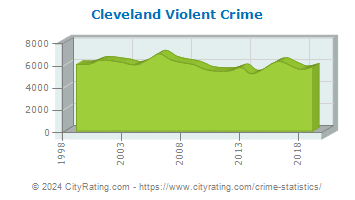
Cleveland's had vouchers for years with no discernible effect on student learning. And the effect on crime?
Cleveland Violent Crime

Underwhelming. Of course, we could try fairly taxing the people who paid for Singleton's campaign and use the money to rebuild our dying cities. But that's not "politically feasible" or something...

Why Does Anyone Listen to Michelle Rhee?

NJ Governor Chris Christie on Michelle Rhee, former Washington DC schools chancellor, 11/11/11:
“No one in America has been more clear that we must change our public education system,” said Christie. "Thank you Michelle"
Michelle Rhee on Chris Christie, 11/16/11:
Michelle Rhee, the former Washington schools chancellor, who sat beside Mr. Christie’s wife during Tuesday’s speech in Trenton, has committed her new organization, StudentsFirst, to providing policy support for Mr. Christie’s education initiatives. “I think it’s incredibly courageous of the governor to take these issues on,” Ms. Rhee said Wednesday. “These are ones that have long been considered sacred cows.”

Chris Christie on the "achievement gap," 11/16/11:
“These reforms provide a comprehensive approach that recognizes there is no single solution. For a new accountability system to be effective and successful in benefitting children, we must have all of the tools that are provided for in this legislation. A piecemeal, incremental approach will not turn around our failing schools or close the achievement gap.

Michele Rhee on the "achievement gap," 2008:
To further these gains and decrease the achievement gap, we must continue to increase the level of accountability for everyone in the system, including teachers.

To recap: Christie loves Rhee. Rhee loves Christie. Christie values closing the achievement gap. Rhee values closing the achievement gap.

Now, some facts:
I’m going to focus this post on fourth grade math, since it seems to be the subject and grade level most suspectible to reform efforts. In DC since 2003, the black/white score gap remained constant, the poor/non-poor gap grew, and the Hispanic/white gap closed slightly.
Achievement gaps would be less disturbing in and of themselves if overall achievement levels were moderate or high. But what we continue to see in DC is that white students score well above both national and urban district averages for their race; black, Hispanic and poor children score well below national averages for their races and classes. This makes DC the city in the nation with the largest black-white student achievement gap. [emphasis mine]
As I've pointed out before, Rhee has been happy to claim credit for all sorts of huge triumphs even when she couldn't possibly have had any effect on the outcomes. But even putting that aside: what in her record would possibly compel New Jersey - which has one of the highest-performing school systems in the nation - to want to implement to the policies she oversaw in DC?

And who would be crazy enough to hold DC and Rhee up as a role model?
[Acting Education Commissioner Chris] Cerf got applause from the crowd when he mentioned the high ranking of New Jersey's education system nationally, and gave teachers a lot of the credit.

But they rolled their eyes when he said that the DOE and governor are not against unions, and laughed outright when he gave high marks to Washington D.C.'s teacher-evaluation system. When he challenged them to look at D.C's data, saying he'd bet $1 right there that he was right, a teacher told him to put the dollar instead into teacher pensions. [emphasis mine]
Oh, that's who...

The New, "Reasonable" Corporate Reformer

Something is happening here in Jersey that ought to give hope to teachers and parents around the rest of the country: the corporate reform movement is running out of gas. Suddenly, privatizers are running into real grass-roots opposition to charters schools; voucher rallies are exposed as Astroturf operations while opposition to giving taxpayer dollars to religious schools grows. Chris Christie, who seemed hell-bent on gutting tenure only a month ago, has suddenly shifted his focus to sick pay reform (yeah, that'll fix all of the state's fiscal problems, sure...).

The corporate reformers are watching their grandiose plans fall apart, and I suspect they are getting worried; their deep-pocketed backers wanted to see results by the end of the year, and it increasingly looks like that simply isn't going to happen. So they're shifting the goalposts and toning down their rhetoric. The preferred outcomes are now more modest, and the new tone is reasonable and conciliatory.

Witness today's op-ed from B4K's Derrell Bradford, featuring his new, wonky sales pitch:
The state Department of Education currently is piloting an overhaul of teacher evaluation in New Jersey consistent with the guidance of President Barack Obama and U.S. Secretary of Education Arne Duncan. The pilot makes student learning, demonstrated in a variety of objective manners, a key factor in how teachers are evaluated. My organization, B4K, supports the pilot program and using student learning as a significant factor to determine if teachers are awarded tenure.
As I pointed out at the time, this "pilot" didn't even allow time for a real analysis of its outcomes before the system was imposed by the state on districts next year. ACTING Commissioner Cerf seems to have backed off on the timetable, because there's still plenty of evidence the state is no where near ready to implement a system that tracks this huge set of data. Maybe if they had started out with an advisory group that included actual teachers, instead of unqualified lobbyists like Bradford, they would have come up with something that actually had a chance of working.

Bradford continues:
The Department of Education’s evaluation pilot program makes objective measures of student performance constitute 50 percent of a teacher’s evaluation, with the remaining 50 percent being grounded in more traditional teacher observation against a high-quality rubric approved by the department. More importantly, both halves of this framework are flexible, with the objective 50 percent allowing districts to make as little as 35 percent of a teacher’s total evaluation linked to statewide standardized assessments (the rest can be district-created assessments or school-based measures).
Oh, please: do you really think cash-strapped districts are going to spend money - let alone instructional time - on assessments other than the state tests they have to give anyway? And I'd like to know if Bradford agrees with what's happening down in Tennessee, where PE teachers pick which school-wide results on state tests (like writing or math) they want included in their evaluations. Because that's exactly what could - and probably will - happen under his proposal.
Moreover, those measures assess student achievement based on growth (how much did students learn over time), not as a single data point. The remaining, subjective 50 percent allows for competition among evaluation rubrics, as districts work to find the right fit. It also changes the rating system to four categories from two.
Which means students taking MORE standardized tests, as the teachers can only be held to account for what happens in their classrooms during the school year - not the year before and not during the summer. I'll bet the testing industry is licking their chops at that. I can see it now: teachers and principals deliberately trying to get kids to score as low as possible in the fall the exaggerate gains in the spring.

Bradford's use of the word "growth," by the way, is quite deliberate: the NJDOE is pushing for Student Growth Percentages (SGPs) to be used in teacher evaluations. So there will be no effort made to try to correct for student characteristics and home environment, even though that has a far larger effect on test scores than anything that happens in school. And no accounting for the fact that students are not assigned randomly to teachers, so principals can reward favored employees and punish others. And no accounting for the biased and unreliable nature of the tests themselves. Or the fact that no matter the percentage of the evaluation, an inflexible number becomes all of the actual decision.

Hey, but no worries! Turns out these tests tell us the same thing as observations!
The University of Chicago, in its study “Rethinking Teacher Evaluation in Chicago,” found there “is a strong relationship between classroom observation ratings and value added measures, and the relationship holds for math and reading test scores. In the classrooms of highly rated teachers, students showed the most growth; in the classrooms of teachers with low observation ratings, students showed the least growth.”
So, the tests confirm what the observations already tell you. Then why have the tests at all? And why try to classify teachers into several levels based on those tests, when the tests - which Bradford himself admits have high error rates - are clearly incapable of that level of precision?

Bradford also ventures into tenure reform in his piece, but curiously leaves out B4K's previous demands that tenure appeals be contained within the system. Maybe he finally understands that taxpayers do not want their schools turned into a bunch of little patronage machines, and that a tenure hearing without an appeal outside the district isn't tenure at all.

And he's pretty much given up on merit pay, which doesn't work. He's going to take established programs like National Board Certification, tweak them a little, and try to claim them as his own. Whatever.

But notice what's missing here: no charter schools. No vouchers. No NJEA bashing.

Bradford is making a last stand on incorporating test scores into teacher evaluations, a practice that is already the status quo in much of the country. Where's the bold new thinking? Where's the courage to stand up for the children? What we have here are the first pieces of evidence of retreat. They made their case, and it has been found wanting.

This isn't over. But the momentum is shifting.

Friday, December 9, 2011

Jounamalism

To paraphrase Atrios: quick, someone put together an education bloggers ethics panel!
On Tuesday, one lucky group of New York City journalists were treated to an evening of drinks, pizza squares, and funny gift exchanges at Mayor Michael Bloomberg’s annual Holiday Party for local press.
In attendance this year were reporters from the New York Times, the New York Post, the New York Daily News, CBS, Fox, and other outlets. The journalists, no doubt straining to retain their “objectivity” throughout, were able to schmooze with dignitaries such as Bloomberg’s longtime partner Diana Taylor (who sits on the Board of Directors for Brookfield Properties, the retail firm that partially owns Zuccotti Park) and Paul Browne, spokesperson for the New York City Police Department.
[...]
Bloomberg bestowed “gag gifts” upon a number of journalists, quipping that they “are reserved only for ‘the one percent,’” according to Fernanda Santos, an education reporter for the New York Times. Santos herself received  a fake Department of Education “VIP Security Pass.”
“I had no reservations going to the party,” Santos told me. “It’s a good time and a fun tradition the mayor’s press office started some years back.”
Yeah, sounds like a hoot. Meanwhile:
The only reasonable conclusion to be drawn from this week’s release by the National Assessment of Educational Progress: Reading and math achievement by New York City’s students is dismal.
The federal test compares progress by fourth- and eighth-graders in 21 big cities. A mere 24% of all New York City eighth-graders read at the NAEP proficiency level; only 12% of black and Hispanic students attained proficiency.
In eighth-grade math, a similar 24% of city students scored at or above the NAEP proficiency level. That amounts to a modest six-percentile-point increase from the 2003 NAEP tests, but the average eighth-grade math improvement of all the big city school districts measured by the feds is 12 points during that period.
OK, let's be fair: as I've said before, "proficiency" on the NAEP is not a basic level of literacy as the label implies - it's actually a high standard of achievement. Still, for a guy who was running around in front the cameras only a couple of years ago, giving high-fives to Joel Klein, this isn't really great news.

I wonder if they have parties like this in Trenton?

Thursday, December 8, 2011

Are Charters Really "Impressive"?

Any time I hear the words "data" and "school" together, my reformy radar goes "ping!":
Walk through the doors of Bergen Arts & Science Charter School in Garfield and you'll see a computer kiosk that lets parents see all their kids' test mistakes so they can practice more at home. 
The database also gives information on the day's quizzes, homework and any demerits for misbehavior. For live updates, parents can tap into a "student database app" on their cellphones. 
At a time when many parents and teachers worry that schools have gone overboard in testing children and lament the time spent on test preparation, families here embrace the school's intensely data-driven approach. Indeed, its children spend almost a week in December and again in March taking practice rounds of NJ ASK, the state's annual four-day testing spree for Grades 3 through 8, and then they take the real thing in May. [emphasis mine]
I'll give credit to reporter Leslie Brody, who has done good work in the past on education; she thought to look at the data and see if it backs up any claims of the school's successes:
Opened in 2007, the charter gets impressive results. In 2010, the latest year for which data are officially available, its students passed state tests at higher rates than students in their home district and statewide. In most of the tested grades, more than 85 percent of the charter's children passed NJ ASK in math. That's particularly high for a school where 56 percent of students were poor enough to get free or reduced-price lunch.
There's some truth here, although I'm not sure how "impressive" it is (especially when you consider how much time these kids spend taking practice tests). Here, for example, is a quick-and-dirty comparison of 5th Grade NJASK scores:


What we want is less red (Partial Proficient) and more blue (Proficient or Advanced Proficient). And, yes, Bergen A&S does do that, although I wouldn't say the difference is overwhelming (that is largely a matter of opinion, and somewhat a matter of the content of the tests). I'd also point out that the district does BETTER on Advanced Proficient scores in Math. But, in general, it's fair to say Bergen A&S does better than the neighborhood schools, although the difference isn't what I'd call enormous.

Brody, much to her credit, understands the critical issue that comes out of comparing charter scores to public school scores:
When charters outperform nearby traditional schools, outsiders often say that's because they attract more involved, organized families, leaving behind higher concentrations of children facing severe financial distress, disabilities, transiency and other hardships. Bergen Arts & Science had a smaller share of special needs children (8 percent in 2010) than Garfield district schools overall. The charter reported no students who came or left midyear, compared with challenging mobility rates of 10 to 22 percent in district schools. State data, however, showed the charter and district overall had similar rates, of children getting subsidized lunch.
I went to the Common Core of Data at NCES to get the demographic data for all of the schools in the zip code of Bergen A&S. Using Bruce Baker's method, I made another another quick graph:


Many of the schools have a larger population of "free lunch" kids than Bergen, but not by a huge amount; some have a slightly smaller percentage. But look carefully at the other columns. Something jumped out at me right away.

Let me highlight it for you:


The raw data for 2009-10 shows that Bergen A&S had more Asian students in its school (63) than the rest of the schools in the district combined (59). Bruce Baker's analysis confirms mine:

The zip code for Garfield is 07026; look how it spikes on the chart. What are we to make of this? Well, you know me and my numbered conclusions:


Keep this in mind as you read this passage from Brody's article: 
Garfield schools Superintendent Nicholas Perrapato said academic files of his students who switched to the charter showed many were top students. "If you're getting the cream of the crop, you should do well," he said.
"It's not that our kids are the smartest kids in the area, but we prepare them," countered the charter's CEO, Nihat Guvercin, a former physics teacher from Turkey. "Students have potential. They only need someone to give them options." [emphasis mine]
I leave it to you, dear reader, to decide if maybe Perrapato has a point.

2) The debate about "boutique" charter schools in the 'burbs of New Jersey often swirls around charters that have a decidedly ethnic flavor to them. Maplewood's and Livingston's proposed charter is a Mandarin-immersion school; so is the one down around Princeton. In Highland Park, it's a Hebrew language charter.

This is occurring at the same time there has been a renewed push for the Opportunity Scholarship Act - a voucher program - by folks from both Catholic and Jewish groups.

Is this what we want in a pluralistic society? A return to segregation in our schools? Yes, I know we have highly segregated schools right now, but should we make the problem worse by clustering ethnic groups into different charter schools? As Baker says:
These figures raise important questions about the contribution of charter schools in the broader education policy and public policy context in a state already grappling with significant segregation and racial isolation (and consolidation, or lack thereof). These concerns may be particularly relevant as increased numbers of culture (ethnicity) specific charter schools are proposed, dispersed throughout the state.
3) Again: I think Brody is a good reporter. She looked at the actual data, which is better than many newspaper folks out there. She's hip to the controversy about charter schools run by Turkish immigrants and referenced it in her report.

But if there's one thing I've learned in writing this blog, it's that there's always another layer to peel back with this stuff. And school operators who tell you they've got a pouch of magic beans are often selling something else. Always approach stories about high-performing charters with skepticism.

Tuesday, December 6, 2011

It's A Wonderfully Stupid Life


Less than a month before the deadline, we have a sure winner in the "Stoopidest Conversation On Cable News TeeVee" category:


Damn you, Muppets, with your anti-capitalism propaganda and indoctrination! Why can't we return to the good old days of Hollywood celebrating the wealthy? Like when they would destroy small towns?

Every time a wacko says something stoopid on Fox, and angel gets its wings! Have an idiotic holiday, everyone!

Monday, December 5, 2011

"Just a Blogger..."

I love this one:

JACKSON — Some school board members want stated formally their prerogative to give the silent treatment to reporters they consider unethical.
A proposed policy would permit the members to decline to speak with reporters whom the Board of Education considers to be in violation of the Society of Professional Journalists’ Code of Ethics.
The proposal would give the board the power to “request the media outlet provide a different journalist to cover the Board of Education and school district,” according to the policy draft released by the district. “In the event the media outlet does not replace the journalist, the Board of Education and its staff members will not be required to provide information regarding activities in the school district or respond to questions and inquiries … beyond the professional courtesies extended by school staff members to a person of the general public.”
The board will vote on Dec. 20.
The resolution will address “people who are calling themselves journalists and are really just bloggers,” said board member Barbara Fiero. [emphasis mine]
I've got no problem holding up bloggers to high journalistic standards; but how about we do the same for print journalists?

Take my last piece on the new Queen of Gutting Tenure, Janine Walker Caffrey. I sourced everything; there are links to just about all of my assertions of fact (maybe I've left a few out that are common knowledge).

Contrast that to the piece that Tom Moran of the Star-Ledger wrote about Caffrey; the piece that prompted me to write my post. Here are the unsourced statements of fact Moran makes:
The legal labyrinth (outlined in the chart at right) can take years to navigate. Districts have to pay attorneys and continue to pay the bad teachers during most of the process. It can easily cost $200,000 a pop. 
[...]
Gov. Chris Christie notes that only 17 bad teachers have lost tenure over the past decade. But many more bad teachers are asked to leave before they get tenure. And most tenure cases end in settlements, so they are not counted as part of that 17. 
[...] 
What Caffrey says out loud, many other teachers and administrators whisper in private, to avoid making waves. But some of them are calling Caffrey and cheering her on. [emphasis mine]
Those are three assertions of fact I would never make without citing a source. I might conjecture that #3 is possible, and I might say there is evidence that strongly suggests #2 (there is), but I would never state any as a fact without a citation - especially #1. And that last sentence should read: "Caffrey claims that many teachers and administrators are calling and cheering her on."

This, by the way, is in addition to Moran's lack of acknowledgement that he has confirmation of Caffrey's stories about her teachers' alleged misdeeds by a second source. Maybe he did confirm them; maybe he didn't. If he did, he should give us a clue who made the confirmations. If he didn't, I have to wonder why he ran with the story at all.

I can tell you that as this blog has gained more attention, I've had people send me story ideas. But I never use their stuff without confirming it. The few times I've cited people as eyewitnesses, I've said who they are, and I only use first person accounts.

The point isn't that I'm "better" than a print journalist; I'm not. I've got no formal training in journalism or its ethics. I'm anonymous (for now), and that wouldn't and shouldn't fly if I was a professional. But it does force me to take extra care to get my facts right; otherwise, nothing I wrote would be taken seriously.

There are some truly awful blogs out there; there are also some truly awful newspapers, magazines and broadcast journalism outlets. Being a blogger doesn't mean my work shouldn't be held up to scrutiny, but it also doesn't mean my work doesn't have value. Judge it on its own merits, but judge your local newspaper that way as well.

Caveat lector.