I will protect your pensions. Nothing about your pension is going to change when I am governor. - Chris Christie, "An Open Letter to the Teachers of NJ" October, 2009

Thursday, December 18, 2014

Charter School "Gibberish"

I thought I was moving up in the world. I was actually getting some high-quality pushback on my writing from folks like Dmitri Melhorn, formerly of StudentsFirst, and the KIPP Kids here in Jersey at TEAM Academy. Not to say I think their arguments have much merit -- they don't. But at least they think a little about things and they understand they have to deal with the facts as they are.

The exchanges have been tart at times, but I can at least respect these folks are willing to hold themselves to a reasonable standard of intellectual rigor. At least I can gauge some good will here as they are willing to acknowledge some basic truths about charter school enrollments and outcomes.

So I was feeling like I had finally earned a better class of critic; that maybe I was getting a little respect.

Then I read this:
Charter school opponents like Julia Sass Rubin and Mark Weber (”New Jersey Charter Schools: A Data-Driven View, Part I”) claim that these recognized differences make charter populations “fundamentally different” demographically, and put their analytic energies towards claiming that the academic success of charter school students is a result of demographics rather than hard work in an effective school. 
New Jersey has 87 public charter schools, which educate nearly 40,000, mostly urban, students. Those students, like their urban district peers, are overwhelmingly poor and minority. But, by and large, charter school students achieve superior results. Why is this?
The explanation isn’t found by statistically parsing minor differences in degrees of poverty -- it is found in the fundamental differences in the effectiveness of instructional practices, the supportive environment, and the culture of accountability found in New Jersey’s high-performing charter schools. 
Charter schools have done more to provide high-quality education to disadvantaged students, and to provide equitable access, than any other educational reform effort in New Jersey.
The data, as presented by Weber and Rubin, obscures the larger picture of public-education equity and, as such, represents statistical gibberish. It ignores the centrality of effective education in addressing all the other ills that plague our urban centers. It also fails to address the significant positive impacts of charters in communities where district schools have failed multiple generations of students. And it does not offer any rationale for why public education in many of our urban areas largely failed parents during the 40 years before charters even became an option. [emphasis mine]
This comes to us courtesy of Rick Pressler, interim president and CEO (they need both?) of the New Jersey Charter Schools Association. It appears that Mr. Pressler, like his predecessor, Carlos Perez, does not much care for the report I authored with Dr. Julia Sass Rubin: NJ Charter Schools: A Data-Driven View, Part I. Apparently, our graphs and numbers and data are nothing more than "gibberish."

Mr. Pressler, when I hear two people conversing in Mandarin, it sounds like "gibberish" to me. But that's not the fault of the people speaking; it's mine, because I don't speak Chinese. "Gibberish" is what people call things they don't understand.

Bruce Baker and I have both explained this numerous times: the "minor differences" in student demographics between charter schools and district schools matter. Mr. Pressler, if you're going to be the spokesperson for charter schools throughout the state, save yourself some eventual embarrassment and read my post (it's quite understandable) about why poverty measures matter. An excerpt:

You'll notice the pattern remains the same, but the dots are "tighter" to the trend line in the middle of the graph. Statistically, half of the variation in test scores can be explained by FL rates. That's stronger than the correlation above, so right away, we have a clue: in a community with large numbers of students in economic disadvantage, FL explains more of the variation in test scores than FRPL.

But let's take it one step further. How does RPL affect test scores?


Whoa! When we looked at FL and FRPL, test scores when down when the rate went up. But look at this -- we've flipped the relationship! In a community like Newark, when RPL rates go up, test scores go up!

Keep in mind that this is a relationship we'll only see if we limit our sample size to a community like Newark. If we tried to do this across the state, we wouldn't see the same relationship: that's because, relative to the entire state, RPL is a measure of economic disadvantage.

But when we limit our framework to Newark only, the relationship changes. Why? Because in Newark, RPL is a sign of relative economic advantage, not disadvantage.
I know this is a little quanty, but do us all a favor, Rick, and drill down a little so we can have an honest conversation. Please.

As to this idea that the alleged "academic success" of charter schools is "a result of demographics rather than hard work in an effective school," let's first acknowledge that there is no evidence of any academic success in New Jersey charter schools outside of Newark. The NJ CREDO report, long touted by charter cheerleaders throughout the state, plainly says that students in charters everywhere but Newark learn less than their peers (p. 16).

The most generous reading of the Newark charter school gains in the CREDO report shows they moved students from the from the 50th to the 60th percentile in math and from the 50th to the 59th percentile in reading: good, but hardly fantastic. The measure of those gains, however, does not take into account the aggregation I discussed above of free lunch and reduced price lunch eligible students. Nor does it take into account the aggregation of special education students of all types.

Nor does it take into account the patterns of attrition at charters like North Star Academy.


Nor the peer effects that even Newark's State Superintendent Cami Anderson, a huge charter cheerleader, acknowledges gives charter schools an advantage (maybe this the reason the author of the CREDO report has since disavowed the "market model" charter cheerleaders laud).

All of these realities keep charter schools from being replicable. Which is why even the big national CMOs like KIPP, which has been free of the disgusting money grubbing found in so many other parts of the charter sector, consistently refuse to expand their networks to the point that they would have to take all comers within a school district. Even they acknowledge that their model works for some students -- but not all.

Now, I will give Pressler one point: we need a more thorough discussion of magnet schools. I've actually done some recent work on this, and hopefully will be putting it out when ready over the next year.

But if Pressler's read even a small portion of the posts in this blog, he knows that I, probably more than any other commenter on education in New Jersey (with one big exception), have harped on the indefensible segregation and inequitable funding that plagues New Jersey's schools. But here's the thing: charter schools do nothing to address the underlying problems. Using charter school proliferation to shuffle kids around within poverty-stricken, inadequately funded, segregated districts does nothing to fix the root problems with our state's public schools.

And this is the ultimate issue with the arguments of shills like Rick Pressler: his charter cheerleading is leading us away from a serious discussion of how to improve the lives of impoverished children. He gives cover to plutocrats like Chris Christie, who guts education funding and turns New Jersey back from its historic commitment to equity. Christie famously said his "reform" plan consisted of vouchers, charters, teacher merit pay, and gutting tenure.

But raising taxes to pay for school funding adequacy? Perish the thought! Luckily, he's got folks like Rick Pressler in his corner, ready to tout charter school proliferation without giving a thought to desegregation and adequate school funding and improving the lives of the poor.

Now that's gibberish.


Rick Pressler explains charter school proliferation.

Wednesday, December 17, 2014

Jazzman In @theprogressive: @GovChristie, School Bully

My new piece for The Progressive is now available on the web: "Chris Christie: School Bully." Here's an excerpt:
Video of Christie’s reaction became the first big YouTube sensation for a governor whose staff prides itself on its social media savvy. When Corfield dared to roll her eyes at Christie’s response, he stopped in midsentence and upbraided her—without the slightest trace of irony—for wanting to “put on a show.” He then proceeded to blame teachers for the state’s fiscal woes, claiming that if they had only taken a one-year pay freeze, he could have plugged the budget hole.
It wasn’t true: The state’s Office of Legislative Services later released an analysis that showed a teacher pay freeze wouldn’t have come close to filling the budget gap. But the truth was never Chris Christie’s top priority; what mattered was that he had found his villains. Teachers, not millionaires and corporations benefitting from Christie’s tax giveaways, were the problem. Cutting pay and benefits for educators was the solution.
Looking back at the video more than four years later, it’s astonishing to see how little Chris Christie has changed. Some politicians mature in office, softening their tone as they come to understand the responsibilities that come with positions of authority. Not Christie: The open contempt he showed toward Corfield that day has resurfaced every time his critics have publicly confronted him.
Click through and read the whole thing. Then consider a subscription to The Progressive; it's only 99 cents via Kindle.

Again, many thanks to Ruth Conniff and her staff for all their assistance on this piece.


Just to add: it's been crazy here at Jazzman Estates, which is why I've been quiet these past couple of weeks. But there's plenty of reformy stuff that needs to be answered, and answer it I will.

Stand by...

Friday, December 12, 2014

Derrell Bradford Returns, More Reformy Than Ever

I'm feeling a bit like Ebenezer Scrooge this yuletide: I keep being visited by Ghosts of Reformy Pasts. First there was Former Acting NJ Education Commissioner Chris Cerf, sanctimoniously pointing at the motes in everyone else's eyes while ignoring the big, reformy, beam in his own.

And now here comes a visitation from an old friend of this blog: Derrell Bradford, a man who was always ready to cast aspersions on every education stakeholder who didn't share his views. Working presently for the reformy outfit NYCAN, Bradford cut his teeth here in New Jersey, where he regularly used his personal story to sell education "choice."

Looks like not much has changed:
If you have money or influence in America, you don’t even blink when your local school doesn’t deliver. You know you can “move” to a private school or another school district, and the local school does too. So if that power is good enough for the wealthiest and most influential, why shouldn’t we give low-income families in southwest Baltimore where I’m from, or Newark, or New York the same options?
As a child I got a scholarship to an excellent school and that changed my life, forever, and there is no day I don’t wake up and know how blessed I am because of it. “Parent Choice” in education is the one thing that can help families, just like mine, and help them today. Take a lesson from my old landlord. Your zip code and your income might dictate where you live … but they shouldn’t determine your child’s future.
Before we dive in, this note:

If you're going to use your personal story to promote your policy agenda, understand you've opened yourself up to critique. Don't feign shock when folks look into your past to see if your story really holds up. Joel Klein, for example, has been using his autobiography to sell his reformy agenda for quite some time. When Richard Rothstein looked into his personal history, however, it turns out Klein's self-portrait of a "kid from the streets" wasn't very accurate.

Some folks got a case of the vapors over Rothstein's debunking, but they missed the point: Klein himself brought up his own story to make his case. Live by the personal anecdote, die by the personal anecdote.

Which brings us to Bradford. The construction that he makes here implies that the education he received when he went to his own "excellent school" is somehow equivalent to the "choice" schools that are and were being pushed by the alphabet soup of Derrell's current and former employers: NYCAN, B4K, and E3. Pushing vouchers and charters has been Bradford's meal ticket for a good long while, and he's been happy to say his story is proof that reformy "choice" can save urban children in economic disadvantage.

The problem, as I've reported previously, is that his own alma mater is nothing like the charter schools Bradford celebrates:
As he told NJ Spotlight, Bradford went to the prestigious St. Paul's School in Baltimore, Maryland. St. Paul's has an operating budget of $19 million, and it enrolls 755 students, for a per pupil cost of $25,166. That's the operating budget, mind you: we don't even know how St. Paul's treats its capital expenses.

Comparing school spending amounts is notoriously complex*, especially when trying to measure the relative spending of public and private schools. I'll acknowledge this is only ball-parking it at best; however, let's use some figures from what is generally regarded as a reliable source, the US Census Bureau. Their latest published reports put the Baltimore City Public Schools per pupil spending at $15,483; Maryland's per pupil spending is $13,871. 

Keep in mind that St. Paul's is, by Bradford's own definition, a "hoity-toity high school" that does not and need not accept English language learners or children with even mild learning disabilities. The public schools of Maryland do not enjoy that luxury: they must take all children, including the most expensive ones to educate.

So Derrell Bradford's education - the one he says he wants for all kids "with all of my heart and in the deepest and truest place in my being" - cost far more than the education public school students get right now. The question, naturally, is whether or not he is willing to pay for the upgrade.
 The answer, of course, is "no":
Bradford: Because we're spending on all the wrong things, like ridiculous facilities, right? Ridiculous, you know, bells and whistles that we don't need. And the most important things, like breaking the monopoly, empowering people with choice, focusing on teacher quality and compensation - we don't do that stuff. 
"Bells and whistles" are the problem, huh? "Ridiculous facilities" are keeping kids back?

From the St. Paul's website:
Middleton Athletic Center
 
Built in 2000, the 4,700 square foot Middleton Athletic Center has locker rooms for all Middle and Upper school students, a 2,500 square foot state-of-the-art weight room, an athletic trainer's room, a video room, three basketball courts, and a wrestling room with two full-sized wrestling mats. 
The Fields
 
The synthetic grass at Tullai Field is the same playing surface used by NFL teams. All of our football, soccer, and lacrosse teams play on the stadium field, where we have hosted MIAA playoff games, NCAA lacrosse teams, as well as various lacrosse tournaments and clinics. 
Click through if you'd like to find out just who benefitted from those NCAA-level lacrosse fields...

Say what you want about charter schools like KIPP/TEAM or Uncommon/North Star or even Success Academies, where Bradford was asked to serve on the board of directors -- at least they enroll a significant portion of at-risk students. Not nearly as many as their hosting districts, mind you, but still a significant number.

But how many of these disadvantaged children get the chance to attend elite private schools like St. Paul's? Yes, prep schools do offer some scholarships, but the vast majority of the students at these schools come from the upper-middle class and higher -- sometimes much higher. Earlier this year, Steve Bogira at the Chicago Reader tried to get a sense of how that city's private school populations compared to the overall student demographics for the region:
The children of the affluent are clearly in constant interaction at Lab [University of Chicago Laboratory Schools, perhaps the most elite private school in the city]. The U. of C. covers half the tuition of students who have a full-time University of Chicago employee in their family, and more than half of Lab students are from such families. But since tuition ranges from $25,296 for full-day nursery school to $28,290 for high school, excluding many fees, even most U. of C. families are spending more than $12,500 a year on Lab. And that's per child; a family such as that of Mayor Rahm Emanuel, with no U. of C. affiliation and three Lab children, is likely paying more than $75,000 a year on Lab tuition. (About a fifth of the families with no U. of C. affiliation receive need-based financial aid.) 
A former Lab teacher who asked that his name be withheld told me, "A phrase often tossed around at Lab was, 'It's like the United Nations.' And many cultures are represented. But it's mostly incredibly rich people."
Lab, which is on the U. of C. campus, is in the midst of a renovation and expansion project that will increase its capacity from 1,750 students to 2,050. It's adding new buildings for early childhood and arts programs, and the expansion "will allow the schools to continue to maintain a diverse student body at a time of unprecedented demand," according to the university's website
When I called Lab with questions about its enrollment, I was directed to Jeremy Manier, news director for the U. of C. I said I wanted to interview someone at Lab about the diversity of its enrollment. I told him I wanted to know, among other things, what proportion of Lab students is from low-income families.
Manier sent me a PDF with a demographic profile of Lab's student body. It said the enrollment was: 51 percent Caucasian; 19 percent "multi-ethnic"; 14 percent Asian; 9 percent African-American; 4 percent other/not defined; 2 percent Hispanic; and 1 percent Middle Eastern.
There was no socioeconomic data. Manier told me in his e-mail that the proportion of low-income students was "similar to the levels at peer independent institutions."
I asked Manier what that proportion was. I also asked him if the proportion of Hispanics at Lab was really only 2 percent, as the profile indicated. (As of 2010, according to that year's census, Chicago's population was 33 percent African-American, 32 percent non-Hispanic white, and 29 percent Hispanic.) 
Manier's response: "There's no additional comment from Lab beyond the original statement we gave." 
I reminded him that I hadn't been after a statement; I'd wanted to talk with someone at Lab about the school's diversity—a board member, perhaps. Diversity was integral to Lab's educational mission, according to the school's website. Wasn't anyone at Lab willing to discuss the subject? Manier said the school wouldn't go beyond its statement. [emphasis mine]
Nobody should be at all surprised by this: elite schools are for the elite. That's why Bill Gates and Chris Christie and Barack Obama, all quite reformy in their cheerleading for "choice," send their own children to very expensive and very exclusive private schools. And it's why children with backgrounds like Bradford's rarely attend on full scholarships:
But the combined enrollments of 1,085 NAIS schools that responded to a statistical survey for the 2012-13 school year was 65 percent European-American, 8 percent Asian-American, 6 percent African-American, 6 percent multi-racial, and 4 percent Hispanic. Maybe the median tuition and fees—$21,167—precludes greater racial and ethnic diversity. 
As for socioeconomic diversity, it's "a priority for the association," McGovern says. But the cost of running independent schools makes it hard to achieve, she adds. "You have to have enough full-pay families in order to support financial aid. But the more full-pay families, the less economically diverse the school." 
And splitting up the available financial aid money requires tough decisions, she says: "Do you give $30,000 a year to one student, or $10,000 a year to three students? Are you offering more opportunities, or bigger opportunities?"
McGovern says she doesn't know what proportion of NAIS students are from low-income families; the association's statistical survey doesn't ask. She says 21 percent of students at non-boarding schools are receiving need-based financial aid this year, and 3.5 percent of these financial aid students are on full scholarships. That works out to less than 1 percent on full need-based scholarships.
Bradford's old school, by its own admission, follows this pattern:
Our aid is intended to bridge the gap between what a family can afford and the cost of their child’s education, and comes in the form of grants that do not need to be repaid by the family or student. St. Paul’s provides assistance to more than 30 percent of the student body. Most of our families receiving financial aid have annual incomes between $75,000 and $175,000. However, we do have families receiving aid whose incomes fall either below or above this range because of their particular circumstances. Therefore, we encourage all families to apply for financial aid to determine what they are qualified to receive and to help make a St. Paul's education affordable. 
Assuming that your family's financial status does not change dramatically, funding will generally be renewed at previous levels.  You must re-apply for financial aid every year. 

TUITION

Tuition for the 2014-2015 academic year:

  • Kindergarten:       $19,975
  • Pre-First:              $22,975
  • First through Fourth Grade:   $23,075
  • Fifth through Eighth Grade:     $24,875
  • Ninth through Twelfth Grade:   $25,700 [emphasis mine]
At prices like these, even families making $175K could use a little help. But let's be clear: a family with an income of $75,000 is solidly in the middle class -- and that's at the low end of St. Paul's.

I don't begrudge Derrell Bradford his education. I don't begrudge anyone the opportunity to attend an elite private school (especially these days, as they are free of the onerous and foolish federal and state mandates imposed on the public schools). I am the first to admit that families who live in the leafy 'burbs are gaining an advantage for their children, and we ought to be addressing this issue and implementing policies to integrate schools.

But anyone who makes an equivalency between "choice" schools -- another name for charters and the less-than-elite private schools that subsist on vouchers -- and elite private schools is selling snake oil. They simply aren't the same.

Bradford's education at St. Paul's gave him two advantages he would never have received had he attended even the highest-flying charters, like KIPP and Uncommon and Success. The first is access to gobs of social capital that can only be found at schools that enroll many children of high socio-economic status. Bradford himself admits he got his first job in the edu-political world because of his childhood friendship with the daughter of his first boss, the wealthy and reformy Peter Denton. You don't make those sort of social connections at an urban charter school, even if it has high rates of attrition.

The second advantage is in resources. Bruce Baker has previously documented the resource advantage high-flying charters have over public schools, but that's nothing compared to the advantage of elite private schools over all publicly funded schools.

KIPP doesn't have schools with NCAA-level lacrosse fields like St. Paul's. Success doesn't have a brand new, 28,000 square foot facility for the performing and visual arts like St. Paul's. Uncommon doesn't field 47 interscholastic athletic teams in 14 different sports like St. Paul's.

These "bells-and-whistles" are what the elite pay for, but they are nowhere to be found in urban charter schools. Instead, there exists a "no excuses" culture that teaches "...the individual is assumed worthless unless he/she fits neatly in the mold of uniformity and compliance."

I've mentioned the work of Jean Anyon many times here, and how she showed that schools are factories of social reproduction. I can think of no clearer example than the difference between elite private schools, with their Harkness tables and squash teams, and "no excuses" charter schools, with their shaming disciplinary practices and standardized test-centered pedagogies.

These differences in funding and school climate go hand-in-hand. If Derrell Bradford really wants kids to have the same education he had, he would start by acknowledging this reality: no matter how many Ivy League pennants an urban charter school puts on its walls, it is not equivalent to an elite private school -- not in resources, not in peer effects, not in school culture, and not in pedagogy.

If our goal is to make urban education as good as that found in the suburbs, sorting kids within poorly-resourced urban districts isn't going to do much to help. We need to start developing strategies to desegregate our schools, which is admittedly a tough haul given we live in segregated communities.

But we don't have to wait to correct inadequacies in school funding. We know that:
On balance, it is safe to say that a sizable and growing body of rigorous empirical literature validates that state school finance reforms can have substantive, positive effects on student outcomes, including reductions in outcome disparities or increases in overall outcome levels.
Right in New York State, there are multiple lawsuits being brought on behalf of students and their families -- see here and here -- to correct the state's truly awful funding disparities. Years ago, New York had painstakingly worked out a funding formula that took into account regional cost differences, districts' abilities to raise funds, and diversity in student populations. The state adopted it, then proceeded to ignore it. For years, New York has refused to fully fund a formula the state itself said was necessary to provide its students with adequate educations.

The plaintiffs in the cases, working with groups such as New Yorkers for Students' Educational Rights and the Education Law Center, have a long, tough, expensive fight on their hands. They could certainly use the help of groups such as NYCAN to raise both funds and awareness. Where, then, is Derrell Bradford and NYCAN during this fight?

Apparently, dithering around with tangental concerns like teacher tenure, charter school proliferation, and "parent triggers." NYCAN and other reformy groups waste their time with this nonsense, leaving the important battles to those who have an understanding of what really ails public schools.

Again: I don't begrudge Derrell Bradford his education. He clearly made the most of the opportunities he was afforded; good for him. But let's not pretend for a second that a kid going to a "no excuses" charter school is getting the same chances Bradford had at his elite private school. Let's not pretend that reformy "choice" will give urban students access to the financial and social capital that made Derrell Bradford what he is today.

What's a "Harkness Table"?

Monday, December 8, 2014

Jazzman In @theprogressive This Month

Blogging has been a bit light these last couple of weeks. One reason is work/family/school; another is that I've been involved in a few extracurriculars. The follow-up to the NJ charter report, for example, will be out soon.

And another big piece was just released today: my first story for The Progressive, the venerable liberal (not pseudo-liberal) magazine. The December-January issue is a double-sized blockbuster focused entirely on public education. I am very proud to say I'm joined by, among others, Pedro Noguera, Tim Slekar, Jon Pelto, Michelle Gunderson, Yohuru Williams, and the always fresh and excellent Jennifer Berkshire, aka EduShyster.

I'm not sure if and when an electronic version of my piece will be available (some of the others are found here), but here's a taste of "Chris Christie, School Bully":
You would think a few years in office would have made Chris Christie’s skin thicken a bit; you would think a sitting governor who was already being talked up as a possible presidential candidate would show some restraint.

But it’s clear to many of us New Jerseyans, after years of observing Chris Christie, that the man craves these conflicts – especially with women. He once told the press they should “take a bat out” on State Senator Loretta Weinberg, a 73 year-old grandmother and one of the most respected figures in Trenton. He called another state senator, Valerie Huttle, a “jerk,” and former Assembly Speaker Sheila Oliver a liar.

This explains, in part, why he takes such glee in railing against teachers, a field where three-quarters of professionals are women. Last November, just before his reelection, Christie held a substantial lead over his opponent, Barbara Buono. The smart move would have been to keep his head down and coast to victory. But on the Saturday before the election, Christie was confronted by Melissa Tomlinson, a teacher and activist who brought a sign criticizing the governor to one of his rallies.

Tomlinson later recounted the details of their encounter to me:

I went to listen to him speak. I stood in the front of the crowd that was standing towards the back. I know he caught sight of me. He stared at me a few times during his speech. I left right as his speech was over to position myself right at the door of the bus. He came out, shaking everyone's hands as he was getting on the bus. I asked him my question, expecting him to ignore me but he suddenly turned and went off.

I asked him: "Why do you portray our schools as failure factories?" His reply: "Because they are!"  He said: "I am tired of you people. What do you want?"
That post remains the most-viewed piece I've ever written on this blog: almost 100,000 hits within 48 hours. I took that as a sign: after years of New Jersey teachers taking it on the chin, one of our own finally stood up to the bully and called him out. There are actually two heroes in this piece: Melissa, and Marie Corfield, who was one of the first New Jersey teachers to stand up to Christie. Their stories are the bookends for the tale of Chris Christie's War On Teachers.

I'd tell you to pick up a copy of The Progressive at your local bookstore, but those are as rare as video rental shops these days. Probably the best way to read it is to subscribe here. It's a great magazine and the magazine's companion site, Public School Shakedown, is required reading for all edunerds.

They've even released a cool video to celebrate the issue:


Blogging resumes this week -- because the reformy never stops...

Thanks to Ruth Conniff for the gig!

Tuesday, December 2, 2014

Chris Cerf Returns, More Reformy Than Ever

It's been a little less than ten months since Former Acting NJ Education Commissioner Chris Cerf announced his resignation so he could go work for Joel Klein selling tablets (with questionable records of quality) to schools. We hadn't heard much from Cerf over the past year -- until today.

In a sprawling op-ed for NJ Spotlight (full disclosure - I write regularly for them) the Chris Cerf we came to know and love over his tumultuous three-year tenure is on full display. Cerf musters his well-worn repertoire of rhetorical devices -- the righteous indignation, the snide dismissal of critics, the tut-tuting at "tone," the claims of success with absolutely no evidence to back them up -- in defense of his protege, the embattled State Superintendent of Newark, Cami Anderson:
Here are five falsehoods worthy of dispelling: 

Falsehood 1

The work of the past 3.5 years (Superintendent Anderson’s tenure) has been a failure:
In fact, while we are in the early innings, more has been done to advance the interests of Newark's children over this period than in the three decades that preceded it. And early results are encouraging (laid out in detail in Superintendent Anderson’s letter).
Go ahead and click the link; what you'll see are excerpts from an apparent letter, dated October 24, 2014, from Anderson to her "friends," asking for their help in defending her in the press. Chris Cerf's op-ed here is clearly in response to Anderson's plea to defend her, making the entire endeavor rather pathetic.

Cerf's claim that the letter contains any evidence of "encouraging" results in Newark is simply absurd. The spotty "data" that supposedly demonstrates the success of Anderson's vaunted "Renew Schools" doesn't even describe how school consolidations may have changed the student populations in the schools. It's ignorant beyond belief to make any claims of "success" without accounting for changes in student populations. And there's no comparing these schools to schools that were not "renewed," so there's no way of knowing whether the "renewal" itself made any difference.

Most professional educators understand that improving schools is a slow and arduous process. But Cerf and Anderson studied at the feet of New York City's Joel Klein, a master of selling "successes" that never were. Cerf tries hard to emulate the master, but it's clear his heart just isn't fully into it:
To be sure, as is always the case, the evidence of improvement is textured and in some respects uneven. The many positive indicators and trend lines, however, paint a picture of hope and progress that is completely at odds with the pessimism that has made its way into the standard storyline.
That is as weak an endorsement as you will ever find, probably because even Cerf knows the truth: most of the "success" Anderson touts can't be seen in student achievement measures. And, to be fair, how could they?

I would never make the case that Anderson was a "failure" or a success on the basis of student outcomes unless the evidence was compelling one way or the other. What is clear, despite any blather about test scores, is that Anderson has utterly failed to win the respect and the support of the Newark community. In this sense, her work has been an unquestioned disaster.

Maybe, someday, the Renew Schools will gain some points on the state's new PARCC tests. Perhaps the graduation rate will rise, although Anderson has played fast and loose with those numbers before. Maybe teacher quality in Newark will improve.

But at what cost? Is it worth alienating parents to get some small test score gains? Is it worth getting marginal gains in graduation rates if it means disrespecting students? Are higher mSGPs for teachers worth flouting the tenure laws and reneging on promises about merit pay?

The pessimism Newark feels toward Cami Anderson is not some figment of Mayor Baraka's imagination. And it takes a lot of brass for an outsider like Chris Cerf to tell the good people of Newark that he sees what's happening in their city far more clearly than they do. But a sense of shame has never stopped Chris Cerf before -- why let it now?
Democratic governors, concerned about alienating their base, all too frequently avoided making hard decisions in the face of pressure from local politicians and activists -- the same ones who had presided over the collapse of the system in the first place, and the same ones who to this day insist on turning serious discussion about positive change for children into a poisonous political circus in which the interests of children are often subordinated to adult concerns.
That's our Chris -- always putting the little ones first...
Nonetheless, even though the state did not fully exploit the opportunity for comprehensive change, the schools and the system itself unquestionably are better today than at the time of the takeover. Most importantly, the takeover created the opportunity for a change-oriented governor (who famously noted that he had received very few votes in Newark) to appoint a transformational superintendent who in fact has been successful in implementing real reform.
See, what all you Newarkers need to understand is that you don't know what's good for you, but Chris Christie -- a man you solidly rejected twice -- does! I mean, if we let "you people" actually run your own schools, lord only knows what kind of chaos you would bring upon yourselves! Local control, after all, is reserved for a certain type of community (wink, wink):


Besides, you can't expect the state to put forward a plan for democratic, local control after a mere 19 years! After all, if any other school board were as out of control as Newark's was back in the day, they would surely still be under state's thumb!

Except for Toms River, the "worst case of corruption" the sentencing judge had ever seen. And Hamilton. And Garfield.  Golly, wonder why they're so different...


And then there's West New York. And Elizabeth, for a long time a wholly-owned subsidiary of the Christie administration.


And don't forget Lakewood.  And Belleville...

Newark could have, at the very least, moved to mere oversight by a state monitor, as in Lakewood and Belleville. But that would have meant that Chris Christie couldn't have appointed Cerf's buddy Anderson, who doesn't have a standard certificate, to run Newark's schools. Heaven forbid she actually go get some training, get qualified, and have to earn the job with the approval of an elected school board.

But that would have put the Christie-Cerf-Anderson "reform" agenda on hold:
Can anyone who has observed the conduct of the reform-resisters over the past two years seriously suggest that the children of Newark would have been better off in their hands? Bear in mind that the same elected officials calling for the end of state control formally passed a resolution calling for a “moratorium” on reform -- this in a city where only about 40 percent of third graders are proficient in reading.
First of all: if state control isn't a "failure," why is Cerf complaining about proficiency rates? I thought the schools were "unquestionably" better. Can't Cerf get his story straight?

But as to the "moratorium of reform": it wasn't a moratorium on all reform -- only the reforms Anderson wanted:
"This moratorium shall include, but not be limited to, the hiring of educational consultants, reductions of school budgets, reductions of staff, opening of new schools including charter schools and regular public schools, designation of Renew Schools, changing of school designs and organizational structures, and closing of schools," the resolution reads. 
The council also called for an analysis of those initiatives and their effectiveness.
One of the reforms the council did not want to stop was fully funding the schools, something Chris Christie fought against while Cerf sat at his right hand. Maybe if Newark had adequate funds, the district wouldn't have had to cut staff. But Cerf seems to think that Newark should just take what it gets, even if it's not enough, and gratefully give up the democratic control suburban districts enjoy:
And finally, no talk of “local control” would be complete without reference to the oft-ignored reality that the state taxpayers send approximately $800 million a year to Newark public schools, roughly 75 percent of its budget. Equalizing school funding is a critical value, and we should properly reject a system in which children’s educational resources are dependent on the value of tax ratables in the city where they happen to live. That said, you would think that “democratic values” are also relevant to the state taxpayers who foot the bill for Newark’s schools -- that “democracy” entitles them to some voice in how their taxes are spent.
I've heard and read quite a few obnoxious words from Chris Cerf over the years, but this is quite possibly the worst thing he's ever said. I know the man has been out of office for a while, but maybe he's forgotten that all New Jersey school districts get some level of state aid. Nobody has ever suggested that democratic control of those other districts should be rescinded.

Newark is constrained by state law in how it can raise revenues for its schools. Much of the land in Newark is exempt from property taxes, and the city can't leverage its ports, including the airport, to raise school funds. It's not Newark's fault it needs state aid; if it's anyone's fault, it's the state's itself.

Cerf's suggestion that state control of Newark's schools and the abrogation of its citizen's rights is justified because the city can't raise revenues like Millburn or Livingston is evidence of an elitism so rank it would put normal people to shame. Does Cerf really think democratic control is only for districts that can raise their own revenues? Is he prepared to call for full state control in every district that takes dollars from Trenton?

I could go on about the rest of this screed, but let me just quickly knock down a few of Cerf's more ridiculous assertions:

- "Charter public schools are just as "public" as traditional public schools." Not according to the Ninth Circuit Court of Appeals, the Census Bureau, the National Labor Relations Board, or established case law.

- "Charters are open to all." Yes, they are open to all, but they certainly do not serve the same students as their hosting public schools.


- "I was personally present with local and national union leadership when they acknowledged that reality and celebrated that much of the money donated by Mark Zuckerberg was going to go into the pockets of their teachers." Too bad you didn't follow through and make sure the district kept its word to Newark's teachers, who were promised $20 million in merit pay over three years but got only $1.4 million (maybe even less) in the first year. Would you be a bit upset, Mr. Cerf, if someone promised you a payday and never delivered?

- "An independent study out of Stanford University confirms that Newark’s charters are dramatically outperforming their traditional school counterparts." Baloney. The most generous reading of the CREDO study shows that Newark charter moved students from the 50th to the 60th percentile in math and from the 50th to the 59th percentile in reading. Good, but hardly "dramatic."

And we know that the high-flying charters in Newark serve fundamentally different student populations, and have significant patterns of cohort attrition:


It's easy to "dramatically" outperform the local public schools when you don't serve the same types of kids, and they leave in droves as they move through grades.


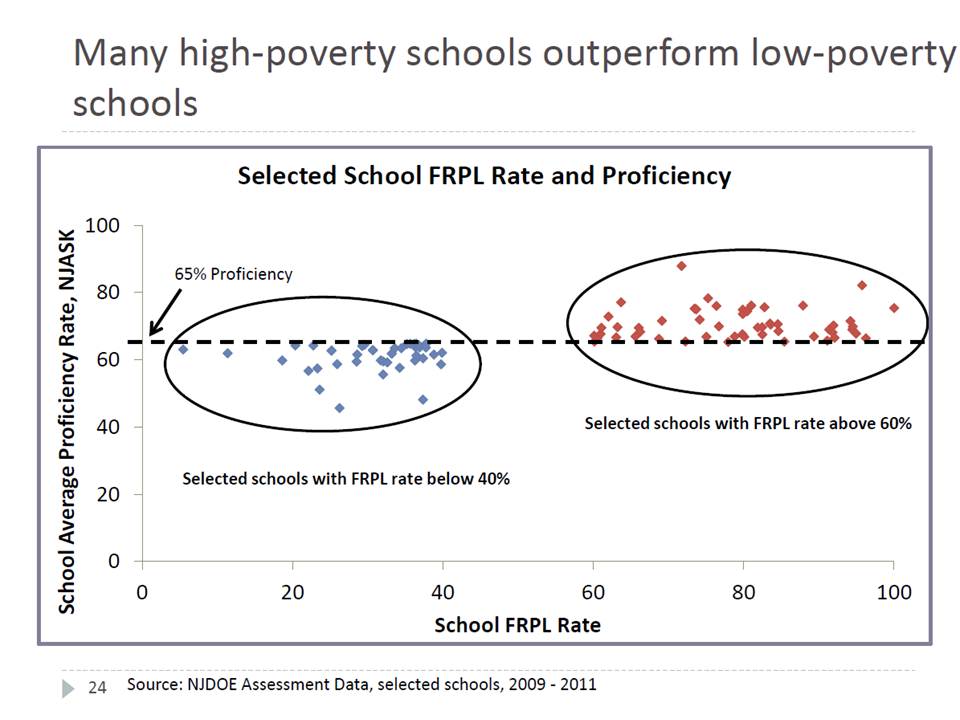
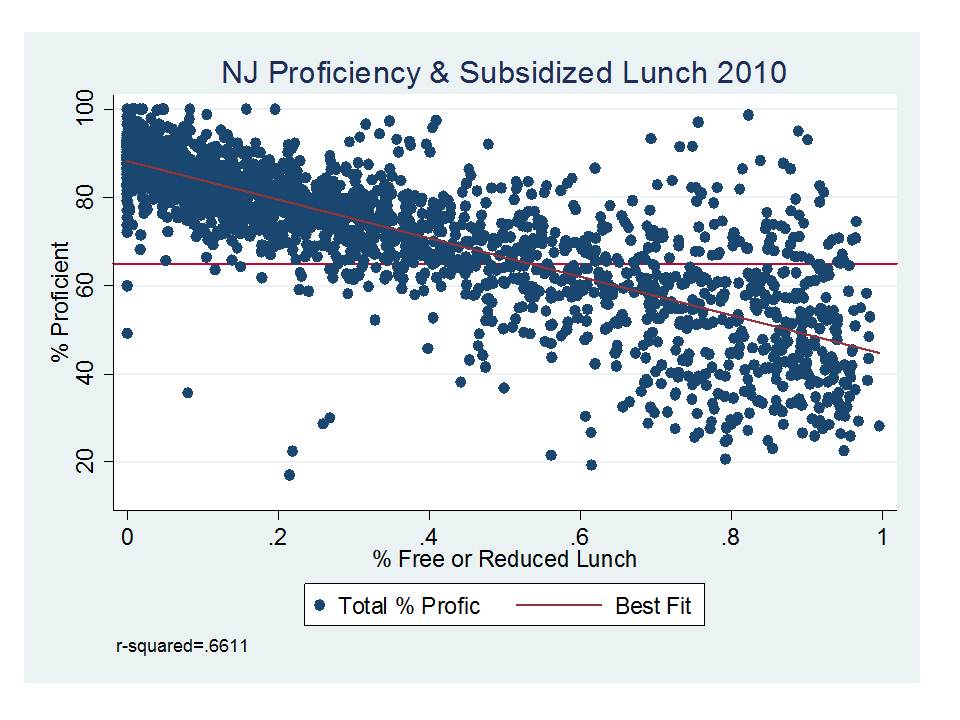
All of this debunking brings me back to the glory days of Cerf's reign over New Jersey's schools. The Commissioner had an uncanny ability to grab a truth and twist it to his will until it lost any objective connection to reality. Take trip down memory lane if you'd like to relive some of Cerf's greatest reformy moments, including the amazing graph that proves poverty doesn't affect test scores!

Cerf World
Planet Earth

It was that casual relationship with reality that defined the Cerf era -- that and a particularly nasty predilection for casting aspirations on the motivations of others. Nice to see he hasn't lost his touch:
More maddeningly -- and this was a central failure of “The New Yorker” piece -- where is the fairness in putting the blame on those who failed to overcome a campaign of knowing falsehoods and vicious ad hominem attacks? Whatever the inadequacies of the engagement efforts, shouldn’t we focus our criticism first and foremost on those elected officials, union leaders, and activists who were pursuing a strategy of deception and vitriol -- who woke up every day seeking to thwart positive change for kids, seeking to prevent the expansion of schools that were getting outsized success for children, seeking to undermine policies designed to increase equitable access to the district’s better schools, seeking to gum up efforts to empower parents with choice, and seeking to thwart all efforts aimed at fostering an honest conversation about which educators were truly superlative and which were badly underserving children? 
Blaming those who failed to completely overcome sabotage rather than the saboteurs themselves feels like a pretty impressive swing and a miss in the coverage.
Mr. Cerf, bad baseball analogies can't save you or Cami Anderson or Chris Chistie from the truth. And that truth is rather plain: One Newark has been rejected overwhelmingly by the community not because they have ulterior motives, but because all the evidence suggests the plan will not work.

While Cerf has spent the last year struggling to get his company to make a product schools actually want, I've spent my free time studying One Newark: see here, here, here, and here. The evidence is, in my opinion, quite compelling: the expansion of charters is unwarranted, the plan has a racially disparate impact on students and teachers, the district did not use good methodologies to identify schools in need of remediation, and NPS did not give its families good information when making school "choices."

For these, and a host of other reasons, the community has said it does not want Cami Anderson's brand of reform. Mayor Ras Baraka, doesn't want it; neither did his opponent in the last election, Shavar Jeffries. The Newark City Council doesn't want it. The Newark School Board doesn't want it. The students don't want it. The parents don't want it. The teachers don't want it. The local clergy don't want it.

Chris Cerf, are you seriously prepared to tell all of these groups, and many other citizens of Newark, that they are "seeking to thwart positive change for kids"? Are you really so sanctimonious, sure so of your own moral superiority, so smug in your convictions, that you are willing to question the motives of all of these people?

Chris, I remember well your confirmation hearing, when you worked yourself into a froth of indignity over Senator Loretta's Weinberg's suggestion that you "sharpen your ethical antennae." How easily you seem to take the slightest offense at anyone daring to suggest you have any but the purest motives -- all while casually trashing the integrity of those dare to disagree with the policies you set in motion.

Good luck in the private sector, Mr. Cerf. Maybe stay there a while longer...

As always: accountability begins at home.

ADDING: Classic Cerf:
Charters are open to all (as opposed to several elite traditional public schools in Newark and many county vocational education schools across the state); they are free; they are accountable to publicly elected authorities; with only trivial exceptions, they are not-for-profit; they select students by random lottery if oversubscribed; and they are subject to the same constitutional and civil-rights scrutiny as any other public entity. [emphasis mine]
Yes, charter schools are not-for-profit -- except for those cases in which they're for profit! Makes complete sense.

But those for-profit charter firms are" trivial." You know, like the virtual schools Cerf's good buddy, Cory Booker, brought to Newark. Or the Camden charter run by throne of the biggest Republican donors in the state of Pennsylvania.

Or the company Cerf himself ran before going to NYC. Trivialities, really....

Wednesday, November 26, 2014

My Dumb Common Core/PARCC Question

I teach music. I have no expertise in the teaching of language arts or mathematics. So maybe someone will help me out with this question:

When I look at the Common Core math standards, I see bands for Kindergarten through Grade 8 -- but not for Grades 9 through 12.

The K-8 Standards are quite precise: Kindergarten, for example, needs to work with numbers 11-19 (I guess we just assume they come into school knowing 1-10...), Grade 1 goes up to 120, Grade 2 to 1000, and so on.

Again, I have enough experience and training as an educator to know I don't have a well-informed opinion as to whether that is developmentally appropriate (would that others had my humility). But let's assume this is a reasonable, evidenced-based sequence. Is it not based on an assumption that all Kindergarteners have the prerequisite education and capability to work with two-digit numbers?

Yet we know that that 5-year-olds have wildly varying readiness for school:
Access to high-quality preschool is particularly needed for low-income children of color, who often start kindergarten behind their peers. By school entry, the gap between the wealthiest children and the poorest children is already pronounced. Children from low-income families are a year or more behind their more advantaged peers. By age 4, low-income children have heard 30 million fewer words than children from more-affluent families and have vocabularies that are half as extensive. The gaps that start at an early age only grow larger, and catching up becomes ever more difficult. By the first grade, for example, there is a full one-year reading gap between English language learners and native English speakers—a gap that increases to a two-year gap by the fifth-grade.
Now, I'm all for high standards, and I don't think we should accept the premise that children who start out behind will inevitably remain behind. I think the way we're currently addressing the issue is stupid, pernicious, and an insult to the teaching profession... but in the spirit of the holiday, I'll put that aside and get back to my question:

The folks who embrace the world view exemplified by the Common Core seem to think it's absolutely essential that we set a "rigorous" standard for 5-year-olds, whether they are ready to meet that standard or not. Then they seem to think that standard should continue to be set each year -- regardless of whether students of varying backgrounds or skills can meet it -- all the way until Grade 8.

And then...

As if by magic, when students get to high school, the notion of a universal grade level standard thrown out the window!

Suddenly, it appears to be just fine that some freshmen take Algebra I, some take Geometry, and some take Algebra II. It seems acceptable that some upperclassmen head on a track toward calculus in high school, and some don't. Even the College Board seems OK with the idea that some calculus students should take harder (BC) calculus, and some should take an easier version (AB).

If differentiation in learning trajectories is OK at the high school level -- even within the Common Core standards -- why isn't it OK at the beginning of a child's education, when the differences in school readiness, ability, and development are so great?

This is a question that is so obvious to me that I can't believe no one has addressed it; therefore, I've convinced myself it must be dumb. Except my own experience and training tell me it's not. Young children are hugely different in their reading, mathematics, music, artistic, physical, and other skills. I see this every day; everyone who works in Pre-K-5 schools knows this. So why is it OK to differentiate instruction, testing, and accountability in high school, but not in the grades below?

The PARCC tests, which are aligned with the Common Core, actually have two different "pathways" for mathematics. I don't have a problem with that -- I'm only asking why we have decided 15 is the mystical age at which sorting in mathematics is warranted. Why not 13? Or 11? Or 5? Where is there any evidence that this is appropriate?

Where is there any evidence that holding the teachers of Grade 6 mathematics accountable for their students' results in a universal test is appropriate, but doing the same for Grade 10 teachers is not?

Someone help me out here. Please.

Jersey Jazzman ponders the Common Core (artist's conception).

Sunday, November 23, 2014

Shorter @tomamoran: We Had To Destroy Camden to Save it

The fact that Tom Moran gave himself gobs of print space in the op-ed section of today's Star-Ledger solely for the purpose of kissing South Jersey Democratic boss George Norcross's posterior pretty much tells us all we need to know about that newspaper's sad decline.

But I just want to point out a few things for the record that Moran, as usual, completely misses:

- Let's start with Moran's rather selective memory about the history of policing and Camden:
For the drug dealers and gangs, things got even better when Camden was hit by the double-whammy of the Great Recession and cuts in state aid. City leaders raised taxes by 23 percent in 2011, but with so little property to tax, it wasn’t enough. 
They went begging to the police for concessions, but the union wouldn’t budge. So despite the crisis in violence, nearly half the force was laid off in 2013. Violence, predictably, exploded. Response time mushroomed to 60 minutes.
You'll notice that Moran's construction, true to form, glosses over the massive cuts in aid to Camden Chris Christie made -- all while lowering taxes on the wealthy and handing out tax goodies to corporations -- and instead places most of the blame on public workers.

Moran goes on to catalog the many alleged abuses of Camden's Finest, neglecting to mention that these brave men and women went out every damn day into what is arguably the most dangerous city in America, risking their lives. When's the last time Moran ever wrote an op-ed thanking these people for their work, instead of publicly shaming them?

I won't pretend there aren't bad cops and I won't pretend there weren't abuses -- I honestly don't know if there were. But Moran's blithe dismissal of the police is typical of his smug attitude toward unionized public workers: if there's a fiscal problem, it's always our fault.

It never, ever crosses Moran's mind that maybe if we raised taxes on folks like Norcross and his other billionaire buddy, David Tepper, cities like Camden wouldn't face a continuing string of crises.

- If you really want to know the story of the Camden police, read Matt Taibbi's excellent article last year for Rolling Stone:
The city for decades hadn't been able to pay even for its own cops, so it funded most of its operating budget from state subsidies. But once Christie assumed office, he announced that "the taxpayers of New Jersey aren't going to pay any more for Camden's excesses." In a sweeping, statewide budget massacre, he cut municipal state aid by $445 million. The new line was, people who paid the taxes were cutting off the people who didn't. In other words: your crime, your problem. 
The "excesses" Christie was referring to included employment contracts negotiated by the police union. A charitable explanation of the sweet deal Camden gave its cops over the years was that the police union had an unusually strong bargaining position. "Remember, this was the only police force in South Jersey whose members regularly had to risk their lives," says retired Rutgers-Camden professor Howard Gillette. The less-charitable say these deals were the result of a hey-it-isn't-our-money-anyway subsidy-mongering. Whatever the cause, until Christie came along, the Camden police had a relatively rich contract, with overtime up the wazoo and paid days off on birthdays. If a cop worked an overnight, he got a 12 percent "shift enhancement" bump, which made sense because of the extreme danger. But an officer who clocked in at noon under the same agreement still got an extra four percent. "Every shift was enhanced," says a spokesman for the new department. 
But a big reason that Christie hit Camden's police unions so hard was simply that he could. He'd wanted to go after New Jersey urban schools, which he derided as "failure factories." But a series of state Supreme Court rulings based on a lawsuit originally filed on behalf of students in Camden and three other poor communities in the Eighties – Abbott v. Burke, a landmark case that would mandate roughly equal per-pupil spending levels across New Jersey – made cuts effectively impossible. The courts didn't offer similar protection to police budgets, though. By New Year's 2011, the writing was on the wall. After Christie announced his budget plans, panicked city leaders got together, pored over their books and collective-bargaining agreements, and realized the unthinkable was about to happen. Camden, a city that even before any potential curtailing of state subsidies made Detroit or East St. Louis seem like Martha's Vineyard, was about to see its police force, one of its biggest expenditures, chopped nearly in half. 
On January 18th, 2011, the city laid off 168 of its 368 police officers, kicking off a dramatic, years-long, cops-versus-locals, house-to-house battle over a few square miles of North American territory that should have been national news, but has not been, likely because it took place in an isolated black and Hispanic ghost town. [emphasis mine]
The New York Times, back in 2011, reported on how the cuts imperiled the city:
But after the layoffs of 163 police officers, Camden is feeling the impact. Callers to 911 who report things like home burglaries or car break-ins are asked to file a report over the phone or at police headquarters; officers rarely respond in person. “If it doesn’t need a gun and a badge at that location,” officers are not sent, the city’s police chief, J. Scott Thomson, said last week. 
Residents have taken their own precautionary measures. One homeowner, Randolph Norfleet, has used the heavy snow this winter as a deterrent to local drug dealers, shoveling each storm’s accumulation onto the footpath where the dealers lurked alongside his home. 
Police headquarters now sits nearly empty, its front reception window sometimes closed, as most of the department’s staff has been pushed onto the street for patrol duty. Detectives cannot devote as much time to investigations; a widely praised bicycle unit was disbanded. Even the canine unit lost two of its three dogs. 
[...]
The layoffs of 163 officers came at a time when the South Jersey city of 80,000, long a symbol of urban blight — it has no movie theater, few supermarkets and a severe shortage of jobs — had finally started to feel safer, residents say. In each of the last two years, Camden recorded fewer than 40 murders, significantly less than the 54 murders of 2008, when the city was ranked the most dangerous in America, according to a widely quoted survey. 
Then a $14 million deficit in the Police Department’s budget, combined with failed union negotiations, led to the unthinkable: laying off officers in a city that clearly could benefit from more police, not less. The layoffs left Camden with 204 police officers, its smallest department since 1949, when a mentally ill man, Howard Unruh, shot to death 13 of his neighbors in East Camden. 
[...]
Chief Thomson, 39, has cut his salary by $15,000 and hits the street himself — he personally has made about five arrests since the layoffs. 
Still, at times, the department is fielding as few as a dozen patrol cars during the day, according to three current officers who spoke on the condition of anonymity because they were not authorized to discuss department staffing. 

Two takeaways: first, the takeover of the Camden police was never about "reforming" the department. Chris Christie wanted to slash Camden's police costs so he could slash taxes on the wealthy -- period. Let's not pretend for a second there was anything else going on.

Second: how many people in Camden literally died so Christie could play games with the city's budget? If anyone really believed the Camden police -- again, assuming a higher level of risk than any other force in the region -- had somehow become too fat and lazy on the backs of New Jersey's taxpayers, that's one thing.

But it's insane to think the only way to reform the contract was to decimate the police and let Camden become a war zone. Camden is not Bến Tre; it didn't have to be destroyed to save it. The city, according to the Times, had actually made some progress before Christie came in and busted the police union.

The thought that Chris Christie destroyed an American city's police department, and put tens of thousands of lives at risk, just so he could bust a union should not make Tom Moran want to cheer -- it should make him feel disgusted.

- I don't know what George Norcross's role was in all this; Taibbi doesn't mention him once in his article, and Moran doesn't clearly state how Norcross influenced the deal. But Moran, as always, doesn't understand how to measure the outcomes:
From 2012 to 2014, the rates of murder and rape have dropped by half. Assaults with guns have dropped by nearly one-third, and robberies are down 12 percent. Police response time has dropped to 4.5 minutes.
Tom, the appropriate comparison is not from 2012, after Christie gutted the police force; the appropriate comparison is to the time before Christie callously slashed aid to the city. Again, the Times reported the city was on the right track.

An actual journalist would look into whether that's true.

- And an actual journalist wouldn't let stuff like this fall down into the memory hole:
For several years, even as the Camden city administration warned that it was unable to financially support its police department, more than half of $12 million in federal and state grants that poured in during that time lay unused.
Most of that money couldn't be used because the city failed to keep police staffing at levels required by the grants.
But more than $500,000 in grant money that the city was free to use sat around for two years until recently when the police department purchased various items, including new cars, portable radios, and tires, according to an Inquirer analysis of police-related grants the city has received since 2009.
In addition to the unused grant money, the city also had $1.8 million in money from a 2001 municipal bond issue lying unused that it recently decided to divert from the fire department to fixing the police administration building.
The beneficiary of the city's newfound largesse is the new Camden County Police Department, whose metro division took over policing in the city this month.
The city has leased the administration building to the county for $1, and it has also transferred the former department's equipment to the county for $1.
"It's amazing how we say we don't have money and now all of a sudden we have all this money to spend," said Councilman Brian Coleman, who has been critical of the way the new county police force was assembled. [emphasis mine]
Amazing, indeed. And amazing Tom Moran never thought to ask Norcross about any of this.

- Finally, what would a Tom Moran column be without an ode to charter schools?
Norcross had seen that state takeovers in Newark, Paterson and Jersey City did not lead to dramatic improvements. And he saw that the rapid growth of charters in Newark had fed a political backlash that threatens the whole reform effort.
“You can learn from the mistakes other people make,” he says. 
His crew came up with Renaissance schools, a hybrid between conventional ones and charters. These are neighborhood schools where local kids are assigned, as in traditional schools. But Norcross recruited the most successful charter organizations to run them. So you get the innovation, but not the trauma of shifting kids to strange neighborhoods, as in Newark. 
“When George came knocking, we politely said, ‘No thanks,’” says Drew Martin, who is running one of three new Renaissance schools in the city. 
Martin is part of the KIPP network, a charter chain that is working miracles in Newark, where its one high school sends more African-American males to college than the entire city of Camden does.
We've been over this about a million times: KIPP/TEAM may be a fine school, but it is not "working miracles." It serves a different student population, with fewer special needs students than NPS. It benefits from serving a larger proportion of children who, while certainly in economic disadvantage, are not in the deeper disadvantage found in most NPS schools.

Another charter operator coming into Camden, Uncommon Schools, has very high rates of attrition. Mastery, the third charter management organization, is well-known for its discipline practices, requiring "submission, obedience, and self-control."

It's also worth pointing out that TEAM spends quite a bit on its schools and students. This is a good thing, but it certainly tempers any claims of "working miracles."

But acknowledging any of this wouldn't get Tom Moran the story he wanted, would it? Because Moran isn't so much a journalist as a scriptwriter. He makes movies starring brave, noble plutocrats like George Norcross, and evil shadowy villains like police and teachers unions.

I'll admit that the legacy of George Norcross is complex. It's hard to imagine where Camden would be today without Cooper Health Systems. Norcross's machine keeps South Jersey in the Democratic column, and that has national implications. I'm even willing to wait and see what happens with the Renaissance schools, although I will never relent in pointing out that Camden's own citizens should have made the call as to whether they wanted to charterize their district or not.

But Tom Moran's column today is not a serious exploration of Norcross's legacy. It's just another worthless paean to wealth; another useless smooch on the rear-end of plutocracy, at the expense of unionized public workers.

No wonder the Star-Ledger continues to circle down the drain...

Tom Moran never met a billionaire he didn't love!