I will protect your pensions. Nothing about your pension is going to change when I am governor. - Chris Christie, "An Open Letter to the Teachers of NJ" October, 2009

Thursday, October 9, 2025

When It Comes To School Finance, Ciattarelli Doesn't Know Jack: Part 1

Jack Ciattarelli is running for governor of New Jersey. You would think that, in a highly-educated blue state, a Republican would take the time to educate himself about two of the biggest issues facing the voters: education and taxes.

But as his campaign has unfolded, it's clear Ciattarelli doesn't know jack:

What are your plans for lowering property taxes? Will it include revising the school funding formula?

Our property taxes are the highest in the nation, not necessarily because of municipal and county budgets, upon which [a governor has] no real power. Where I could have real influence is the school tax, and that’s because of state aid. So, we need a new school funding formula. The current one is nefarious. It’s arbitrary and violates the equal benefit clause of our state constitution that says no community is supposed to suffer at the expense of another. So, with a more equitable distribution of state aid, we can lower property taxes. The cost per pupil in a place like Newark is $37,000, while the state average is $16,000. No one can justify to me that a particular student needs $21,000 more per year to educate them. That makes a compelling case why the current formula is unfair. Does that mean I will leave a community or student behind if that school district isn’t performing well? No. I believe in a voucher system, like we’ve seen in Arizona, Ohio, and Florida. I also believe in school choice, and charter schools to achieve that objective. 

We'll get to the false promises of school "choice" soon enough. What I'd like to focus on instead is that "$37,000" per pupil spending figure from Newark. Where does it come from? Is it accurate?

I'm tempted to let Ciattarelli off the hook here, because there is an ostensibly reliable source for the claim. The National Center for Education Statistics lists the per pupil spending for Newark as $36,862 in 2021-22. But there's a well known problem with this data: it often includes charter school payments in its expenditures but excludes charter schools students in its enrollment counts. This can—and in Newark's case, does—inflate the per pupil spending figures for districts with lots of charter schools.

(If you really want to get into this, see my note below.)

So Ciattarelli is using a figure from an otherwise reliable source, but one that isn't valid for comparisons. I'd let him slide... except there are plenty of other ways to verify the claim, and it's obvious he didn't care to (which I think says a lot about how he would run things as a governor). 

Let's use the best national data source available: the Annual Survey of School System Finances (F-33) from the Census Bureau. (These are average sweighted by enrollment.)

DistrictTotal Current Spending, FY2023Pct. Poverty, 5-17 yer-olds (2023)Pct. English Language Learners (2023)
Newark City$28,63130.0%21.6%
All other NJ districts$25,40811.2%8.3%

Yes, Newark spends more than the average New Jersey school district—but not $21,000 more. But there's something else...

I've included the childhood poverty rate and English Language Learner rate for Newark and the rest of New Jersey.* Newark's poverty rate is nearly three times as much as the rest of the state. Its ELL rate is also nearly three times the rate found in other NJ districts.

We know for a fact that schools enrolling more children in poverty and English Language Learners need more resources to provide those children with equal educational opportunity. Newark and other cities need more funding for their schools because they serve the most disadvantaged children.

Now, there's very good reason to believe the state is not providing the extra funding these schools need. I'll say more on this in a bit, but for now, let's acknowledge that Jack Ciattarelli has his facts wrong: Newark does not way outspend other districts in the state, especially given the challenges facing its student population.

If Jack is going to run the state in the slipshod way he runs his campaign, New Jersey ought to take a hard pass. We already had a Republican governor who played fast and loose with the truth when it came to public education, and it didn't work out so well.


A note about federal school finance data and charter schools: States have all sorts of ways of funding charter schools. In New Jersey, the funding for each student enrolled in a charter is "passed through" the student's resident school district to the charter school; in other words, the local tax revenue and state aid for the district goes through the district to the charter.

In the NCES data, these payments are counted as expenditures for the district. But the charter school students aren't counted in the total number of students enrolled. This means the spending on a charter school student's education gets added when calculating the per pupil spending figure for a district, but the student themselves is not included.

The upshot is that per pupil spending is inflated. That's the problem with Ciattarelli's figures.

Again, I could almost forgive this: it's an obscure point and it would be easy for someone to make this mistake... IF they didn't bother to check their work against other sources. Ciattarelli clearly didn't. I want better from my next governor, don't you?


* Source: The School Finance Indicators Database.


Sunday, October 5, 2025

NJ Governor's Race and Education, Part 2: Should NJ Become Mississippi?

Here's Part I of this series.

We're in the middle of a governor's race here in New Jersey, and the Republican candidate, Jack Ciattarelli, is saying some highly questionable things about NJ's schools.

Jack Ciattarelli: We do have the most segregated schools, but I wonder if we would be having this discussion if the performance of schools with predominantly black student populations were outperforming schools with predominantly white populations. We need to get back on day one to improving all of our schools, and I intend to do that with a high-impact curriculum. New Jersey recently slipped from two to 12 on the national report card. Most of that’s because we haven’t made up for all the learning lost when Phil Murphy and the Democrats shut down our schools for two years. We opened up our nursing homes, and we closed down our schools. Louisiana and Mississippi have moved significantly—Louisiana from 48 to 32 with a high-impact curriculum. What is that exactly? If your child is behind a grade level in any of the critical life skills, like reading, writing, or math, that child will spend the next marking period and the one thereafter doing nothing other than reading, writing, and math to get them on grade level. The data is clear. I’m a data-driven guy as an MBA and CPA. If the child is not on grade level for reading and writing by the end of eighth grade, more than likely, they will be underemployed their entire life. So while that lawsuit proceeds, let’s pick the schools on day one with a high-impact curriculum. [emphasis mine]
"The" national report card? What is that, Jack? Whose report card? Whose ranking? What year are we talking about? 

An unfortunate fact of our nation's conversation about education is that politicians like Ciattarelli will regularly repeat questionable, unverified talking points like this, and no one—no one—from the media will ever ask for specifics or sources. (To be fair, neither will their political rivals; does Mike Sherrill's staff fact check Jack's claims?)

Ciattarelli's claim is a variation on the "Mississippi Miracle" trope, which, in turn, finds its roots in the "Science Of Reading" movement. Basically, recent boosts in some of Mississippi's scores on national tests (more in a sec) have prompted pundits to claim that the state's embrace of a certain type of reading instruction has transformed the state's schools. As a consequence, politicians of both parties have held up Mississippi as a role model for other states -- including high-performing states like New Jersey.

I'll leave a full discussion of the Science of Reading to experts like Paul Thomas. For now, it's enough to note that many of the claims advocates make about SoR are way, way overblown, and that a lot of people have embraced phonics instruction as if it was abandoned for years, which it was not. But put that aside... let's instead focus on Mississippi—as well as Louisiana and Florida, two other states Ciattarelli has lauded. Have they seen their test scores rise while New Jersey's fell?

Before answering, we first have to understand that each state has its own accountability tests, aligned to different learning standards and testing different content. There are very few ways to directly compare test scores in one state against another, because there aren't any tests given to all children in all states. 

The closest thing we have to a national test that allows comparisons between states is the National Assessment of Educational Progress, often called the nation's report card. The NAEP is not given to every child in the nation, but to a representative sample of students in 4th, 8th, and 12th Grades.*

The two main tests are in math and reading. We'll start with the Grade 4 reading test: how is Mississippi doing compared to New Jersey? In fact, Mississippi is catching up:
There's no doubt that Mississippi, and Louisiana, have seen significant growth in Grade 4 reading scores. There's also no doubt New Jersey has seen a decline over the past several years. Of course, so has Florida, another state often touted as an educational "miracle." For that matter, the nation overall has seen declining scores since 2015.But did you note where NJ stands as of 2024? NJ is still above the nation, and above Ciattarelli's preferred states, on Grade 4 reading scores.Pundits often cheer for the "growth" Mississippi has shown in its 4th Grade scores. But go back to 2003—see how low the state was? This is a key point that gets lost: It's much easier to grow your test scores when you start off low, because you literally have no where to go but up!Now, unlike some others, I'm not prepared to completely dismiss Mississippi's test score rise in Grade 4, especially because there's also growth in math scores.

This is interesting, because I've yet to hear anyone talk about the "Science of Math." It could be better reading ability helps students perform better in math. It could be Mississippi made changes in math instruction. It could be that Mississippi was so bad back in 2003 that simply changing standards to better align with the NAEP led to gains that were fairly easy to achieve. It could also be that demographic changes in student populations had an effect.

In a typically sober and fair article, Matt Barnum looked at a variety of potential courses for the gains, including Mississippi's Grade 3 retention policy. Matt's more skeptical about retention's potential effects than I am, but OK, there's certainly room here for discussion. 

What there is no evidence of, however, is that Mississippi has been taking kids out of every class but math and reading and writing when they don't read on grade level—which is Ciattarelli's plan. 

Where did Ciattarelli even get this insane idea? He's says he's a "data-driven" guy; OK, where's the data to support this? Are we seriously thinking of denying kids music and art and PE and science and social studies and tech and all sorts of other mandated subjects because "data-driven" Jack believes that's what they do in southern states? Where is his evidence? Isn't it fair to ask?

Furthermore, if Jack is so "data-drive," why hasn't he looked at the NAEP results in Grade 8? Because they tell a very different story.


The highly-praised 4th Grade test score "growth" in Mississippi is almost completely missing in Grade 8. And, yes, New Jersey has seen declines since 2017—but so has the rest of the nation. And yet New Jersey still sits at the top of the heap.


Same story in math: test score losses post-pandemic across the board, but New Jersey is still a top performer.

Think about it this way: Suppose you are offered a brand new house anywhere you want to live in the US. The catch is you have to send your kids to public school. Which state are you going to choose, based on these scores? 

As I said in the last post, New Jersey has a lot of work to do on its "opportunity gap." But it has been, and remains, a relatively high performing state. We should be extremely cautious about throwing that advantage away by emulating states that may have had a few gains, but continue to struggle in many other ways.

Let's talk about Jack and school taxes next.

* Most researchers put little stock in the 12th Grade tests as 17-year-old students have no incentive to perform well on them. 

Saturday, October 4, 2025

NJ Governor's Race and Education, Part I: Should NJ Become Mississippi?

Is this thing still on?

I've got some thoughts I want to share about the NJ governor's race and education over the next few weeks, so I'm firing up this blog again. Hopefully, advocates for NJ's public schools will find these posts helpful.

Let's start this by examining a claim by the Republican candidate, Jack Ciattarelli:

Jack Ciattarelli: We do have the most segregated schools, but I wonder if we would be having this discussion if the performance of schools with predominantly black student populations were outperforming schools with predominantly white populations. We need to get back on day one to improving all of our schools, and I intend to do that with a high-impact curriculum. New Jersey recently slipped from two to 12 on the national report card. Most of that’s because we haven’t made up for all the learning lost when Phil Murphy and the Democrats shut down our schools for two years. We opened up our nursing homes, and we closed down our schools. Louisiana and Mississippi have moved significantly—Louisiana from 48 to 32 with a high-impact curriculum. What is that exactly? If your child is behind a grade level in any of the critical life skills, like reading, writing, or math, that child will spend the next marking period and the one thereafter doing nothing other than reading, writing, and math to get them on grade level. The data is clear. I’m a data-driven guy as an MBA and CPA. If the child is not on grade level for reading and writing by the end of eighth grade, more than likely, they will be underemployed their entire life. So while that lawsuit proceeds, let’s pick the schools on day one with a high-impact curriculum. [emphasis mine]

We'll leave aside several other... questionable claims here and focus instead on Ciattarelli's comparison between New Jersey and two southern states: Louisiana and Mississippi. The clear implication is that they are doing something right, and NJ is doing something wrong. 

I'll get to trends in a future post; for right now, let's instead look at where these states are today. I'll throw in Florida as well, because I've heard Ciattarelli make similar claims about it. I'll also add national averages for context.

The source for comparisons here is the National Assessment for Education Progress, generally considered the gold standard national assessment. The NAEP is given to a representative sample of Grade 4 and Grade 8 students in all states; the tests are in math and reading.

We'll start by looking at the state-level average outcomes in these four exams for all students. The data is from 2024, the last administration of the NAEP.

NAEP: All Students, 2024
Gr 4Gr 8
MathReadingMathReading
Florida243.4218.2267.2252.9
Louisiana234.5216.0266.8256.5
Mississippi239.2218.5269.1253.5
National237.5215.0273.8258.0
New Jersey240.1221.6281.7266.0


To help interpret these tables, I've put the states that beat NJ in green, and the ones that lose to NJ in light red. What do we see? In nearly every exam and grade level, New Jersey outperforms Florida, Louisiana, Mississippi, and the national average.

It's difficult to convey the scope of the performance differences, but let's try this: Typically, a standard deviation on the NAEP is between 30 and 40 points. A standard deviation is also around the difference in test scores found between the highest- and lowest-income students. So the gap between the FL and NJ average in Grade 8 reading is roughly one-third to one-half of the difference between the least-affluent and most-affluent students. That's significant.

Note that the gap in scores is wider in Grade 8 than in Grade 4. We have to be cautious about reading too much into that, but we should at least consider the possibility that as students get more schooling, the differences between NJ and the southern states gets larger. That's a good thing for the Garden State.

Let's consider two other student populations. Here are the scores for students who qualify for free or reduced-price lunch (FRPL), a proxy measure of poverty.

NAEP: Economically Disadvantaged Students, 2024
Gr 4Gr 8
MathReadingMathReading
Florida234.7209.6258.4244.8
Louisiana227.6208.8257.6249.6
Mississippi233.8211.9262.4249.0
National225.9202.0257.5244.6
New Jersey221.9201.8259.2247.4


New Jersey doesn't do nearly as well in the Grade 4 tests... but the gap closes, and even reverses a little, in Grade 8.

How the NAEP measures "economic disadvantage" is a complicated topic I'll get to some time. For now, it's enough to say that the level of relative economic disadvantage for FRPL students in different states is not the same; for that reason, it's difficult to compare states on this measure without some transformation of scores (and even then...).

There also an issue about grade retention and its effect on test scores. But let's set that aside and concede that NJ has work to do to close its opportunity gap. That begs a question: how do the students who don't qualify for FRPL fare on the NAEP?

NAEP: Not Economically Disadvantaged Students, 2024
Gr 4Gr 8
MathReadingMathReading
Florida252.9229.7277.0262.5
Louisiana253.7236.0288.9274.2
Mississippi256.0238.2287.7265.3
National251.1229.2288.0269.5
New Jersey254.1236.5295.2277.0


Only Mississippi beats New Jersey in this category in Grade 4; however, by Grade 8, NJ is blowing the doors off the others, especially in math.

Does New Jersey have problems with its education system that manifest in NAEP scores? Unquestionably, yes: the opportunity gap in this state is too big and needs to be addressed (Ciattarelli's state aid plan will make that gap worse, but let's talk about that in another post). 

But should New Jersey, on the basis of its NAEP scores, be looking to these southern states as models for reform?

You tell me.

More soon, including a discussion of "growth."


Monday, August 12, 2024

Student "Growth" Measures Are STILL Biased

 This caught my attention:

New Jersey school districts may soon be evaluated differently, with a greater emphasis on student growth as compared to student achievement.

The Department of Education is proposing changes to the New Jersey Quality Single Accountability Continuum, known as NJQSAC, which is used to evaluate the effectiveness of school districts every three years. The accountability system looks at five areas: instruction and programs, fiscal management, governance, personnel and operations.

Several school superintendents pitched their concerns with the current evaluation system at a State Board of Education meeting on Wednesday. Speakers said they support putting a greater emphasis on growth but noted this is just a start, as other issues remain that make it difficult for low-income and high-diversity school districts to earn passing scores. [emphasis mine]

I'll be the first to say that QSAC does need an overhaul -- or, at the very least, a serious review, particularly the "instruction and programs" component. There are always going to be problems when you are trying to assess the behaviors of school districts by assessing the behavior of students, which is what QSAC does. At the very least, we should acknowledge those problems.

For example: Yes, student performance is certainly going to be affected by the performance of school districts. But district operation is certainly not the only thing that causes student test scores to rise or fall. If a school district has proportionally more students in poverty, its test scores will be lower; that doesn't mean it's doing a "bad" job, it's just enrolling more students who are at a disadvantage. 

School leaders in New Jersey get this:

Springfield School District Superintendent Rachel Goldberg said NJQSAC is inequitable and unreliable. She compiled NJQSAC data from the last 18 months and found instruction and program scores are directly correlated to the economics of an area.

“What this means is we are not measuring school quality, we are measuring socioeconomics,” Goldberg said.

This is exactly right; let's look at some examples.


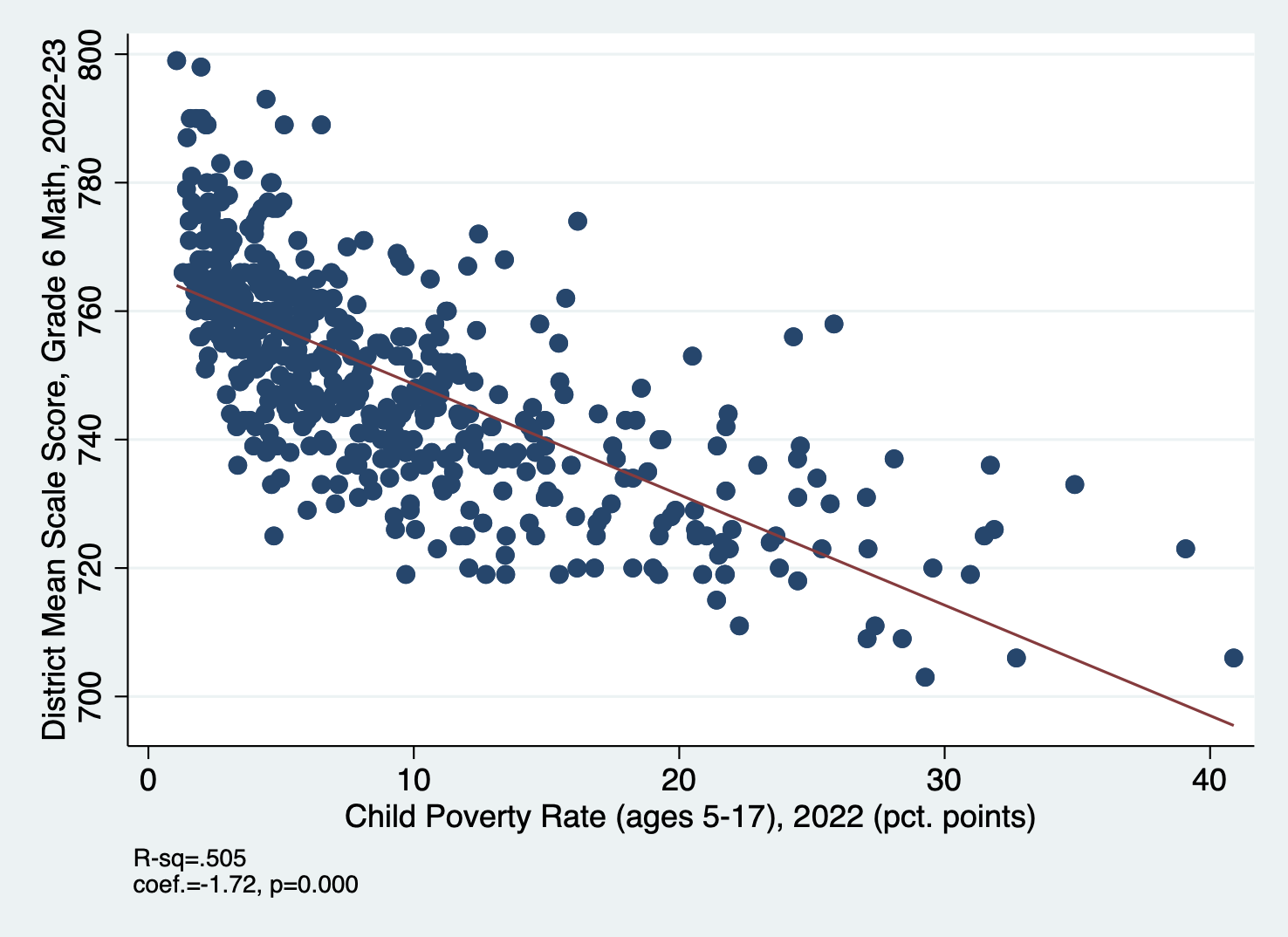
Here are the New Jersey school districts for which we have data* on their child poverty rate and their mean (average) scale score in the statewide 6th Grade math exam. Clearly, as poverty rates go up, test scores go down (it's the same in other subjects and grades). The "R-squared" tells us that half of the variation in test scores can be statistically explained by poverty rates. Yes, districts with the same poverty rate can vary in their test scores: some score higher than predicted, and some lower. But the overall trend is clear: as poverty rises, test scores fall.


Here are Grade 6 math scores against median household income. As we would expect, scores rise when income rises. When Dr. Goldberg says, "...we are not measuring school quality, we are measuring socioeconomics," this is what she means. This isn't fair to school districts, and it needs to be fixed.

The problem is this: what if the proposed solution is also not measuring school quality, but students' socioeconomic conditions?

Under the proposed changes, progress in math and English Language Arts would be worth more points than achievement in math and English Language Arts in K-8 and K-12 schools. Progress would be measured using student growth percentiles, which measure the relative year-to-year performance changes of students compared to other students with similar prior test scores.

The assumption under which this proposal works is that "progress" is not biased the way that "achievement" is; districts with less-affluent populations would have an equal chance with districts that have more-affluent populations to show "progress." 

But when you look at the data*, it's clear that this isn't the case.


Here are growth measures -- known in New Jersey as Student Growth Percentiles, or SGPs -- plotted against poverty rates. Compared to the graph above that plotted test scores against poverty, it's evident that the explanatory power of poverty on growth isn't as great as poverty on achievement -- but there is a correlation, and it's significant. As poverty rises, SGPs fall -- and while the correlation isn't as strong as above, it's still statistically significant (that "p=0.000" note is telling us this). On average, if the child poverty rate in a school district goes up by 10 percentage points (say, from 10% to 20%), SGPs drop by a little more than 5 points.


We can see this also when plotting income and SGPs. Again, the correlation isn't as strong as with income and test scores, but the correlation is there, and it's significant (p=0.000). On average, if district median income goes up $50,000, SGPs rise 3.5 points.

Now, at first glance, that may not sound like a lot. But you've got to remember that SGPs are a relative measure. SGPs rank and order districts (or schools, or students) compared to each other, and not to some objective standard of growth. It is conceivable that all school districts in New Jersey showed some level of growth in test scores, but some districts grew more than others. So some districts are going to get dinged under QSAC, even if their students made progress. Somebody's got to be at the bottom of the distribution.

When SGPs were first introduced into the state, then-Commissioner of Education Chris Cerf assured everyone that SGPs :"...fully take[s] into account socio-economic status..." It wasn't true then, and it's not true now, which is why I and others strongly objected to including them in teacher evaluations.

Why are SGPs still biased? It's complicated (I try to break it down here). The short answer is that test scores are measured with error: sometimes scores from the same student in the same subject vary because of a host of factors that have nothing to do with their abilities (or their teacher's). That error leads to the SGP model understating the predictive power of prior tests on later ones. Again, it's a complex problem -- which just serves to highlight how unfair it is to hold school districts (or teachers, or students) accountable using a metric only a scant few people who are highly conversant in statistical methods and psychometrics understand.

Am I saying we can't use student test scores at all to help evaluate and oversee school districts? Not necessarily. The inventor of SGPs himself has noted that they may not show a causal relationship between district quality and student outcomes, but as a descriptive measure, they could help to identify districts that may be in need of remediation. With appropriate training, the NJDOE might consider using SGPs as a way to better allocate their limited time, using them as a sort of early warning system to point to districts that may need to improve their instruction and programs.

What New Jersey absolutely should not do is come up with some hard-and-fast formula that weights SGPs by some amount, then tag districts that don't come up to a particular threshold. Remember, the core rule for using test outcomes in any sort of accountability system is that there must be a convincing validity argument made for using them in this way, and that higher stakes demand stronger arguments. That has not happened with using any test outcomes as a part of QSAC, let alone SGPs.

A final thought: As we emerge from the pandemic and get back to "normal," we're going to be revisiting a lot of issues in education policy, such as the appropriate use of high-stakes testing. I believe this actually affords us an opportunity to clear up some of the misconceptions and misunderstandings that dogged us for years during the "reform" era. Let's not miss that opportunity.

More to come...


* Poverty and income measures are from the School Finance Indicators Database, which gets the data from the American Community Survey of the US Census Bureau. SGPs and test scores are from the School Performance Reports published by the NJDOE.

Saturday, August 10, 2024

Is This Thing Still On?

Hello? 

It's been a while. And as it turns out, I've still got a few things to say. 

Stand by...

Friday, August 27, 2021

On Remote Teaching and Learning In an Ongoing Pandemic

Some recent stories I've been thinking about (all emphases mine). Tennessee:

Gov. Bill Lee’s administration is getting pushback in Memphis on new Tennessee restrictions that make it harder for district leaders to close school buildings and shift students to remote instruction as pediatric COVID cases climb.

Meanwhile, school board members with Shelby County Schools held a moment of silence Tuesday to remember two students, two teachers, and one young alum who recently died. School officials did not release the cause of death for any of the five.

“We must stand together during this difficult time,” Superintendent Joris Ray said.

A day earlier, district officials encouraged families to direct their complaints to the governor’s office as a petition circulated demanding a virtual option that allows students to stay with their teachers. More than 13,000 people had signed the petition by Tuesday afternoon, and a small group of parents also protested outside the district’s headquarters on Monday. 

“We hear your concerns and understand your frustrations regarding options for remote learning,” said a statement from the district. “Stand for safety with us by contacting Governor Lee and state legislators.”

The call to action reflects the ever-growing divide between the Republican governor and Tennessee’s largest school district over the best way to teach while protecting the health of children too young to be vaccinated. COVID’s delta variant has returned Tennessee’s case numbers to levels not seen since the pandemic’s wintertime peak.

Shelby County leaders said their hands are tied on remote learning options beyond enrolling in Memphis Virtual School. They cited new rules and criteria passed recently by the Tennessee State Board of Education for closing schools and remote learning. 

Those rules allow individual students to switch temporarily to remote instruction if they’re sidelined by the virus, either because of illness or exposure. But districts can’t toggle back and forth with remote learning without an executive order from the governor, according to state officials. School systems that have to close entire schools because of COVID outbreaks must use days usually stockpiled for inclement weather, flu outbreaks, or staffing problems.

New Jersey:

As students head back for a third school year impacted by the pandemic, COVID-19 continues to complicate the education landscape and the impact of remote learning has yet to be fully assessed. As achievement gaps have emerged, many districts are planning to return fully in person learning in hopes of restoring traditional learning, even as safety concerns mount around the highly contagious delta variant.

But remote learning will remain a part of students' lives for the foreseeable future, experts say, with tens of thousands of students in quarantine just weeks into the school year for some. How schools approach remote learning is varied: While some view it as a Zoom extension of the classroom, others are taking novel and holistic approaches to try to improve the quality of instruction.

For now, in-person learning is the only option for students like Cosby's daughter, a rising senior, as New Jersey's governor was among several leaders to require full-time, in-person K-12 instruction this school year. Other large school districts, like New York City, are starting the year without a remote option.

In recent days, however, the New Jersey state education department has issued guidance that "strongly encouraged" schools to provide remote instruction for students during quarantine, NorthJersey.com reported.

Atlanta:

(ATLANTA) — A few weeks into the new school year, growing numbers of U.S. districts have halted in-person learning or switched to hybrid models because of rapidly mounting coronavirus infections.

More than 80 school districts or charter networks have closed or delayed in-person classes for at least one entire school in more than a dozen states. Others have sent home whole grade levels or asked half their students to stay home on hybrid schedules.

The setbacks in mostly small, rural districts that were among the first to return dampen hopes for a sustained, widespread return to classrooms after two years of schooling disrupted by the pandemic.

When the school year ended last year, I was sure we were going to be going back to something relatively close to "normal." But then came Delta, with Lambda and who knows how many others on the horizon. Combined with vax resistance that is, infuriatingly, larger than I expected, and an anti-mask movement fueled largely by inanity on social media, it's clear this year will be anything but "normal."

Which means we've got to come to terms with remote learning; it's not going away any time soon, if ever. For all its faults -- and they are many -- remote learning is a schooling option that can and should be deployed if necessary as a public health measure. 

But the patchwork approach we're taking to remote learning isn't smart policy. We need to start delineating when and why we need remote learning, and then set standards for what it should be. We also need a clear-eyed acknowledgment of the challenges inherent in implementing remote learning, including an accounting of what resources will be necessary to make it work.

I propose we start by laying out some scenarios for when schools will need remote learning:

1) The all-out emergency. This is the Spring of 2020 scenario all over again: a new health threat emerges that is so grave and/or uncertain we have no choice but to fully close down all schools. I think most of us acknowledge the chances are quite good this will happen again sometime in the not-too-distant-future.

What was lacking in early 2020 when we tried this for the first time? Universal broadband connectivity for all students and staff. Devices of high enough quality that instruction could be delivered. Curricular materials suitable for remote learning. Staff training in remote instruction. Student training. Parent training. Support infrastructure. Time flexibility to meet parent/student needs.

I'm leaving out a host of other things that aren't under the control of schools: adequate space for students at home, time off for parents, social services, etc. Remote learning doesn't work without them, but these are issues outside of education policy. And, arguably, so is broadband connectivity. It's clear the internet is now as indispensable to modern life as electricity, and high-speed access should be seen as a necessity.

Getting students devices is probably the easiest challenge to overcome: it's a matter of money and will, although supporting all those devices will require adequate staff. Developing high-quality instruction is another matter. I can see teacher prep programs developing entire courses on the subject, and on-going professional development for teachers will inevitably be focused on improving remote instruction. 

You can probably guess my feelings on this: we already ask an awful lot of teachers. Now we want them to be able to turn their practice on a dime, always ready to jump to another mode of instruction immediately and seamlessly. This means teachers will not only have to add remote instruction planning to their already jam-packed days; they will need to develop skill sets similar to the ones already in demand in other parts of the economy.

If we're going to have a school system that is able to transition to remote learning in an emergency, we're going to have to pony up. We need more resources, we need more staff, and we need to pay teachers for their extra time and the skills they will develop. There's just no way we do this on the cheap.

2) The local response. In this scenario, a local outbreak requires a temporary transition to remote learning for all students in a class, a school, or a district. In some ways, it's similar to the scenario above, except the participants are limited: other classrooms or schools carry on as usual.

The biggest difference I see between the local response and the all-out emergency is that totally going remote may not be the only option. A district or school may opt instead to implement a hybrid schedule, where students rotate their in-school and at-home days. Maybe all students attend in-school part of the day and learn remotely during another part. This was the case for many districts through the last school year, and I believe it's the most likely scenario for a local response to a pandemic.

The "good" news is that at least some of the preparation and planning for the all-out emergency can be transferred to the local response: broadband, devices, training, planning, etc. But, as I discuss below, there is a big difference between teaching everyone on-line and teaching some on-line, some in-person.

Again, adequate resources will be essential in providing accepted local responses. There is an obvious and clear connection between a school district's ability to provide hybrid instruction and its funding. Districts will not be able to provide acceptable remote learning models unless they have the resources to plan and implement them.

3) The individual response. Like everything else, America is divided on whether children should be back in school. Context matters a lot: people who might be comfortable sending their children to a school with mandatory masking may not want their child in a school without it. But even with strict mitigation in place, some families may see the risk to their child -- or other members of the family who are immunocompromised -- as too great.

In addition, a student who is exposed to the virus outside of school might need to quarantine for a while, even if they don't contract Covid. What sort of schooling should they be offered?

I see three possible responses. First, regular classrooms are set up to accommodate remote learners, essentially joining a regular class synchronously via Zoom or Google Meet or whatever. Second, separate schooling is provided to students that is entirely on-line and run by a teacher who only does on-line instruction. Third, some sort of combination of the two.

Each of these has its pros and cons. Teaching some students in-person and some on-line is really, really difficult. The classroom has to be set up to accommodate both sets of students. Lessons have to be planned so that everything students need at home is provided, and so delivery can take place simultaneously to remote and in-person kids. Some subjects -- PE, art, music, lab science -- are almost impossible to imagine being taught with both sets of students in sync. But in this model the students who are remote stay with their classmates and current teacher, which, if they return to live instruction, would make things easier.

Moving students to a separate class might work for those who make a long-term commitment to stay at home. One big advantage is that teachers who are immunocompromised, or who had family who were, would still have a place to teach. It's very difficult to imagine, however, a student who needed to quarantine for a short while benefitting from being temporarily placed into an entirely separate class with a teacher who had no prior experience with that student.

It's also worth noting the structure of school districts may make fully on-line classes harder or easier. Large districts may be able to set up and staff these classes more easily than smaller ones. Small districts may need to pool their resources to reach a critical mass where they can offer these classes.

Finally, it might make sense to have some sort of combination of the two. But no matter the mode of instruction, I believe there are several changes that would have to be made to make them work. Among them:

  • Class sizes will have to be lowered. You can't expect a teacher to give kids getting remote instruction the attention they need in a hybrid setting if the class is already too large. The cues teachers observe and react to during in-person instructions aren't available in remote learning. During hybrid instruction, their focus can't be distributed in the same way it is during in-person learning. Lowering class sizes is the best way to make sure teachers can respond to all of their students' needs in a mixed-mode setting.
  • Staff will need more planning time. If it's coordinating across classes or simply planning lessons with two modes of delivery, teachers can't be expected to add this to their plates without additional time to figure out how to make it work.

I'm not arguing here that remote instruction can't or shouldn't become a regular part of K12 schooling. I am laying out the challenges -- and I'm sure there are many more I haven't thought of -- to make the point that this will not be easy, more resources will be needed to make it happen, and this will take time. 

No one who knows how schools actually work could possibly think we can just rearrange a few schedules and buy a few more laptops and schools will be all set for remote instruction. But if this has to happen -- and I think it does -- we'd better start making plans for it now.

Saturday, May 15, 2021

Lakewood, NJ: Where Public Schools Are Left To Whither, Part IV

In the decade I've been writing this blog, I've seen some really horrible behavior towards teachers (a prime example here). But I don't think I've ever seen anything quite like this:


This is from last September, when the Lakewood Education Association (LEA), the local teachers union, was, like all other local unions in the state, advocating for the health and safety of its members while districts made opening plans. 

Maybe you sympathize with the teachers; maybe you don't. But the truly obnoxious behavior of Michael Inzelbuch, the district's attorney, is remarkable. Inzelbuch wound up apologizing, as he should have, although as far as apologies go this one is awfully weak:

We'll talk later about how Lakewood's school district has responded to the pandemic. For now, let me restate that I believe at least three things will happen when public schools are left to wither, as they have been in Lakewood:
  1. When a large part of a community abandons its public schools, chaos ensues and accountability dissolves.
  2. Segregation is the inevitable consequence of school privatization.
  3. Educators will be disrespected in a community that does not support its public schools. 
#3 is precisely what's happening in Lakewood: a climate of disrespect for teachers working in public schools -- teachers who are educating only a small fraction of the community's children.


Again: Lakewood has highly segregated schools. The majority of residents send their children to private religious schools, mostly yeshivahs. 


The Hispanic minority in the community, however, sends their children to the public schools.


When your child attends a public school, and you actually see what teachers do for students, you're far more likely to appreciate their work and value it. But when the majority of a town's residents don't attend public school, they miss out on that perspective. It's not that they necessarily have disdain for public school teachers so much as they don't have a personal connection; they can't see the value of teachers through the eyes of someone whose own children were affected by them. Teachers might teach other people's kids, but they don't teach their own.

That manifests itself through things like Inzelbuch's embarrassing behavior. But it also may manifest itself in how well teachers are paid. Let's unpack this a bit:

When the majority of a town's children attend the public schools, there are at least two big reasons why residents will care about the quality of those schools. First, they care about the education their own children receive. They'll want good teachers, good facilities, and good administrators, and they'll be willing to pay for them, at least up to a point.

Second, the value of their homes will depend on the quality of the schools. The perceived quality of schools is a major driver of property values, so homeowners have an incentive to make sure that perceived quality remains high. To be sure, there are many negative consequences to this reality, especially because education is a "positional good," but there's little doubt concern about property values is a driver of concern about school quality.

In Lakewood, however, both of these drivers are switched off. The majority of parents in the town don't have a personal stake in the public schools; consequently, home buyers won't pay more for property in Lakewood if the quality of the public schools improve. I'm sure people in Lakewood who have opted out of the public schools don't want them to be "bad," but they have little personal incentive to make sure the those schools are "good" either.

A community like Lakewood, therefore, isn't going to have the same incentive to recruit and retain teachers for its public schools. And teacher salaries will reflect that lack of incentive.


This is a salary model I've used before. Basically, I take every full-time teacher in the state and predict their salary based on things like experience, labor market, job category, and so on. I then compare what the model says they should make to what they actually make; in this way, I can compare Lakewood teachers' salaries "apples-to-apples" with teacher salaries in the rest of the state.

Consistently, year after year, Lakewood teachers make less than what the average teacher makes in New Jersey, holding other factors constant. This is consistent with recent testimony in a trial about Lakewood school funding, which found Lakewood salaries were the lowest in the state compared to similar districts.

I'll write more about this trial in a bit. For now, let me conclude with this: in both their interactions with district officials and in their pay, Lakewood's public school educators are being disrespected. But this is an inevitable consequence of what happens when a community largely abandons its public schools.

More to come.

ADDING: A recent and telling story from this past March:

Most recently, eight Clarke teachers and staff were infected with the virus, including four who were hospitalized, according to Kimberlee Shaw, president of the Lakewood Education Association (LEA), which represents nearly 900 employees. 

But instead of closing the school and switching to all-virtual classes, the district chose to suspend Assistant Principal Madaly Rodriguez-Jones and moved an administrator from another school to temporarily take her place. 

“They should have closed it for two weeks and given everyone the 14-day quarantine,” said Shaw. “They claimed they did put in purifiers, but that was after.”

The Rodriguez-Jones paid suspension, originally set to end March 30, was extended this week to April 30, according to Shaw and the board agenda. District officials did not respond to requests for comment or explain why the move was made. 

[...] 

“I don’t know what the district thinks they know, but this is an ever-changing situation and I felt like my staff members were being blamed for getting COVID,” Shaw said. “And they felt that way, they were upset that it was looking like the district was blaming the teachers.”

But the Clarke situation is just the latest concern for teachers in the 6,000-student district, which is among the few that have remained open for all students since the beginning of the 2020-2021 school year. 

Shaw said that has resulted in 371 positive tests, 214 students and 157 staff, since July 2020, but no school closings or even partial shutdowns.

“It is taking its toll, our staff is tired, they are covering classes because they are short of staff, they are worried about the virus,” Shaw said. “Right now staff is doing their job and trying to stay safe and we are hoping that if another outbreak occurs that the district will reconsider and shut that building, it worries the staff, they feel they are not being notified.” [emphasis mine]

I ask you: does this sound like a district where teachers feel respected? 

ADDING MORE: This should come as no surprise:

LAKEWOOD - More than 30 school district teachers are being let go at the end of the school year without clear explanation or cause, according to teachers’ union leaders who say the move is occurring at a time when the district faces a teaching shortage.

“We had staffing shortages before the pandemic and the pandemic only exacerbated it,” said Lakewood Education Association President Kimberlee Shaw, whose local represents more than 700 teachers and staff in the 6,700-student district. 

[...] 

“It’s chaos for our students,” added Shaw. “They crave routine and stability. They never know who their teachers are going to be from one month to the next. It’s stressful for all of us and makes me worry about our students’ safety and continuity of instruction.”

In a release, the LEA stated that more than 100 staff members had left the district since June 30, 2020. “The district has a history of firing non-tenured teachers without cause,” the union release added. “Most of these teachers and staff members report being ‘blindsided’ by their non-renewals since they had positive evaluations and no history of disciplinary issues.”

“Meanwhile, they’ve had little to no support from the district through mentoring or professional development. The district also lost nearly its entire guidance department and Child Study Team at the high school at a time when student mental health is at crisis level and the district is implementing a new Social-Emotional Learning initiative.”