I will protect your pensions. Nothing about your pension is going to change when I am governor. - Chris Christie, "An Open Letter to the Teachers of NJ" October, 2009

Wednesday, December 2, 2015

Return To Teachers Village, Part II: Who's Teaching At Teachers Village?

Here are links to all of the posts in this series:

Part I - Introduction
Part II - The Teachers
Part III - The Students
Part IV - What's It Costing Us?

 * * *

Just exactly how much money have taxpayers put into Teachers Village?
The project received nearly $40 million in tax credits from the state Economic Development Authority and $60 million in federal New Markets tax credits as well as Qualified School Construction bonds. It also received public funding from Newark and the Casino Reinvestment Development Authority.
Goldman Sachs, Prudential Financial, TD Bank, Brick City Development, New Jersey Community Capital and others provided private equity, as well as billionaire investor Nicholas Berggruen.
Between grants, tax breaks, and government-backed bonds, the public has paid quite a bit to make Teachers Village a reality. But what have they received in return? The developers of TV would have us believe they have, thanks to the largess of the taxpayers, created a new sort of complex that will attract and retain the sorts residents necessary for Newark's revival:
If Ron Beit has his way, the next big thing in urban renewal won't come from any of the political elite or the CEOs in cocktail attire who gathered in a parking lot here Wednesday morning for the ribbon-cutting on his latest project.
It will come from teachers.
A founding partner and CEO of the Newark-based developer RBH Group, Beit said his shift in vision came from walking into THRIVE Academy, a charter school in Newark's central ward. 
"I was blown away by the work they were doing," he recalled. "The teachers were really energizing, they were focusing on education -- I want to harness that energy. These people were top of the class, they could go anywhere for jobs, but chose to go into Newark and teach." [emphasis mine]
So getting teachers to live in Newark, and not just work there, is one of the major rationales for the project:
The idea is to create a community of teachers who will live in the apartments, shop at the stores, teach at nearby schools and meet with other teachers and their families in plazas designed for collaboration. Their presence will bring energy -- and disposable income -- to the now run-down area.
Designed by star architect Richard Meier, famous for the Getty Center in Los Angeles and the Barcelona Museum of Art, the Teachers Village looks somewhat out of place rising clean and new from Newark's streets. 
But Beit believes the development will "catalyze" the neighborhood; his logic goes that bringing middle-class residents to the city's depressed downtown en masse is a recipe for a mixed-income, and more vibrant, city.
OK, fair enough... so long as the teachers living and working in TV are, indeed, invested in Newark's prosperity and in the teaching profession. But who, exactly, is living and working in Teachers Village?

We don't have any data, other than what Beit chooses to release, that tells us about the residents of TV. According to his letter to The American Prospect (which I highlighted in Part I of this series), only about 12 percent of the residents are Newark Public Schools teachers, working for the district. More than double that are charter teachers (about 26 percent); about 30 percent are tutors with a one year commitment working for Great Oaks charter school.

There are three charters housed in TV: Great Oaks, Discovery Charter School, and one of the schools that is part of the TEAM/KIPP network in Newark. According to staffing files from 2014-15, here are the numbers of certificated staff:

LEACertificated Staff, 2014-15, Newark, NJ Schools
NPS3870
TEAM-KIPP245*
Great Oaks CS25
Discovery CS7
Other Newark Charters1146
* All TEAM-KIPP teachers.
Keep in mind that TEAM-KIPP operates several campuses in Newark, but only SPARK Academy is in Teachers Village. Because TEAM-KIPP does not disaggregate its staffing data, we don't know which of their teachers are actually working in TV. 

That said, I still think it's instructive to look at the characteristics of the staff working at these three charters compared to both the NPS district staff and the rest of Newark's charter sector. First, it seems logical to think the teachers working at TV would be the first group Beit's firm turns to when marketing its apartments. Second, if the idea is that bringing these teachers into the neighborhood is a "catalyst" for renewal, it stands to reason the teachers working as well as living at TV are a part of the plan.

Finally: if the taxpayers are subsidizing this development, I would argue that there should be some accounting for whether the project is helping to develop an educator corps that is committed to both the teaching profession and to working and/or living in Newark. So, keeping in mind the caveats above (especially regarding TEAM-KIPP, as we can only look at all of their teachers, and not just the ones assigned to TV), let's see how the staff working in TV compares to the rest of Newark's teachers. We'll start with race (click on any graph to enlarge it):


Here are the racial profiles of the different certificated staffs at TV charters, other Newark charters, and NPS. Educators working in Teachers Village are more likely to be white than teachers working for the district schools. Great Oaks does have proportionally more black teachers than NPS schools; however, they have far fewer Hispanic teachers.

Race, however, isn't the most notable difference:


Staff working at Teachers Village are much younger than staff working at NPS. Only at Discovery CS are the staff older; however, there are only 7 staff members from Discovery in the NJDOE file to begin with. TEAM-KIPP and Great Oaks have staffs that are young even compared to the rest of Newark's charter sector. 

There is a large correlation between age and home ownership: younger people are far less likely to own homes than older people. If Teachers Village is marketing rental units to teachers, it stands to reason they will attract younger teachers; in Newark, those younger teachers are more likely to teach in a charter school.

And the age of the teachers is naturally going to correlate with their years of experience:
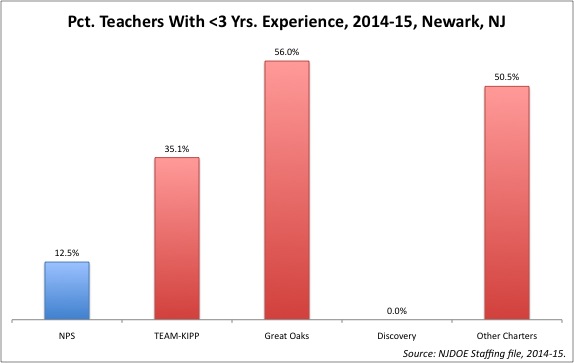


Discovery CS has a relatively experienced staff (again, however, it's quite small). But TEAM-KIPP and Great Oaks CS have staffs with many more inexperienced teachers proportionally than NPS as a whole. As I've noted many times on this blog, there is a clear research consensus that teachers gain most in effectiveness in their first few years of teaching; however, there is still substantial evidence that gains to experience for teachers continue well into their second decade of teaching.

There is also a substantial difference in the certifications of TV teachers and their peers in NPS:


Both NPS and Discovery teachers are far more likely than teachers throughout the Newark charter sector to have standard certifications. Great Oaks, in contrast, has proportionally many more staff members with either provisional certifications, or with Certificates of Eligibility, the "alternate route" certification offered by NJDOE. There is evidence that alternate route teachers are less likely to remain in their initial teaching assignments than teachers who receive training leading to a standard certification.

Finally, let's look at salaries:


As in most professions, teachers make more as they gain more experience. This chart shows rising salaries in all of the sectors throughout Newark (I've omitted Discovery CS here because their small number of teachers gives a distorted view of how their "scale" might work). But, as I've noted before, TEAM-KIPP pays its novice teachers considerably more than NPS. Of course, they have very few teachers who have more than 15 years of experience; this works out well for them, as they can pay their teachers a more competitive wage without having to worry about continuing to give them increases to retain them into and past their second decade of work.

Great Oaks lags NPS in salary at first, but then beats the district after a few years. Again, however, the charter has very few teachers who stay more than a few years at the school. Both Great Oaks and TEAM-KIPP, because they offer higher wages, ask their teachers to work longer hours and longer school years. 

This is a decided advantage for these schools' students, who don't have many alternatives outside of school for enrichment compared to more affluent suburban communities; however, the low levels of experience in the staffs of these schools suggests (as Bruce Baker has noted) that their model is to churn their faculty. In other words: teachers appear to work overtime at the charters for extra pay, but only stay at their schools for a few years before moving on.

And if that's true... then Teachers Village is, by all appearances, perfectly designed for charter school staffs. It's a rental property, which means residents can easily pick up and move on after a few years. It houses two charter schools that have high proportions of relatively inexperienced staff. Those charters are more likely to hire staff who do not have standard credentials. And the staffs are substantially younger than the staffs at the neighboring district schools.

It's fair to say, based on this evidence, that Teachers Village was made for charter schools, and charter schools were made for Teachers Village.

As to whether this is good for urban renewal in Newark -- I don't hold an expert opinion. It certainly seems like there could be an upside from having young, college-educated people with significant disposable income move into Newark's downtown. That said, I don't know if a churning groups of tenants does much to help build a neighborhood that is vital and vibrant.

I do have an expert opinion, however, about whether this model is good for education -- and I am highly skeptical. Teaching should be viewed as a profession, and not as a temporary job one does before moving on to their "real" career. And Newark needs experienced, dedicated teachers.

The federal Department of Education has recently made educator equity a priority, requiring states to submit plans that show they are working to make the distribution of highly-qualified educators fair across all districts, regardless of the socio-economic or racial characteristics of those districts' students. The Department has particularly focused on making sure "...that poor and minority children are not taught at higher rates than other children by inexperienced, unqualified, or out-of-field teachers..."

Again: we don't have direct data about who lives in Teachers Village, and the data we have about who works there is incomplete. Still, the data we do have suggests TV staff are less experienced and more likely to not have standard certification than the staff in NPS schools. How does marketing rental housing to teachers and leasing property to charter schools with relatively inexperienced staff help to correct inequities in access to highly-qualified teachers?

If getting more experienced, highly-qualified teachers into Newark's schools is our goal, Teachers Village would be just about the last idea I would think of to meet that goal. Maybe it has other benefits, but improving the quality of Newark's teaching corps does not seem to be one of them.

And what about the students? Is Teachers Village helping to meet the needs of Newark's most deserving children? Let's look at that next.


Teachers Village Ground Breaking, 2012.

Tuesday, December 1, 2015

Return To Teachers Village: Part I

Here are links to all of the posts in this series:

Part I - Introduction
Part II - The Teachers
Part III - The Students
Part IV - What's It Costing Us?

 * * *

Earlier this month, Rachel Cohen of The American Prospect wrote an article about Teachers Village, a development project in Newark, NJ that houses three charter schools in addition to retail stores. Teachers Village is unusual in that it also has dozens of housing units that are specifically marketed to teachers. Developments like this are actually starting to pop up across the country, fueled by a series of tax breaks, including the New Markets Tax Credit.

Cohen quotes yours truly several times in the piece on the basis of a series of posts I've written -- see here, here and here -- where I question the wisdom of using public monies to build facilities that are rented to both publicly-funded charter schools and the people who work in them. I especially wonder why Ron Beit, the developer of Teachers Village, and his investors should get all sorts of public largess when the project seems like it's designed to cater to renters who are likely not going to be career-long educators:
Beit's got himself one sweet deal, doesn't he? He uses $100 million in tax credits to finance a project in Newark, then lines up a group of charter schools as his business occupants, who will pay their rents with taxpayer funds.

Then, as if that isn't enough, he sets himself up to direct a steady flow of college-educated renters right into his residential units - through TFA [Teach For America]! In fact, TFA has a page where prospective "teachers" can figure out their expenses when they move to Newark. By default, rent is listed as $1150: right in the range for units at Teachers Village. There's also a happy-happy neighborhood description on the TFA-Newark website: I don't think a real estate agent could have written one better.

This is hardly a new idea: in Baltimore, 70 percent of Miller's Court's residents are TFAers. Again, the financing was helped by New Markets Tax Credits.

But I have to imagine that Beit's looking downstate at Camden (and, for that matter, other cities in New Jersey) and licking his chops. The whole place has been taken over by the state and stands poised to become as charterized as New Orleans. Tax credits, bond money, and other public funding has flooded into the area: the expansion of charters is part of that deluge. Land is cheap and the city needs an influx of yuppies to begin the gentrification its leaders so desperately crave. It's the perfect place to replicate Teachers Village.

There's been plenty written about how TFA has become a political organization. But I suspect it's also poised to become a power broker in the brave new world of 21st Century urban development. Cities used to have to put together marketing campaigns and development plans to start gentrifying neighborhoods. Now, they just have to give TFA a call, and the yuppies will come rolling in.

And it's all paid for with public monies. Everyone cool with that?
It turns out that Beit was not particularly happy with Cohen's piece (FWIW, I thought she was quite fair). He wrote a letter to TAP that they published last week:
Rachel Cohen’s article, “Can Affordable Housing Retain Teachers,” features Newark’s Teachers Village, an inner city project to provide affordable and market rate housing to teachers and administrators in a city struggling to revitalize. Unfortunately, the article paints a picture that is misinformed and full of inaccuracies about this exciting project.
Ms. Cohen could not have visited the area and included many [quotations that were inaccurate], such as, “The problem is that (Newark’s Teachers Village) is clearly designed for white, young professional types…” and “It’s just becoming a little yuppie commercial district…”.
In fact, 72 percent of all the residents in Teachers Village are minority, and close to 70 percent of all residents are educators. Of those, 44 percent are Americorps or Tutor Corps (recruited nationwide to train at Great Oaks school). Thirty-eight percent of the residents are charter-school teachers and 18 percent are district teachers.   
[...]
Most celebrate Teachers Village as a place for district schoolteachers, charter schoolteachers, and independent schoolteachers to live together, exchange ideas, and share the energy and innovation that can only be a benefit to the city and the children of Newark.
Teachers Village is a sustainable model that should be introduced in every municipality across the country as a tool to recruit and retain the best teachers, as well as to stimulate economic development in neighborhoods that have long been left fallow; where no one lived or worked for many years. Putting teachers from all types of schools—district, charter, and independent—at the center of the community and building a vibrant, affordable, 24-hour neighborhood around our city’s working professionals is an honorable pursuit and one that should be emulated across America.
I find it interesting that Beit chides Cohen for her conclusions while simultaneously presuming to speak for the "most" who "celebrate" Teachers Village. But it's his use of statistics that really got me thinking: what do we actually know about who is living, working, and learning in Teachers Village?

I'm going to be exploring this question in a series of posts this week.

Let's start with Beit's data. "72 percent of all the residents in Teachers Village are minority..." is the sort of factesque data point that looks good at first glance, but could really mean anything. What's a "minority"? Are Asian residents part of that group? LGBT residents? The truth is that Newark is about one-quarter white, so it would be hard for Teachers Village not to have many non-white tenants  That doesn't mean it won't be attracting residents with a different demographic profile than those in the surrounding neighborhoods.

Beit also says, "70 percent of all residents are educators," but he immediately qualifies that by noting that 44 percent of those are tutors working for Great Oaks Charter School, one of the three charters renting at Teachers Village. The tutors at Great Oaks are the core of the school's signature program, as described by its website:
Who applies to the Great Oaks Tutor Corps?
The majority of Great Oaks Tutor Corps fellows are recent college graduates who:
  • Are generally interested in education and want to give a year of service.
  • Are interested in education policy and wish to experience life on the ground in an urban school.
  • Plan to pursue a career in medicine, law or enroll in another graduate program and wish to first give a year of service.
  • Want to become high-performing teachers. In Newark and New York City, people in this category may choose to apply to the Great Oaks Teacher Residency.

Where will I live?
Tutor Corps fellows in Newark will live in Teachers Village. Fellows for the New York City campus will receive housing in Brooklyn. Bridgeport fellows will live near downtown Bridgeport. Wilmington Tutors will live in the heart of downtown Wilmington. All fellows will receive a modest living stipend. [emphasis mine]
You'll note the program specifically says that at least some of the Tutor Corps fellows do not want to become teachers. Teachers Village, then, is providing a good amount of temporary housing for people who are not career educators.

I'll talk more about the teachers at Teachers Village later in this series; for now, let's acknowledge that Beit's contention that his development is "...building a vibrant, affordable, 24-hour neighborhood around our city’s working professionals..." is quite a stretch. By most people's definition (hey, if Beit can generalize, why can't I?), a tutor with a one-year commitment is not a "professional."

Keep in mind that the tutors are not paying their own rent: housing is provided to them at taxpayer expense. This year, 20 Great Oaks tutors are subsidized through a $268,600 grant from the federal AmeriCorps program as administered through the state. The tutor program also received $300,000 of Mark Zuckerberg's famous (and tax-deductible) donation to Newark's schools. I don't know of any program assessment that's been done, but the comments of the tutors themselves on Glassdoor are quite interesting.

In any case, this is yet another stream of taxpayer-funded revenue flowing to Beit's group through Teachers Village. And there isn't a lot of evidence that Beit is giving the school a break on its leasing fees for putting up the tutors in his building. According to Great Oaks's Comprehensive Annual Financial Reports for 2013, it paid $280,177 in rental fees for the tutors (p. 48). That fee rose to $399,994 in 2014 (p. 47), the year Great Oaks moved into Teachers Village. Granted, the school's enrollment grew by about one-third, so maybe the number of tutors being put up grew as well; again, I can't find a program assessment, so who knows? But even if it did, there's no reason to believe, based on these numbers, that Great Oaks is getting an especially good deal compared to what it was paying previously.

Look, it's perfectly fine to have a program that brings tutors into a school (although why the students who benefit from those tutors should have to go to a school that is under private control escapes me). But Beit has created -- with a great deal of assistance from this state's taxpayers -- a development that is housing a large number of "educators" who have no obligation or incentive to stay in Newark or in teaching. 

The tutors are temporary residents of the city. Granted, they are young and college-educated: exactly the sort of folks urban developers want to bring in to "revitalize" neighborhoods. But there is no reason to believe they are invested in the city in the same way homeowners and career professionals would be.

It's worth noting that Beit's company, RBH Group, boasts that it has, "...acquired through 30 transactions, over 79 properties in Newark’s downtown core." Who, then, benefits from bringing in a steady stream of college-educated youngsters in Newark? Certainly not career teachers, who might be offered incentives to buy housing in Newark and would see any gains in the value of their property then accrue to themselves. The money that might have provided those incentives is, instead, being channeled into properties that, if they increase in value, will benefit RBH Group.

Let me be clear: it's perfectly fine for Ron Beit and his group to make money developing properties in Newark and elsewhere. I don't even have a problem with providing some sort of incentive to help that process along. Newark needs investment if it's ever going to become a vibrant, thriving community. But let's get something straight:

Teachers Village is a very big investment of public dollars. It is not a philanthropic undertaking; it is a profit-making enterprise. As such, the public deserves a clear-eyed view of how its funds are being spent. It also deserves a serious analysis of whether that spending is a good investment in education, not just real estate development.

Let's take a look at that next.

Next: Part II -- Who Is Teaching At Teachers Village?


Teachers Village Ground Breaking, 2012.

Monday, November 23, 2015

Blogging Update: Happy Thanksgiving!

Dear Readers,

Apologies, but work, school (NOT where I work), personal, and family obligations have kept me from blogging over the past week.

I've decided to avoid lame, over-quoting blogging (you know who you are) and take off the rest of the week. Pro-public education snark recommences after the holiday.

Have a happy and safe Thanksgiving!

Best,
Jersey Jazzman

Actual exponential growth...

Thursday, November 12, 2015

Proud Teachers Are Banned In New Jersey #ProudToBeAParsippanyTeacher

How dare these unionized teachers express pride in their profession!
Teachers Ordered to Remove “Proud to be a Teacher” Signs
“Pride in Parsippany”, boasts the great township sign at the intersection of Rt. 46 and Vail Road. The teachers of Parsippany’s public school children however, are not to be afforded the opportunity to exhibit that pride according to an edict issued today by the school district’s chief administrator. Teachers have been ordered to remove a simple black and white sign that says only “I am Proud to be a Teacher” in plain block letters, followed by a smaller tag line, “Parsippany-Troy Hills Education Association”.
The message, uniformly printed on standard white printer paper, had been posted on classroom doors in all district school buildings for several weeks before acting superintendent Nancy Gigante issued a directive that they be taken down. Gigante cited Board of Education policy forbidding political actions or statements on building premises as the reason for ordering the removal of the signs.
“We view this statement as a positive message to both students and parents”, said Joe Kyle, PTHEA president. “ We have always been proud of our role as teacher, coach, counselor and guide to the children of Parsippany, and we never intended for the sign to be anything other than a declaration of that pride.”
Kyle went on to say that the PTHEA would be challenging the validity of Gigante’s interpretation of the Board policy in question. “Our members were proud to go out of our way to willingly bail out the Board after the recent Middle School disaster, and so we are astounded that a printed declaration of that pride is deemed a political action statement”. PTHEA members worked diligently to restore a workable schedule in both Central and Brooklawn Middle Schools, going above and beyond their contracted duties. [emphasis mine]
A little history is in order here:

Way back in 2010, at the start of NJ Governor Chris Christie's War on Teachers, Christie decided that the biggest problem New Jersey faced was overpaid school superintendents. It was all a distraction from his chronic underfunding of New Jersey's schools, fueled by his tax giveaways to the wealthiest citizens of the state. Christie needed a villain to blame for his failure to fund schools according to the state's own law; he found one in Parsippany superintendent Lee Sietz.

Seitz, you see, had the temerity to expect that someone who was doing a decent job ought not to take a huge pay cut just because Chris Christie says he should. So Christie launched a disturbingly personal attack against Seitz for daring to making a low six-figure salary while running a large, successful suburban school district. Christie used Seitz to justify imposing a superintendents pay cap that has since chased talented school leaders out of the state.

Unfortunately, Parsippany has suffered from Christie's nakedly political ambitions. Seitz's replacement came into the district and immediately decided his top priority was to make sure his teachers were wearing the right sort of pants while at work.

No, I am not making this up. Click through -- I dare you.

When the Parsippany Board of Education announced Seitz's replacement would be resigning this year, there was actually applause. That's how bad things had become in Parsippany: this past year, the district's middle school was in complete chaos because the administration couldn't even generate basic school schedules.

So now Parsippany is currently operating under the "leadership" of an acting superintendent who appears to spend most of her time correcting the mistakes of her predecessor. You would think this acting superintendent, Nancy Gigante, would have larger concerns than worrying whether her teachers were proud of their chosen profession.

You'd be wrong:


Here are Passippany's teachers, following orders and throwing simple signs declaring their pride in their profession into the trash.

This is what you've come to, America: your teachers aren't even allowed to express pride in their profession in their own classrooms.

This is exactly the sort of school "leader" Chris Christie wanted to replace the experienced, professional superintendents he chased out of this state: petty bureaucrats who share his bullying tendencies. This is where public education is headed...

Unless we all stand up and say: "Enough." Stay strong Parsippany. On behalf of teachers across New Jersey and the nation: thanks to Joe Kyle and our colleagues in Parsippany-Troy Hills for taking on this fight.

Send this around and let everyone know that you are:

#ProudToBeAParsippanyTeacher


ADDING: It's worth pointing out that Scott Rixford, the superintendent who replaced Seitz and spent his days checking teachers' pants before resigning this past fall, was one of the top lieutenants in Christie's Department of Education when it was being run by Chris Cerf. Rixford was the executive director for one of the Regional Achievement Centers (RACs), Cerf's brainchild. The RACs, fueled by reformy billionaire Eli Broad's money, were supposed go into "failing" schools and turn them around with superior managerial knowhow.

Think about it: a guy who couldn't even produce a schedule for a middle school was the guy Chris Cerf and Chris Christie put in charge of telling schools how to improve.

Heckuva job, fellas...

Wednesday, November 11, 2015

Charter Schools, An Exchange: Part VI (Final)

This is the last installment of an exchange about charter schools between myself and Dmitri Mehlhorn. 

Part I: Mehlhorn's opener.

Part II: My reply.

Part III: Mehlhorn's response.

Part IV: My second reply.

Part V: Mehlhorn's second response.

Part VI (this post): My final reply.

I hope everyone has found this enlightening. My sincere thanks to Dmitri Mehlhorn for engaging me in this debate.

* * *

In his final installment in this debate, Dmitri Mehlhorn posed five questions to me. Here are my responses.

Q: "Jazzman, why don’t TPS (traditional public schools) test results go down as charters expand?"

A: We don't really know that they don't. But even if they don't, there are other pernicious effects for district schools when charters expand. 

As I explained in Part II, the evidence we have about the effects of charterization on neighboring public district schools is quite limited. The Texas study Mehlhorn cited earlier (Booker et. al, 2008) shows a small positive effect for hosting districts; however, the proliferation rate of charters was quite small. In that study, most districts had well under 5 percent of their students in charters, so it's reasonable to think any "cream skimming" -- the process where charters take only those students who are more likely to thrive under a "no excuses" model -- had only a small influence on the district schools.

What happens when the charter enrollments get up to 40 percent, as they are in Washington, D.C., or soon will be in Newark? We really don't know, and it's going to be very difficult to figure out the answer when it happens. The plain fact is that there are many confounding variables when trying to figure out the effects of charter school growth on sending districts' outcomes. Test scores may go up or down, but pinning the cause on charter schools is going to be a formidable task.

In Washington, D.C., for example, the past decade has seen large changes in the city's demographics. Can we really attribute any changes, positive or negative, to charter school proliferation when the city is undergoing such large shifts in its student population characteristics? 

In addition: how sure are we that the students enrolling in charter schools would have otherwise gone to public schools? There is good reason to believe charters are attracting at least some of the population of students who would have gone to private or parochial schools. That could explain, in part, why public district schools'  test scores remain static when charter enrollment grows.

All of this, however, is speculation. I and others will continue to dig into the issue... but let's be clear about one thing: test scores are not the only measure of the potentially pernicious effects of charter schools.

As I said previously in this debate: high quality research shows that charter schools have a negative effect on the budgets of their hosting schools. This makes sense, as charters are redundant systems of school administration, and do not allow districts to fully leverage economies of scale. In other words: when every charter school has its own high-paid superintendent and administrative staff, that's inefficient. And we have more and more evidence that is the price to be paid for "choice."

I'd rather see money go into the classroom. I'd rather we cut back administration as much as possible, and put our funds into hiring the people who actually educate our children. Having multiple systems within a single community runs counter to that goal.

I am also very concerned "no excuses" charters are reinstalling a hidden curriculum of obedience within our schools that is only being foisted on students of particular races and socioeconomic classes. I've cited Pedro Noguera several times during this debate, and I'll do so again right now: we don't teach kids in the suburbs the way "no excuses" charters teach urban students of color. Chanting and marching and teacher tracking and rote repetition is not the type of education suburban parents seek for their children. Why, then, is it acceptable for children coming from segregated, economically disadvantaged communities?

This has consequences outside of the charter schools. When the public schools feel the pressure of charter "accountability" breathing down their necks, are they more likely to open up their curricula to exploratory and experiential learning, or narrow them with a focus on test prep? Are they more likely to have their youngest students marching through the halls, or will they instead give them extra time for play? Will they allow their teachers and principals to have the autonomy with accountability of professionals, or force them towards pre-scripted instructional methods that are "proven" to be "successful"?

Those who define "success" through test scores are not likely to ask such questions.


Q: "Jazzman, why aren’t race and history relevant to the burden of proof here?"

A: They are -- and history teaches us school "choice" is often a front for school segregation. Further, the "choice" offered urban parents is not suburban "choice."

Here's an ugly truth: school "choice" has a segregationist history. Here's another ugly truth: today's "choice" plans appear to be leading to more segregation, not less. The Civil Rights Project at UCLA found that "that charter schools, in many ways, have more extensive segregation than other public schools."

I approach the idea of reintegrating schools with some caution as I think there can easily be a deficit perspective inherent in the idea: that somehow we need to "save" students of color by mixing them in with more white students whose families have the "right" values. That said, we also have to acknowledge that this country deliberately segregated itself, and that segregation extends to its schools.

I don't see that the charter movement has done anything to address this reality. The "high performing" charters we hear so much about in the press (thanks to those charters' extensive public relations machines) seem to be very happy to embrace a school system where urban "choice" means choosing between a racially segregated, underfunded public school and a racially segregated, better-funded charter school.

As I've asked throughout this series: is this really the best that we can do?

And let me state once again: suburban "choice" is not urban "choice." Contrary to the claims of those who don't seem to know much about how suburban schools work (more on that soon), suburban "strivers" do not go into separately governed school systems that abrogate the rights of students and parents. Disruptive children in suburban schools -- and yes, they are there, believe me -- do not get booted out of their schools except under the most extreme circumstances.

Those who point to the suburbs to justify the proliferation of charters are making a false analogy. As they do, poverty and institutional racism calcify, resources are distributed inequitably, and a pedagogy of compliance is foisted on the most underserved and deserving of our children.

Again: is this really the best we can do?


Q: "Jazzman, why don’t you push for good charters?"

A: I'd rather push for equity: equity of resources, equity of access, equity of lives.

There is a place for school choice if we adequately fund schools and equalize the lives of children. But choice is not a substitute for equity.

That's worth repeating, loudly:

Choice is not a substitute for equity.

Why would anyone put promoting school choice at the top of their social justice agenda when our schools are being massively underfunded? Why would anyone think expanding charters is a top priority when 22 percent of our children live in poverty, and 45 percent live in low-income households?

I am a capitalist. I believe a well-regulated market generally is the most efficient way to move capital where it is needed, and I believe ingenuity, talent, and hard work should be rewarded. I have no problem with people who create useful goods and services making lots and lots of money as their reward.

But America's economic system is leaving far too many of our families behind, and our children are paying the price. It is utterly shameful that the most powerful nation in the history of this planet allows so many of its children and their families to live in squalor while a select few gather up all of the income gains we have made over the past few decades.

The idea that a few more schools operating outside of democratic control can make up for this is, frankly, ridiculous. Who could possibly believe this? Who could possibly think setting up more of these schools is a serious response to our current situation? Who could possibly imagine that New Orleans or Newark will all of a sudden become an economic paradise where poverty and inequality are magically swept away by a few bumps in test scores thanks to charter schools?

It's long past time for the charter cheerleading sector to stop pretending they have found a large-scale solution to poverty. Too many in the charter industry pat each other on the rump because their schools put the pennants of elite colleges on their walls, never stopping to think for a moment that millions of people in this country are doing necessary work that does not require a college degree, yet are struggling to survive. Should they all go to Yale? Should all the truck drivers and brick layers and home health care aides get Ivy League degrees? Would that make things better?

Social mobility is not social equity. The minute you guys realize this is the minute I'll consider pushing for more "choice." Until then, I've got bigger concerns -- and so should you.


Q: "Jazzman, how much improvement would be enough?"

A: Hey, I'm not the one who said charters are closing the "achievement gap"; I'm only pointing out they aren't closing it.

Dmitri, you missed the point of my argument on effect size, so I'll try one more time:

The spokespeople for the charter sector -- not me, but them -- are the ones saying their schools are somehow proving that poverty isn't destiny. They are setting up the comparison between affluent and economically disadvantaged schools and students, not me. They are the ones saying their schools are closing the "achievement gap."

They are wrong:


Yes, higher test scores are better than lower scores -- duh. But tiny, incremental gains are not enough to close the "gap" that the charter cheerleaders say they are closing.

Again I ask: is this really the best we can do? A few more answers correct on a bubble test? For a select few students who manage to make it through the gauntlet that is a "no excuses" school?

A fully functioning, well-funded, and equitable education system is a necessary precondition for a just society. We need good schools if we are going to lift people out of poverty; nobody disputes this. But you can't expect schools to solve the problems of chronic poverty on their own.

This, however, appears to be exactly the argument the charter sector keeps making for itself: expand charters and the effects of poverty on school outcomes will simply fade away. Except the evidence shows it won't. So let's stop pretending that school "choice" a some sort of substitute for a meaningful, wide-scale program of social and economic justice. Clearly, it isn't.


Q: "Jazzman, do we already have some areas of agreement? If so, what do they mean?"

A: We'd be more likely to find agreement if your side would stop bashing teachers unions and public schools.

Here's the reformy LA Times, claiming charters are "...free of sometimes stultifying union rules." Here's a charter staffer saying her school is "Free from union contracts..." Here's a pro-charter film excoriating the "...sorry statistics of union-fueled schools..." Here's the NY Post saying that the UFT, NYC's teachers union, is "...associated with yet another education failure" because its charter school "...can’t compete with the non-union charters." Here's a report from the "liberal" MSNBC that claims charters are "...unencumbered by teachers unions or antiquated rules and regulations that can choke innovation." Here's a pro-charter think tank claiming charters are better off when they "... reject the fixed salary levels that have been comfortably adhered to and influenced by teachers unions."

Time and again, the charter industry has stated, both implicitly and explicitly, that their "freedom" from teachers unions is a key part of their success. I've been looking at this a good long time, and I can only find one theory that explains a charter advantage that comes from having a non-unionized staff:

That fraction of the charter sector that is "high-performing" has schools that churn their staff and keep experience levels low. They are, consequently, able to keep staffing costs low compared to the public schools in their host communities. Experienced teachers on traditional union-negotiated step guides make considerably more than their charter counterparts, but that doesn't matter much for the charters, as they have only a few teachers with experience into their second decade and beyond.

These charters are able to offer higher starting salaries than the neighboring district schools. For that higher salary, teachers work longer hours and more days, allowing the school to spend more time drilling its students and, in some cases, offering extracurriculars. Consequently, the children score higher on test scores.

That's it. That's the "non-union charter advantage": a less-experienced staff working longer hours, incentivized by higher starting salaries but ultimately having shorter teaching careers.

This is a smart strategy from a business sense, but I think it's ultimately bad for the teaching profession to move more and more educators into what is essentially temp work. Further, I don't think this is scaleable. "High-performing" charters, in my opinion, are going to exhaust their human resource pool soon; then what?

In any case, there is no reason to believe charters have found some magical efficiencies because they don't have to worry about unions stifling them. Those who make that case are engaging in unwarranted union bashing instead of honestly and carefully analyzing how charters really get their test score gains.

The charter industry has also built the justification for its existence on claiming our public schools have "failed." Not only is this extremely unhelpful in garnering the necessary financial support our schools have been lacking; it's also unjustifiably sanctimonious considering that charter schools do not do he same job as public schools.

Even charter operators like KIPP, who pride themselves on attempting to serve the most disadvantaged students, do not follow the same enrollment procedures as public schools. In Camden, KIPP decided it would only enroll kindergarten students in its first year and grow each year after that. But the Camden Public Schools don't have that luxury. Neither can they, like Mastery's and Uncommon's schools, pick and choose which grades they would like to serve and how many students they would like to enroll.

Success Academy's attrition practices are now well known; however, even if we put them aside, Eva Moskowitz herself says she won't take new students into her schools after Grade 4. She says it's "not really fair" to the higher-performing students to be slowed down by the lower-performing ones who might come in. Again, that's fine for her schools, but the public schools she is muscling out through colocation don't have that option.

As I've said before, I am sympathetic to the point of view of urban parents who want the positive peer effects they see suburban families enjoying for their own children. I've never criticized a parent for enrolling their child in a charter school, and I never will. But it's unfair to seek out that peer effect while simultaneously claiming public schools are "failing," even as they serve a different population of students.

The charter industry has made a lot of noise lately about putting aside the district vs. charter battle and moving on to areas of agreement. If their spokespeople are sincere, however, they ought to stop beating down teachers unions and public schools. I'm not saying unions are always right, and I'm certainly not saying urban public schools don't need a lot of improvement, starting with -- but certainly not limited to -- more resources.

But justifying your existence by continually wagging your finger at the teachers and the schools that are doing a different job than the charters is, frankly, obnoxious. My charter school friends: a little humility would go a long, long way.

Thank you, Dmitiri, for this exchange.

Wednesday, November 4, 2015

Charter Schools, An Exchange: Part V

UPDATE: I see Dmitri is retweeting all the odd-numbered parts of this series (his), but not the even-numbered parts (mine). OK... but do yourself a favor: read my responses. See for yourself if Dmitri's arguments hold up.

I feel quite confident that you'll find he doesn't have much cause to believe he got the better of me in this exchange. But you be the judge.


Dmitri Mehlhorn and I continue our exchange about charter schools.

Part I: Mehlhorn's opener.

Part II: My reply.

Part III: Mehlhorn's response.

Part IV: My second reply.

[ADDING: Here is the rest of the exchange:

Part V: Mehlhorn's second response.

Part VI: My final reply.]

Leave your thoughts in the comments below. My final reply will be up shortly.


* * *

Five Questions for Charter Critics
Jazzman-Mehlhorn Episode V

Reform skeptic Jersey Jazzman is hosting a debate about charter schools. He and I have spent 4 posts and about 10,000 words discussing the past few years’ worth of research by charter advocates, detractors, and academics. We will probably have a “long tail” of comments in social media, but this is the final formal installment of my appeals to Jazzman and the other skeptics who have engaged over the past year or so, including Sue Alexander, Dr. John Thompson, Deb Stahl, Jack Covey, Ajay Srikanth, Daniel Katz, Greg Clark, Mindy Rosier, Ben Spielberg, Peter Greene, Ben Faber, Randi Weingarten, Dr. Bruce Baker, Gail Richmond, Ed Harris, Jennifer Berkshire, and others.

If you’re up for it, I have five questions for all of you. Of course, this is not an exhaustive list – we could talk for years about test scores, poverty, fixed costs, and other issues. But in the spirit of trying to make progress in at least some areas, I’d be grateful for your honest take in these five areas, not conflated with other issues.  

(1) Jazzman, why don’t TPS test results go down as charters expand? 

Mark, the skeptics’ most common and most powerful arguments involve “skimming.” Compared to TPS [traditional public schools], these arguments claim that charter populations qualify more for reduced-price rather than free lunch (i.e., mild poverty rather than extreme poverty); charters push kids out more often; charters don’t always backfill open seats; charters deliver peer groups rather than better education; charters don’t serve as many SPED [special education] or severe SPED students; charters only serve students whose parents are motivated enough to apply; etc. These claims have elements of truth, but the key question is their aggregate impact including offsetting issues.

Mark, do you acknowledge the role this claim plays in the architecture of charter skepticism? After all, if skeptics are right on this issue, charter test-score gains are illusory, and thus charter expansion will hurt TPS by leaving them with a hard-to-teach cohort. If skeptics are wrong, then the charters’ test-score gains result from something the charters are doing, and charter expansion does not damage TPS by leaving them with a hard-to-teach cohort.[i]

Mark, as you know, both sides have invested heavily in studying TPS student achievement as choice expands. I won’t revisit all prior posts, but you know I’m looking at Washington DC; New Orleans; Florida; some boroughs in New York City; and some districts in Texas.

Mark, where is the evidence backing up the idea that hard-to-teach cohorts will be increasingly concentrated in TPS, driving down results? Is it possible for you to acknowledge the weight of the current evidence on this subject?  Will you have the courage to articulate a testable explanation for why the facts have repeatedly been the opposite of skeptics’ predicted results? 

(2) Jazzman, why aren’t race and history relevant to the burden of proof here?

In your most recent piece, Mark, you characterized my burden of proof argument as follows: “if someone can gather up a few parents who want something, they should get it, absent a compelling reason that they shouldn’t.” I would like to better understand why you and other skeptics are so quick to dismiss the racial and historical issues suggest a different presumption.

Let’s start with race. On average, graduation rates, test scores, and other metrics suggest that African American students and Hispanic students are poorly served in existing TPS, especially by comparison with white, Jewish, and Asian students. Parents in African American and Hispanic communities often speak out on the topic of school choice, in interviews, focus groups, polls, and charter applications. I have cited some of the results in previous posts, but the short version is a lot of these parents really want more charter schools.  Tens of thousands of parents (or more), who bear the legacy effects of centuries of state-sponsored racism, should not be dismissed as “a few parents” who’ve been “gathered up” by “someone.” Their agency and their numbers suggest a different presumption.

Turning from race to history, your post refers to Russell’s Teapot. That is a perfect frame for what many parents of color say. For white, Jewish, and Asian parents in TPS, choice and the threat of choice long ago enabled meaningful control over their children’s schools. Thus, current anti-charter laws have unique and disparate force among low-income black and Hispanic parents, who become compelled to send their children to struggling TPS.  The anti-charter policy therefore amounts to the following: “I, Jersey Jazzman, offer you the Russell’s Teapot monopoly public school system. This public school system is a century-old experiment that has not yet delivered results for your community. We cannot give up, however, until we try to supplement those schools with more social services, more resources, and other innovations. Until every possible test has been tried (other than charter schools of course), you will be required to send your community’s children to these TPS into the infinite future.”

Mark, this is not a choice between two impossible-to-assess claims.[ii]  As you know, we are not talking about authorizing a specific charter, but rather laws that limit the expansion of *any* charters. As you note, our nation has gathered considerable evidence about this question.  We know that nonprofit and private actors compete with public actors for public dollars in other sectors, including healthcare, energy, and military procurement. We know that wealthy parents already have extensive school choice.  In light of that, why isn’t the burden of proof on the monopoly public school system, which overwhelmingly employs relatively prosperous white people, and which was constructed without meaningful input from (and often deliberately in opposition to) communities of color? 

(3) Jazzman, why don’t you push for good charters?  

You seem to agree that the best charter school chains can deliver results.  Why don’t you push to replace charter caps and limits, like we have here in Virginia, with enlightened charter authorization policies like those of Boston? 

(4) Jazzman, how much improvement would be enough?   

If you are open to facts, I am trying to understand what evidence would be sufficient for you to prove the theory that charters actually work better than TPS for low-income students of color.   
You dismiss the CREDO 2015 results in a few ways, but I think you’re missing the forest for the trees. To try to clarify the issue here, let me try to stipulate as many of your objections as possible.

First, let’s talk about whether a fraction of a standard deviation is meaningful.  You don’t like my healthcare example, and we can’t seem to agree on human height,[iii] so let’s use the market returns example that you approved. You said that a difference of 0.1 standard deviations was not a big deal, because “if my investment goal is to make a million dollars, getting $275 over $232 is not of any practical significance for me” (emphasis yours). Jazzman, that’s more than an 18% difference in end-of-period wealth, and I used a starting number of $100 just to make the math obvious. The median net worth of a household in America today is about $81,000; using that as a starting investment delivers a 10-year difference of $35,000 in extra wealth. And remember, 10 years still a shorter period of time than a child spends in K-12 schools. 

That said, you suggest that 0.1 or .11 standard deviations is not the right benchmark, because those are the aggregate average gains Hispanic ELL students, who seem to benefit especially from charter schools.[iv] So, let’s broaden to include all black and Hispanic students in poverty, who benefit by less in math (.08 and .07) and reading (.06 and .04).[v]  If you apply those numbers to the financial market calculations from the prior paragraph, you get gains of ~ $27,000; $24,000; $20,000; and $13,000.  To me, none of those are small potatoes, but the real point is that it depends on your perspective. Parents and policy-makers would certainly be on safe ground in concluding that gains of that magnitude are worth embracing. Any instrument that reliably delivered those kinds of gains would instantly become the industry norm on Wall Street.

You argue that the effect sizes of charter schools are merely “a few more bubbles filled in correctly.” Yet Mark, a few bubbles per year on average, across a large population, represents marginal additional mastery every single year. It’s not a perfect or complete measure, but it may just be the difference for a kid on the edge. Maybe the best way to frame it is not that students advance faster; rather, maybe it’s that they don’t fall behind. Either way, even if you and many others do not think that those bubbles matter, millions of educators and parents care about them.

All of which leads back to the original question: how much would be enough?  What would charter schools have to show you for you to accept the theory that these schools, because they do not have to deal with the union contracts and other bureaucratic hurdles, actually deliver better results for low-income children of color?   

(5) Jazzman, do we already have some areas of agreement? If so, what do they mean?

For policy-makers interested in choice policy, it seems as though we might agree on a few things.  Having read your work, and that of many other conscientious charter skeptics, I thought I’d take a stab at areas of agreement, and see if you could agree to any of them, or articulate an alternative package of agreements, and then suggest what policy-makers might learn from those areas of choice when deciding whether or not to maintain charter caps. 

For my part, I agree that for suburban areas, and for white, English speaking, prosperous children, traditional public schools currently perform as well as charter schools, or better. I agree further that, even for poor students facing residential segregation, charters alone will not eliminate the achievement gap between the children of wealthy families and the children of poor families (although charters will at least start to equalize the narrow issue of school choice, which wealthy families have and these families do not). I agree that some charter schools have been much more effective than others, and that charter authorizers should therefore be careful in expanding charters and aggressive in closing them. I agree that numeracy and literacy, as measured by test scores, are not a complete measure of student achievement or school performance, and that therefore over time we need to monitor lifetime student outcomes.   I certainly agree that schools alone won’t solve all of humanity’s problems, from wealth inequality to violence to sickness.  I also agree that more money, if spent properly on students, could help students obtain better outcomes. 

I have not been able to identify your explicit concessions, as they often appear as caveats or rebuttals.  I believe, however, that you acknowledge the shameful history of American traditional public schools, including the consequences of residential segregation, and the racial motives of public actors who built the modern K-12 system from the late 1800s to the early 1900s. I am confident you condemn situations where TPS student discipline is turned over to physically violent police, or where teachers are abusive, just as I would condemn those situations in charter or private schools. I bet you also would acknowledge that wealthier parents use both political power and the threat of choice to navigate traditional systems for the benefit of their kids.  I suspect you agree that not all TPS expenditures have been wise, or for the benefit of students – indeed, you may even agree that public sector traditional public schools have an extensive history of fiscal waste, fraud, and abuse.  I suspect you also agree that public funding, multi-sector provision, and private citizen choice works in some areas, such as public services in Denmark, or healthcare provision (as opposed to healthcare finance) in the United States. 

Is that a fair summary, Jazzman?  If so, can you think of any compromises to recommend to policy-makers who might be reading this exchange? 

* * * *

Thank you again for your platform and the patience of your audience.  I hope this has moved a few minds, or at least opened up a few lines of communication. 


[i] I agree there remains the fiscal challenge of spreading fixed costs over fewer students. As I’ve noted, this is a real issue, but it’s a very different and more focused conversation than the skimming allegation.  Moreover, if we dive into the fiscal data, I believe we’ll find the same result: that the aggregate impact of charter expansion on TPS fiscal management is net positive, not net negative.  We’ll save that for another conversation, however.
[ii] When you ask the question: “is this really the best we can do?”, you are setting up an absurd standard.  By that standard, **no action** would ever be taken, ever, because no single action is ever by itself the best we can do.  The question at hand is whether we should expand charters or not. 
[iii] On height, the question is not whether the gain would make you an NBA basketball player, but whether most people would care. In the world of cosmetics, a product that delivered an average height gain of one-third of an inch would become a multibillion-dollar product. Also, when you double down on the Loveless / Spielberg examples, you use final adult height, rather than what clinicians and biostatisticians refer to as “height velocity” – i.e., how fast you grow. Height velocity is the apt comparison for growth over a long period, and standard deviations of height gain are pretty wide. 
[iv] Your protests about my focus on Hispanic ELL are a little bit overwrought, as I suspect you realize on reflection. As I have written in the past, this is the national cohort relevant to my daughter’s friend from soccer, whose personal story you entirely ignore in your rebuttal. It is also the most clear case for charters, because these parents are least likely to have either voice or choice to navigate TPS, so you’d expect charter gains to be especially stark.  To be clear, the Hispanic ELL population sub-group is an aggregate result, as it includes the results from those cities whose charters perform very poorly, as well as for those cities whose charters perform well.  If I had isolated only the better-performing cities or better-performing charters, the result would be much greater.
[v] The cohorts of students of color in poverty are the benchmark relevant to our debate, because those are the students who are least well served in the status quo. Of course I care about the other students, but those generally are not as poorly served in the status quo.