I will protect your pensions. Nothing about your pension is going to change when I am governor. - Chris Christie, "An Open Letter to the Teachers of NJ" October, 2009

Thursday, February 21, 2013

Chicago Teachers, Be Thankful for Karen Lewis

I have made a point of staying out of local union politics. While I have shared my disagreements at times with labor leaders, I am ultimately on their team. I made a point of not telling members of the Newark Teachers Union how to vote on their contract, although I made it clear that I had problems with the deal; I didn't think it was right for me to demand another union member go on strike while I stayed safely in my job.

So, I've kept away from taking sides in union votes. And I haven't endorsed any candidates for labor union office.

Until now.

Chicago teachers, you should know how lucky you are to have Karen Lewis as the president of your local. And you should reward her efforts on your behalf - and on mine - with another term.

I'm not going to get into the details of the current race, because I know nothing about them. I will, instead, direct you to the great Fred Klonsky. I've never met Fred (or his brother, Mike, another great blogger), but his blog is a must-read. And if he says Lewis's opponents are not to be trusted, I will give that great weight.

But the local politics aside, understand what Lewis has done for every teacher in America: she showed us that we can win if we stand up for ourselves.

For a while, I thought New Jersey was the epicenter of teacher-bashing: Chris Christie went on a tear in 2010 that remains the pinnacle of excellence in educator insulting. But as this blog has gone increasingly national, and as I've followed the writings of the many great bloggers on the left, it's become clear to me that we are in the middle of a nationwide assault on the teaching profession.

We have been blamed over and over for problems that we didn't create and cannot be reasonably expected to fix. We have seen most of the fun sucked out of our jobs. We have been ignored while those who failed at doing what we do make policy. We have been losing our pensions, our benefits, and our raises, none of which were so awesome to begin with. We have been insulted and condescended to and bullied and mischaracterized.

Karen Lewis was the first of us in a good long while who gained national stature simply by standing up and saying: "Enough." She hasn't been intimidated by lesser minds and smaller hearts. She doesn't give a damn about the children of privilege who made backdoor deals to screw us out of our right to collectively bargain. She stood up to her foul-mouthed, incompetent, overbearing mayor and told him the children of the great City of Chicago were far more important than the obnoxious plutocrats who pull his strings.

Teachers of Chicago, know this: some of us are lucky enough to have a local leader like Karen Lewis, but far too many of us are not. There aren't nearly enough people in this world who are willing to stand up, look power straight in the eye, and not blink.

My fellow teachers, I won't tell you whom to vote against. But please, for the rest us:

Karen Lewis for President of the Chicago Teachers Union. Thanks.

This world needs more women willing to speak truth to power.

Jeb Bush Hires His Biggest Cheerleader To Smear Ravitch

This one starts with yet another gilded reformy-type falling on his fainting couch:
Diane Ravitch has hit a new low in the hyperbole she allows on her blog site.

This was written about charter schools:
“But the privatizers declared war on our schools, our kids, our teachers, our parents and our taxpayers.
“We didn’t start this war, any more than Poland in 1939. But we must fight back. And ultimately, emerge victorious.
“And when you’re in a war, and you’re defending the lives of your community, unfortunately, nuance or thoughtful qualifications become luxuries we can no longer afford.” (Diane’s post here)
Seriously, Diane?
Comparing school choice for parents with the Nazi invasion of Poland? [emphasis mine]
Uh, wait a minute - the writer doesn't say: "Ravitch wrote this about charter schools." He uses the passive voice: "This was written about charter schools:". Why would he do that... unless he knew Ravitch didn't actually write the words he quotes.

Which, of course, she didn't: Ravitch was quoting a reader who sent in a comment. Check out the original post here, which Ravitch starts with this prelude:
This parent takes issue with Mark Naison and Bruce Bernstein, who wrote a post about how to tell whether your local charter school is avaricious. The few “good charters” are used by the corporate charter chains to clear the path:
It's awfully hard to miss that it isn't Ravitch who wrote the words, don't you think? Which is obviously why the author of the post criticizing Ravitch used the passive voice: he must have known that Ravitch was not the author of those words.

Ravitch has become the voice of the opposition to the undemocratic, anti-teacher, science-adverse, billionaire-funded, anti-union, and just generally awful education "reform" movement. Consequently, she's become a target: toadies of the wealthy love to suck up to their paymasters by unloading on this distinguished scholar and grandmother whenever and however they can.

But this particular attack reeks of a special odor of slime. Who penned this carefully crafted mudball? Well, the post is hosted by Jeb Bush's Foundation for Excellence in Education (honestly, the names - have these people no shame?). And the author - well, he goes way back with the former Florida governor:
Mike Thomas serves in the communications department, writing editorials and speeches. Prior to joining the Foundation, Mike worked for more than 30 years as a journalist with Florida Today and the Orlando Sentinel. He has written investigative projects, magazine feature stories, humor pieces, editorials and local columns. He won several state and national awards, and was named a finalist in the American Society of New Editors’ Distinguished Writing Award for Commentary/Column Writing in 2010. As a columnist for the Orlando Sentinel, he wrote extensively about education reform, becoming one of its chief advocates in the Florida media. Mike graduated from the University of Florida with degrees in political science and journalism. His wife is a teacher and he has two children in public schools. [emphasis mine]
Yes, it's certainly true that Thomas promoted "reform." But more than that: as a columnist for the Orlando Sentinel, Thomas was a shameless cheerleader for Jeb Bush.

Let's go to the tape (all emphases mine). 9/20/11:
Jeb Bush was the main attraction at the Sentinel “Education Reform” luncheon this afternoon (Tuesday).
And he didn’t disappoint.  The issues and the arguments over them are old hat by now, and many have largely been settled by the data.  In that regard there was nothing ground-breaking at the event. Jeb could have snoozed his way through it.
[...]
But the crowd seemed to be on her side.  Jeb wasn’t condescending in the least. He stuck to the data in an engaging manner, pointing out the progress that has been made and where reform now has to go. He noted that competition  improves public schools. He made the case for the “common core” standards, which will be akin to national academic standards designed to make American kids competitive on the world stage. He also outlined his vision for web-based education that can create individual learning programs for each kid.
[...]
The panel member who stole the show was Orange Chairman Bill Sublette, who talked in complete thoughts, came across as smart as Jeb and did the hometown proud.  He was the pragmatist, embracing reform but criticizing an education system that is too college-centric, at the expense of technical education, and also lamenting the large number of failed charter schools.
2/17/11:
Also, Jeb seemed to endorse Indiana Gov. Mitch Daniels for the Republican nomination, not a huge surprise. Both men are serious, policy-centric Republicans, representing the anti-Palin wing of the party.
12/20/07:
When news of the state investment pool problems surfaced, some raised the issue of whether Jeb Bush had a hand in selling the state securities from Lehman Brothers that have since been downgraded and caused a run on the bank. Jeb had joined Lehman as a consultant over the summer.
The idea seemed a bit bizarre to me, picturing Jeb as Willy Loman, knocking on the door with a suitcase filled with securities. That’s just not his thing. But even so, he declined to comment at the time. And such things have to be checked out as a matter of course.
Anyway, reporter Dan Tracy contacted Jeb by e-mail, and he decided to put the matter to rest and disavow anything to do with the state purchases. I believe him.
This one's great: even when ostensibly criticizing Jeb Bush, Thomas just can't help but show his love for the awesome man. 1/28/10:
Charlie Crist is great at playing dumb because he is, well …never mind.
But Jeb playing dumb is like, well, Charlie playing smart. It’s just too much of a stretch. Jeb is one of the foremost political experts on high speed rail in Florida. Jeb could tell you how many rail spikes they’d need to build the track to Tampa. Jeb was the guy who called a previous high-speed rail proposal a “boondoggle of epic proportions.”
What exactly has changed in the six years since he said that?
Answer: Nada.
More disingenuous is Jeb’s reason why this version of high speed rail would be “a good thing.”
To wit: “…the federal government is going to take the ridership risk.”
So a boondoggle of epic proportions is good for Florida as long as it wastes federal money instead of state money? We’ll just heap another billion or so on the federal debt?
This is precisely why the federal government is trillions in the red. Politicians don’t consider federal dollars real money. That was the case with George W. Bush and Karl Rove. But Jeb always seemed to be a true believer in matters of fiscal prudence. This shows you how ingrained wasteful spending is in the political realm.
7/8/09:
This link is to a lengthy interview of Jeb Bush by Tucker Carlson for Esquire. Agree with him or not, you can't argue with the man's IQ and his vision for the future. He also is the only Republican with a grasp on what it will take for the Party to regain power. Some of the ideologues would do well listening to how he can critique President Obama without turning it into a personal attack. And if the Party does not heed his advice on toning down the immigrant bashing, the Republicans will be a minorty Party from here on out. Too bad Carlson wasn't briefed on Charlie Crist. I would have enjoyed hearing Jeb respond to those questions.
8/17/10:
 I am a well-known shill for Jeb Bush’s education reforms because the proof of their success is in the data. [Uh, that is hardly settled when it comes to Florida. See here for more. - JJ]
 2/7/11:
Blame me for Jeb’s bad grammar 
No, really, that's the headline. Just read it. Oy.

4/14/08:
Under Jeb, we were on our way to “great things.”*
1/11/11:
Bush never has been comfortable with the obsession many Republicans have with immigration reform. Obviously he regards it as a distraction from more important matters.
 9/29/09:
Crist has a serious problem separating fantasy from reality.This goes beyond the typical political hyperbole to downright fraud. He had absolutely nothing to do with Florida’s gains in education. All this was a result of Jeb Bush’s accountability reforms. This would be like Gator backup QB John Brantley taking credit for the win over Kentucky.
9/20/07:
Yes, I voted for Jeb Bush and given the chance, would do so again.
 3/24/11:
Can you imagine: Donald Trump v. Michelle Bachmann in a debate?
The Donald v. The Loon!
The battle for the Birther vote is on.
And the only once left to save the Republicans from this circus is Tim Pawlenty?
Oh where, oh where has Jeb Bush gone.
Oh where oh where could he be?
Oh my lord, Thomas is now singing his praises of Jeb! I could do this all night, but I'd better stop before I go into a diabetic coma from reading all of his sweet, sweet praise of the great Governor Bush...

Mike Thomas was such a shameless brown-noser of Jeb Bush that even his colleagues joked about how often Thomas wrote about the Florida pol. Susan Ohanian has more about Thomas's barely restrained love for Bush while at the Sentinel. He unexpectedly left the paper in 2011, knocked around Orange County politics for a bit, and then landed his current gig - working for Jeb Bush - this past fall.

Golly, do you think maybe Bush appreciated all those years of kind words when he hired Thomas to be a shill for Bush's foundation?

Back in 2007, Thomas wrote a post about two of the many scandals swirling around Bush's time in Tallahassee:
The most recent concerns his appointment as a director to CNL Bancshares. As governor, Jeb sat on a state board that granted CNL Holdings a $3 million tax credit for creating jobs in Orlando. All the promised jobs were not created and CNL only has received $200,000. Nobody disputes that under the rules, CNL was entitled to the credit. So Jeb did nothing in the way of special favors for CNL. The idea that years later, CNL now is greasing Jeb’s palm for the credit is downright bizarre. Despite that, the St. Pete Times (an excellent newspaper, by the way) quoted a Florida Common Cause official as saying the recent appointment "smacks of political payback."
      Also raising eyebrows was that Jeb’s administration backed a toll road called the Heartland Parkway, which was pushed by CNL board chairman, James Seneff among many, many others. The road, a bad idea because it would have contributed to massive development in rural areas, was not built and will not be thanks to Charlie Crist.
     So CNL is paying Jeb back for tax breaks, the majority of which it never got, and a toll road that never was built. More realistic is that CNL scored a coup by getting a former governor with Jeb’s brains and clout. I dare say Jeb could sit on just about any board he wanted.
Aside from the typically cloying sycophancy, notice that Thomas dismisses as "bizarre" the notion that someone might pay you off in the future for doing them a favor in the present.

I mean, where would anyone get that crazy idea?

Keep this little tale in mind the next time you read some "journalist" gushing about how awesome corporate reform is, in spite of all evidence to the contrary. They know how the money flows. They know which side the Billionaire Boys Club has backed. They know who will look at their resumes when they leave their current jobs - if they have a record of saying the right thing.

Hey, fella! When you get tired of writing for a conglomerate struggling out of bankruptcy, give us a call!


* I really, really hope Thomas responds specifically to this quote. It would be like Christmas in February. Come on, Mike, you know you want to...

Wednesday, February 20, 2013

NJDOE Knew About LEAP's Problems

UPDATE: Here's the latest update to this story. Looks like LEAP non-profit status was reinstated. But this still raises the question: how did NJDOE allow the school to get away with not filing its tax forms for three years?


Over the last couple of weeks, we've seen a flurry of reporting about one of the biggest charter school disasters in New Jersey, if not the nation: LEAP (Leadership, Education, and Partnership) Academy University Charter School in Camden. LEAP and its funder, Gloria Bonilla-Santiago, are now entangled in allegations of incompetence, cronyism, and abuse.

And yet, in spite of the many, many problems the charter has encountered, Education Commissioner Chris Cerf has given LEAP his blessing. Here he is this past October, cutting the ribbon at the opening of LEAP's brand new $12.5 million STEM school.


You may wonder how Cerf - the sole authority over charter schools in New Jersey - could have been so clueless about LEAP. The fact is, he wasn't clueless at all: Commissioner Cerf and the NJDOE had already identified LEAP as a "Low Performance" school long before Cerf attended the opening its new facility.

Back in May of 2012, the Courier-Post's Kevin Shelley reported that "fellows" in the NJDOE, paid by the foundation of California billionaire Eli Broad, had created a secret proposal to have the state take over Camden's schools, expand the use of charters and private schools in the city, and shrink the district's public school population.

As part of the proposal, author Bing Howell organized Camden's current public and charter schools into three "tiers": High, Moderate, and Low performance. LEAP's high school was Moderate, but its elementary and middle schools were Low. (click to enlarge)


So the NJDOE knew LEAP was not performing well; and yet, only now are we learning about the many problems LEAP has faced:

- LEAP's tax-exempt status was revoked when it failed to submit essential financial statements. Bonds that were issued to support the school's expansion - guaranteed by Rutgers-Camden, where Bonilla-Santiago is a professor - are now at risk.

- The IRS's revocation occurred back in 2010, even though the story broke publicly only this year. The NJDOE has never, to my knowledge, published information about LEAP's fiscal problems (perhaps the constantly shifting personnel in charge of charters at the NJDOE is part of the problem).

- LEAP's books were so poorly kept that it had to repay over $136,368 to the state for "payments it received for nonallowable expenses during the 2009-10 school year."

- LEAP and Bonilla-Santiago have an anti-union history, engaging in what was described as "illegal activity" until stopped by a ruling from the Public Employment Relations Commission (PERC).


- LEAP's "executive chef" Michele Pastorello got a $24,000 raise this year, bringing his salary to $95,000, far above the typical wage for the position. Pastorello just happens to be the live-in boyfriend of the school's founder, Bonilla-Santiago. Bon appetite!

- Bonilla-Santiago has been accused by a former worker at LEAP of using school personnel to do work on her house.

- Years ago, LEAP was engaged in athletic recruiting violations, resulting in a rewriting of the rules of the New Jersey State Interscholastic Athletic Association (NJSIAA).

This is a very poor track record - and, again, the NJDOE knew LEAP was having academic problems. But none of this appears to have mattered in the slightest to Commissioner Cerf or anyone else in the department. The NJDOE ignored the obvious warning signs about LEAP's performance and allowed them to expand regardless.

For a man who talks so much about "accountability," Commissioner Chris Cerf seems to take little responsibility for what has happened at LEAP. It's long past time for the New Jersey Legislature to demand that Cerf explain how he could have allowed LEAP's expansion before addressing the many problems this charter faces.

Accountability begins at home.

Tuesday, February 19, 2013

Gulen Charters Expand in New Jersey

In New Jersey's latest round of charter school approvals, two new charters were approved for Paterson: Paterson Arts and Sciences and Paterson Collegiate Charter School. Darcie Cimarusti over at Mother Crusader has been letting us know about the man behind PCCS, Steve Wilson, and his rather checkered past. But what about Paterson A&S?

According to the state's records, Paterson A&S's contact is Mr. Nihat Guvercin; he is currently the CEO of a network of three charters in Garfield, Hackensack, and Passaic. A little more than a year ago I took a look at Bergen Arts & Sciences in Garfield:
I went to the Common Core of Data at NCES to get the demographic data for all of the schools in the zip code of Bergen A&S. Using Bruce Baker's method, I made another another quick graph:


Many of the schools have a larger population of "free lunch" kids than Bergen, but not by a huge amount; some have a slightly smaller percentage. But look carefully at the other columns. Something jumped out at me right away.

Let me highlight it for you:


The raw data for 2009-10 shows that Bergen A&S had more Asian students in its school (63) than the rest of the schools in the district combined (59).
 In a story for The Record, Leslie Brody quotes the superintendent of the local school district:
Garfield schools Superintendent Nicholas Perrapato said academic files of his students who switched to the charter showed many were top students. "If you're getting the cream of the crop, you should do well," he said.
Will Paterson A&S engage in a similar pattern of segregation? Did anyone at NJDOE ask about this when reviewing their application? Or will the state stick with their standard operating procedure and not hold this charter accountable for outcomes in equity of access?

Brody also referenced the concerns about the Gulenist movement and charter schools:
While the cafeteria is ringed with colorful flags reflecting the wide range of students' backgrounds, the school has some Turkish twists. About a dozen of 130 staff members at the two schools have Turkish roots, Guvercin said. They give Turkish language classes, lead summer trips to Turkey and offer Turkish tea to guests.
In some states, such as Texas, charter schools led by Turkish immigrants have caused controversy, with critics claiming the schools were used to bring in teachers from Turkey and give contracts to Turkish businesses without fair bidding. In June, The New York Times ran a lengthy examination of these schools, citing some researchers' findings that many were inspired by the views of Fethullah Gulen, a Muslim preacher. Gulen, who lives in the Pocono Mountains, has promoted peaceful dialogue and tolerance but had critics who feared his influence in Turkish government.
Guvercin said he admires Gulen — just as he admires Gandhi — but his teachers never talk in class about Gulen's philosophy. He stressed that charter opponents should visit before forming opinions. "Some people are not comfortable with any ethnic backgrounds," he said.
60 Minutes did a piece on Gulen charters last year and their growing influence on the "school choice" movement. According to the website Gulen Charter Schools, both Guvercin and Bergen A&S are connected to the Gulen movement. Again, did anyone ask about this at the NJDOE?

The NY Times published a story in 2011 that questioned how Gulen-affiliated schools were spending public monies, steering virtually all contracts to Turkish-owned businesses. Did the NJDOE investigate this allegation as it relates to Guvercin's schools before approving the charter for Paterson A&S?

According to the Times's story, Gulen schools rely heavily on foreign nationals on H-1B visas for their workforce:
Around the country, the most persistent controversy involving the schools — and the one most covered in the news — centers on the hundreds of Turkish teachers and administrators working on special visas. 
The schools say they bring in foreign teachers because of a shortage of Americans qualified to teach math and science. Of the 1,500 employees at the Texas Harmony schools this year, Dr. Tarim said, 292 were on the special “H-1B” visas, meant for highly skilled foreign workers who fill a need unmet by the American workforce. 
But some teachers and their unions, as well as immigration experts, have questioned how earnestly the schools worked to recruit American workers. They say loopholes have made it easy to bring in workers with relatively ordinary skills who substitute for American workers. 
“I think they have a preference for these H-1B workers,” said Dr. Ronil Hira, a professor at the Rochester Institute of Technology who has studied the visa program. “It may be a preference for a variety of reasons — lower wages or a network where they’ve got family or friends and connections and this is a stepping stone for them to get a green card.” 
The American jobs, often offered to educators at Gulen schools around the world or graduates of Gulen universities, also provide a way for the movement to expand its ranks in this country, Dr. Yavuz said. 
American consular employees reviewing visas have questioned the credentials of some teachers as they sought to enter the country. “Most applicants had no prior teaching experience, and the schools were listed as related to Mr. Gulen," a consular employee wrote in a 2009 cable. It did not say which schools had hired the teachers. Some with dubious credentials were denied visas. 
In February, a Chicago charter school union affiliated with the American Federation of Teachers complained to the federal Department of Labor, alleging that the Chicago Math and Science Academy and Concept Schools, a group that operates 25 schools in the Midwest, had abused the visa system by “routinely assigning these teachers duties or class load that seemingly do not take into account the laws governing H1-B visa holders.” 
The Labor Department had already been investigating at least one Concept school. The investigation appeared to have been triggered by a complaint in July 2008 by Mustafa Emanet, a network systems administrator and teacher at a middle school in Cleveland. By law, imported teachers must be paid “prevailing wage.” Mr. Emanet alleged that while his visa reflected his promised salary, $44,000, he was actually paid $28,000 his first year. 
A Labor Department spokesman said the investigation was ongoing. [emphasis mine]
Well, isn't that quite the coincidence? Because the Paterson teachers union is in the middle of a protracted contract negotiation, and the union alleges the state-controlled district's latest offer was for no raises that aren't tied to merit pay. What better way is there to depress salaries for teachers than to dump a slew of low-wage workers into the education labor market?

Here's Bruce Baker:
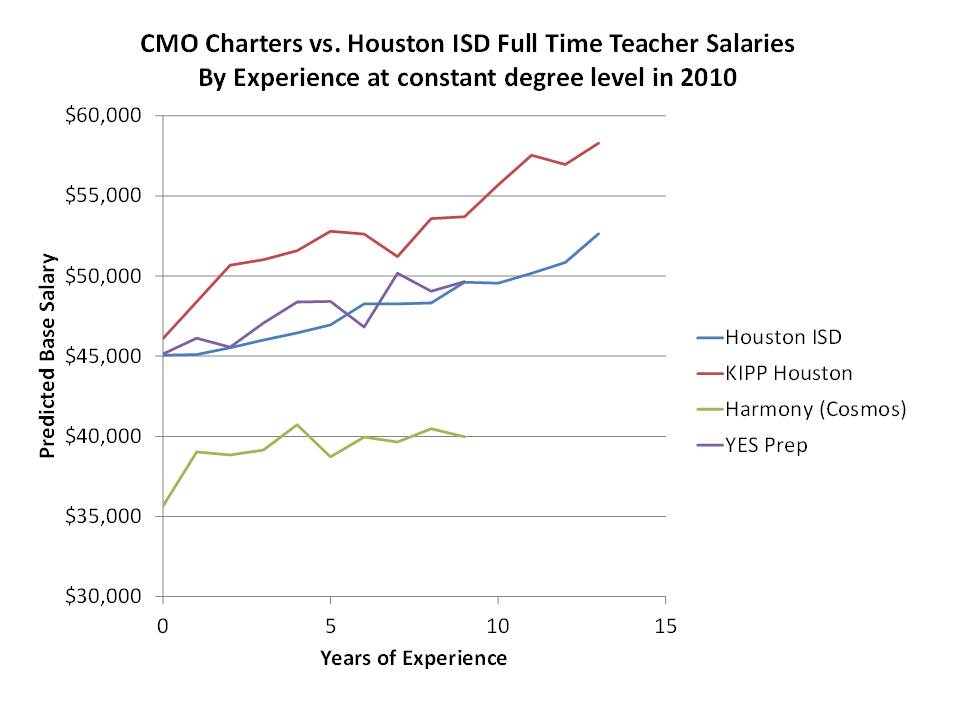
Harmony (Cosmos/Gulen) schools in Texas are relatively low spending schools and have particularly low labor expenses. Notably, this network of Texas charter schools is large enough to drag down average spending and average labor costs for charters statewide. 
In the Houston area in particular, not only do the Gulen schools pay very low starting salaries, but salaries don’t appear to grow over the first few years of experience. Notably, the Harmony/Cosmos/Gulen schools really don’t have any teachers with more than a few years of experience. Now, this could be in part because no-one would really want to stick around if there’s no outlook for wage growth over time, or because no-one who would have intended to stick around ever applied to begin with, leading the schools to make extensive use of temporary imported staff. 
Figure 1. Houston Area Wages for Charter & District Schools
Figure 2 through Figure 4 show the average school level wages for teachers in Texas district and charter schools in Houston and Austin. Notably, Harmony schools have very low average experience levels and also have very low average salaries. They also have low average salaries even given their low average experience levels. Is it any wonder they suffer a teacher supply problem? Especially with a curricular emphasis on math and science? And especially in tech heavy urban centers. [emphasis mine]
Read the whole thing, and remember this: Paterson already has a Gulen-affiliated school, the Paterson Charter School of Science and Technology (Gulen's own website makes the connection! Here's more.). Adding Paterson A&S further expands the Gulen charter network in North Jersey - and it potentially increases the number of low-paid teachers in the region.

The NJDOE has promised to release the application from Paterson A&S soon. I can't wait to see what it does - and what it doesn't - reveal.

Monday, February 18, 2013

Charter School "Chef" Makes More Than Teachers!

Want to make money at a charter school? Don't become a teacher; be a chef!
A March 2012 menu feature at Camden's LEAP Academy University Charter School was grilled cheese, tomato soup, peas, and fresh fruit. This month, the menu features grilled cheese, tomato soup, and strawberry applesauce. 
A more striking change than in the menu is what executive chef Michele Pastorello is getting for his work now - a $24,000 raise from last year. 
He will make $95,000 this school year - significantly more than comparable food-service directors' salaries in other New Jersey public school districts. 
The raise came as part of a new food-service contract the school entered for this year, replacing Aramark with Metz Culinary Management. According to the school's bid specifications, obtained by The Inquirer from a person knowledgeable about the matter, Metz was required to retain Pastorello. 
Pastorello is also the live-in boyfriend of the founder and board chair of the charter school, Gloria Bonilla-Santiago. The two are in a "committed relationship," said school spokesman Adam Dvorin. 
Because of her personal relationship with Pastorello, Bonilla-Santiago recused herself from any votes dealing with the food-service contract, Dvorin said. He said neither Bonilla-Santiago nor Pastorello were available for interviews. [emphasis mine]
Oh, she "recused herself," did she? Well, then, everything must be just fine! Nothing to see here folks, move along...
A school district of fewer than 5,000 students would generally pay a food-service director - the post comparable to executive chef at LEAP - between $45,000 and $50,000, said Tom Dermott, president of Clarion Group, a food-service consulting firm. A suburban district with 20,000 to 30,000 students could pay about $60,000, or at most $80,000, he said. 
But $95,000 is "pretty steep . . . well above market rate" for a charter school with about 1,000 students, Dermott said. 
The food-service director for the nearby Pennsauken School District, which has 5,603 students, has a $76,206 salary, according to school officials. The Cherry Hill School District food-service director, who is an Aramark employee, makes about $50,000, according to a person familiar with the contract. That district has about 13,000 students.
I guess this is the sort of awesome stuff charters can do when they are "freed" from the "burden" of "bureaucracy" and allowed to "innovate," right?

LEAP, of course, is the charter that lost its non-profit tax status and has now put its bonds, guaranteed by Rutgers-Camden, at risk. The charter, which has failed to make Adequate Yearly Progress for years and underperforms relative to its student population, has an anti-union past and a history of athletic recruiting violations. Bonilla-Santiago has been accused of using school personnel for her personal benefit. The school is the center ring in New Jersey's charter school circus...

And yet Commissioner Chris Cerf, oblivious to LEAP's many problems, happily cut the ribbon this past fall on the charter's new facility:


There he is, enjoying the ceremony while his friend Bonilla-Santiago helpfully holds the ribbon. I wonder what they had for lunch afterwards...

Meanwhile, Camden's public schools - you know, the ones that have to serve the kids LEAP won't take - are crumbling. And the beautiful, deserving children of Camden - who live in one of the poorest, most dangerous cities in America - wait and wait and wait for new schools that will teach all of them.

How much longer does this idiocy have to continue before the New Jersey Legislature wakes up and demands accountability from Commissioner Cerf and Governor Christie? How many more accusations of cronyism and cheating and favoritism and mismanagement and incompetence and segregation do we need to endure before someone finally admits that the New Jersey charter oversight system is completely broken?

Chris Cerf's NJDOE has proven yet again that it does not know how to approve or oversee New Jersey's charter schools. There should be a moratorium on any new charters until state law is rewritten and control of charters includes local approval and oversight. 

This clown show has gone on long enough.

Accountability begins at home.

Joel Klein: As Excellent As He Says He Is? Part VI

Joel Klein is one of America's foremost proponents of corporate education "reform." He asserts that public education is in such a crisis that it constitutes a national security threat - a threat that can be dealt with by buying technology from the firm he runs for Rupert Murdoch, Amplify. He also believes that the "reforms" he and Mayor Michael Bloomberg instituted in New York City - including mayoral control, school closings, charter expansion, and test-based teacher evaluations - should be replicated across the country, based on what he terms the "compelling" improvements made under his tenure.

But does the record support his claims? What is the legacy of Joel Klein in New York City? I'm looking at the evidence to see if the facts support Klein's boasts. Here's the series so far:

Part I: Joel Klein has no problem twisting the facts to suit his ends. Has he done the same thing when crowing about his "success" in New York?

Part II: When you break down national test scores by student subgroups, Klein's "success" in New York isn't very impressive; in fact, it's downright disappointing.

Part III: A look at national test scores as a whole, comparing New York to other cities during Klein's reign. The results? Meh.

Part IV: Klein compares test score gains in NYC to the other cities in New York State. But he forgets to mention that child poverty has soared in Upstate while remaining relatively flat in NYC.

Part V: The demographics of the "Big Five" cities in New York State changed dramatically during Klein's tenure. Yet Klein doesn't mention this when discussing his record of "success."


Once again, here's former NYC Schools Chancellor Joel Klein on his - and Mayor Michael Bloomberg's - record of "success':
Similarly strong improvements were achieved on state tests, although the story here is harder to explain because the state changed the testing requirements several years ago, and so the number of kids passing (i.e., achieving the proficiency or advanced level) dropped because the questions were intentionally made harder and it took more correct answers to pass. 
Nevertheless, if you compare New York City’s performance under Bloomberg to two other groups (the other so-called “big four” cities in New York State — Rochester, Buffalo, Syracuse and Yonkers — and the rest of the state), each of which took precisely the same tests as the city, the results are compelling. 
In a nutshell, in 2002, when Bloomberg started, on all four tests, New York was much closer to the big four cities and far away from the rest of the state. 
Today, it’s the other way around, showing that the city moved significantly forward when compared to the other two relevant groups. Indeed, despite the fact that the exams were more difficult and required more correct answers to pass, New York City increased its pass rate on all four tests; the other two groups didn’t come close. [emphasis mine]
As I showed in my last two posts, Klein is engaging in a serious deception of omission here, because he refuses to acknowledge the very large changes in both child poverty rates and student demographics in the "Big Five" over the last decade. Any fair reading of these statistics would concede that New York City has enjoyed an advantage over Rochester, Syracuse, and Buffalo (less so with Yonkers) that would help Gotham's test scores relative to the other cities.

But what if a researcher tried to control for these shifts in student populations? What if he could isolate the effect of New York's City's "reforms" from both state-wide trends in tests scores and changes in student populations? To his credit, Klein briefly mentions one such study:
Independent studies by respected researchers like Caroline Hoxby and Margaret Raymond at Stanford, James Kemple at the Research Alliance and the independent public policy institute MDRC all support this conclusion. So do the numbers, which the critics conveniently ignore. [emphasis mine]
Here is the copy of Kemple's study I've been working off of; apparently, it's also been published in a book, which I have not yet read, in what Kemple's paper says is a "slightly edited form."

Let's start with an acknowledgement: this is a clever study and Kemple is a serious researcher. But does the study back up Klein claims? When we account for student differences, can we attribute relative gains in NYC's schools to Bloomberg's and Klein's policies?

Let's ask Kemple himself:
A second limitation is that although the analysis can shed light on the overall effect of reforms that occurred during the Children First era, it cannot isolate the specific features of the Children First reforms that may have been most responsible for these effects. As discussed elsewhere in this volume, the reforms have had many components, and these were designed to interact with each other and with other policies and school conditions. By exploring the variation in Children First effects across schools within New York City and by collecting data on the implementation of specific reform activities, further research can expound on the mechanisms that enhanced or limited the impact of Children First reforms; studies of this nature are being undertaken by a number of researchers, including the Research Alliance for New York City Schools.

As a final note before discussing the findings, the paper also presents differences and similarities between New York City and the remaining New York State districts in an effort to provide a further context for interpreting test score trends in New York City. These comparisons control statistically for test score trends prior to 2003 and for differences in school demographic characteristics. However, there are dramatic demographic and prior-performance differences between New York City and the rest of the state; greater caution should be exercised when using these comparisons to infer evidence about effects of reforms undertaken during the Children First era. (p. 8) [emphasis mine]
So Kemple is cautioning against using his study in exactly the way Joel Klein uses it. Even if Kemple can show a gain in NYC's relative scores, we should be very cautious about saying those gains were caused by policies under Bloomberg and Klein.

But even if we could say with certainty that relatively higher test score gains should be attributed to Klein's policies, I'd still say Klein is wrong to cite Kemple's study as proof of his "success" - because I don't think Kemple has conclusively proved that NYC had better student achievement than the other "Big Five" cities when accounting for student population changes.

Kemple uses a method called a "comparative interrupted time series analysis" to create what researchers call a "counterfactual": a hypothetical outcome of what would have occurred had Klein's policies not been in place. Here's an example:

This shows the "Percent of Students Scoring at Level 3 or 4, Grade 4, Mathematics School Year 1998-1999 to School Year 2009-2010." The color key is in the chart below.


Here we have the hypothetical "counterfactual" judged against the actual gains of NYC's students. Which begs the question: how did Kemple come up with his "counterfactual"? On this question, I'm afraid, the documentation is light: I would challenge anyone to replicate Kemple's results based on what's in this paper. Kemple does refer to other research that has used the same methods, which is fine, but it doesn't help us understand how he came up with his counterfactual. So we're left in the dark here on the critical question: is the counterfactual a valid comparison?

Even thought we don't have Kemple's exact methods, from what I can ascertain I'd say there are more than enough issues here that we should be very, very wary of the conclusions Joel Klein makes based on this study:

- Conflating Free Lunch and Reduced-Price Lunch. This is one of Bruce Baker's pet peeves, and rightly so: there is a real difference between the deep poverty of children who qualify for Free Lunch and those who are in relatively less poverty who qualify for Reduced-Price Lunch. It appears that Kemple conflates the two categories, and that may well mask some of the variation between New York City and the other Big Five. Remember, NYC did not get hit with the sharp increases in child poverty that ravaged Upstate over the last decade.


(By the way: in Kemple's paper, it appears that he does not use any poverty data when constructing his "Estimated Counterfactual," but does use it when creating the "Adjusted New York State" estimate (p.10). Why? And why use it later (p.19)? Is this a publication error?)

- Using Proficiency Rates changes instead of test scores changes. This is one Matt DiCarlo harps on often: changes in proficiency rates are not the same as changes in test scores. Kemple himself acknowledges that simply dealing with proficiency rates may mask real improvements - or declines - in test scores.

A proficiency rate tells us how many students passed a certain minimal score on a test. Think of a track team: if five out of ten high jumpers on the team can clear six feet, we might say their proficiency rate is 50%. If we want to increase this rate, we would need to get more members of the team to jump over that six-foot bar (or lower the bar - which is what New York State did. Kemple says that's OK because all students in the state were affected - but were they affected equally? Hmm...).

But that doesn't tell us how high every athlete can jump, and it doesn't tell us about their improvement. If one team member starts the season at 4' 9" and ends at 5' 11", he will have made great progress, but he still won't be "proficient." And if another jumper starts the season at 6' 8" but ends at 6' 1", we won't see his decline measured in the team's "proficiency."

Kemple use of proficiency rates is likely masking many changes in actual test scores. His paper says he will be looking at changes in actual scores the future; I don't know if this analysis has been released.

- Using data that isn't finely disaggregated. This is a problem in all educational research: the data sets just aren't very well-tuned. "Special education," for example, is a great big box that includes students who have everything from simple speech impediments to severe cognitive disabilities. There's not much a researcher can do about that, and it doesn't mean you should discount research on this basis alone. However...

Lets go back to the changes in student demographics in New York State over the past decade. Take white students:


I had to double check the numbers when I saw this, but it's true: the Syracuse City School District had 9,799 white students in 2002-03, and 5,843 white students in 2010-11. Buffalo and Rochester saw significant declines as well. The Upstate urban cores have seen significant drops in white population over the last decade (p. 15), but I suspect the aging of the Upstate white population is also contributing to the student population changes. NYC's relative white student population has remained flat.
But in the comments, Ken Houghton makes an excellent point:
One of the problems with using percentages is that it can obscure population changes. 43% of x(2003) = 9,799, while 27% of x(2011) = 5,843. So there's about a 5% drop in the population in Syracuse over that time, but a 40% decline in the White population.

Which wouldn't matter if White were homogeneous. But it's not--and the people most likely to leave are those who have the resources to be able to leave.

It's a double effect: you have fewer White students, and significantly more poor White students as a percent of the White population.

If anything, your down-and-dirty method understates the negative impact, because the cohort has changed as well.
Kemple's model may well account for a declining white population in Syracuse when he builds his counterfactual for New York City; what he can't account for, however, is the differences within that sub-population of white students: most likely, the families who leave are quite different from the families who stay.


So we've got some real concerns here. I'd also add that the study - like any study that uses standardized tests results - naturally conflates student achievement with test scores. Even if we buy into the validity of Kemple's counterfactual, we have to take a further leap and assume that gains on New York state tests are actually gains in real learning. But it may well be that New York City's children didn't get relatively better at math or language arts; instead, they got better at taking state math and language arts tests.

Given that New York City's performance on the National Assessment of Educational Progress was relatively weak over the same time period, I'm inclined to believe that any relative gains on New York's tests were a manifestation of Campbell's Law: Klein made the state tests the focus of schooling, so the test scores rose.

Again, this is a serious study and it deserves a serious reading. But absent a theory as to why Klein's and Bloomberg's policies might have led to a relative rise in New York City's proficiency rates, Kemple's research has more than enough holes in it for us to approach it with great caution. It certainly isn't a strong enough counterweight to the relatively poor showing on the NAEP that we should ignore NYC's disappointing performance on national tests.

In addition: we now have new reasons to believe that even the absolute gains NYC made in state tests are suspicious. Like Washington, D.C. and Atlanta, evidence is beginning to emerge of a culture of cheating within New York City's schools. More on this next.

Uh-oh...