alexandr
Diane Ravitch cares about school segregation now? That's new. http://pllqt.it/t0H4FD
 Diane Ravitch
@alexanderrusso If you read "Reign of Error," you will find a chapter on the importance of desegregation. How can you judge without reading?
It's true: Diane did write an entire chapter in Reign of Error about the effects of segregation on schooling. I know because I pointed that chapter out in my review of the book, and included an excerpt:
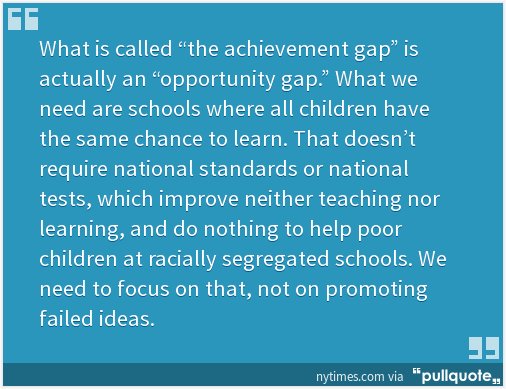
But the wounds caused by centuries of slavery, segregation, and discrimination cannot be healed by testing, standards, accountability, merit pay, and choice. Even if test scores go up in a public or charter school, the structural inequity of society and systematic inequities in our schools remain undisturbed. For every “miracle” school celebrated by the media, there are scores of “Dumpster schools,” where the low-performing students are unceremoniously hidden away. This is not school reform, nor is it social reform. It is social neglect. It is a purposeful abandonment of public responsibility to address deep-seated problems that only public policy can overcome.So, from my perspective, Russo is just dead wrong about Ravitch's views. He disagrees:
Over-testing & under-funding are fine but they're not cops out of schools, classroom bias training, etc.
There's really no point in continuing to debate whether Diane Ravitch has adequately addressed segregation -- and other issues related to education, race, and class -- or not. Russo has his opinion and I have mine (not that Diane needs me defending her). I do, however, find it odd that a guy who has publicly admitted he doesn't follow Ravitch's work thinks he has a grasp on her world view:
As you already know, I don't think that's very constructive for CPS over all for Ravitch or anyone else to keep bashing at failed or imperfect reform efforts rather than begin working on some joint efforts. And the truth is that while I like her personally I've basically stopped paying attention to Ravitch because she's become so rigid, ideological, and almost cartoonish in her positions. [emphasis mine]So whatever. But I'd like focus for a bit on Russo's last tweet...
One reason (among many) that Twitter wars are dumb is that most people's view of the world can't be condensed accurately into 140 characters. But I don't think I'm mischaracterizing Russo here in saying that he seems to believe over-testing and under-funding, while perhaps important issues, are not the totality of the conversation we should be having about race, class, and our public schools.
I agree. Dismantling the school-to-prison pipeline certainly requires de-criminalizing our students, which means putting in place structures and procedures that maintain order in schools without denying students -- particularly students of color -- agency.
Classroom teachers most certainly need to reflect on their practice and improve when it comes to issues of race (and class and gender and creed and sexual orientation). I know it's sometimes hard to have those conversations; I'll admit I've had times, as a straight, white, middle-class man, where I've been clueless about my privilege until someone pointed it out to me, and I've had to acknowledge the effects of that privilege on my work as a teacher.
So there's lots of work to do here -- and we haven't even touched on things like the racial composition of school faculty, or disparities in school governance, or racial and other bias in curricula, or a dozen other issues.
But let's note how Russo framed his tweet: apparently, over-testing and under-funding is one set of issues, and more immediate concerns about social justice in schools is another. I, however, would argue these issues are not separate; to the contrary, they are tightly intertwined.
Because there will be no sustained social justice in our schools in the absence of adequate and equitable funding.
The first reason why is obvious: you can't claim our school system is just when students are receiving fundamentally unequal educations due to resource disparities. As I noted recently, one of my great frustrations with the charter school sector (or, more accurately, a large part of it) is their continuing insistence that the "choices" they are offering their students and families are somehow equivalent to the "choices" suburban families have when enrolling the children in well-funded public district schools.
There is no equivalence. Even the highest-flying charters cannot match the offerings, atmosphere, and resources of more affluent suburban schools. And the students know this -- they know the system is unequal. They know their "choice" -- underfunded, crumbling, neglected public district schools or "no excuses" charter schools -- is not the "choice" kids in the leafy 'burbs get.
Research has clearly shown that schools serving more at-risk students need more resources to achieve comparable results. And yet even progressively funded states, like New Jersey, have reneged on their commitments to fully fund urban public schools -- even though that commitment is probably still not enough to provide an adequate education for those students.
But even if we set this reality aside, there's another problem with separating funding and social justice in education: bringing restorative practices to schools costs money. As Rethinking Schools points out:
And so we see also the importance of moving beyond a test-and-punish curriculum if we really want social justice in our schools. Over-testing and under-funding make achieving social justice in education much more difficult. Evans, Lester and Anfara (2013) note:But simply announcing a commitment to “restorative justice” doesn’t make it so. Restorative justice doesn’t work as an add-on. It requires us to address the roots of student “misbehavior” and a willingness to rethink and rework our classrooms, schools, and school districts. Meaningful alternatives to punitive approaches take time and trust. They must be built on schoolwide and districtwide participation. They are collaborative and creative, empowering students, teachers, and parents. They rely on social justice curriculum, strong ties among teachers and with families, continuity of leadership, and progress toward building genuine communities of learning.Too often, this is not what we see in places that tout a focus on restorative justice. At far too many schools, commitments to implement restorative justice occur amid relentless high-stakes “test and punish” regimens—amid scripted curriculum, numbing test-prep drills, budget cutbacks, school closures, the constant shuffling from school to school of students, teachers, and principals.Meaningful restorative justice also requires robust funding. It can’t mean a high school teacher released for one class period to “run the program” or a mandated once-a-year day of staff development training. Under these circumstances, announcing one’s embrace of “restorative justice” is hypocritical window dressing.
A quick tour around the web finds plenty of examples to confirm this. California, for example:Despite its many benefits, restorative justice in schools remains largely an abstract idea, while punitive discipline remains the norm. One obstacle to wider implementation of a restorative justice disciplinary model in schools is the cost of developing such a model. In Minnesota, the State Legislature authorized a $300,000 grant for four districts to develop alternative disciplinary measures. In Denver, a non-profit organization supported the schools implementing restorative justice models. Without supplemental sources of funding, it is unlikely that schools will have the financial resources to develop their restorative justice programs, given the existing pressure on schools' budgets and personnel resources. [emphasis mine]
If they had more money to improve discipline in their schools, administrators would spend it on counselors, staff training, conflict-resolution programs, support services and rehabilitation services, rather than security, a study released Monday reported.Another example:
But of course they have less money. And the study, by the Oakland-based education resource and research group EdSource, found that state budget cuts are affecting the ability of administrators to deal with student discipline and behavior. Overwhelmingly, the respondents -- from 315 school districts around the state -- said they were concerned about discipline and also whether it varies by students' racial and ethnic backgrounds. [emphasis mine]
How about Pennsylvania?But the data—along with interviews with parents, students, and educators—reveal that progress so far is halting and uneven. Critics say that’s because the transition from punitive to restorative justice is haphazardly evaluated and underfunded. In fact, Peer Courts, a model program extensively promoted in the Board’s 2009 resolution, was forced to close this year due to budget cuts. Meanwhile, suspensions and expulsions are actually rising in some schools that have yet to embrace restorative practices, often in low-income, high-crime neighborhoods. At one, Thurgood Marshall High School, suspensions have almost tripled since 2007.The resulting picture is a school-by-school patchwork, at best an unfinished project to reform the traditional juvenile discipline paradigm. It’s a work-in-progress that contains lessons for educators and parents in other districts who are looking for effective disciplinary policies in a time of severe budget cuts. [emphasis mine]
Let me be clear: I don't think budget cuts should be used as an excuse for schools to not examine their disciplinary practices. I think administrators and teachers must improve in making their schools places of true social justice, even when short-sighted politicians refuse to do their jobs and adequately fund schools.But in states like Pennsylvania, budget cuts have endangered districts’ ability to dedicate and train staff in new approaches to discipline. Thirty-four states will spend less this year on education than they did before the recession. The School District of Philadelphia lost $300 million for the 2013–2014 year and had to close 23 schools and fire almost 4,000 staff members, including all its assistant principals, more than 250 counselors, and more than 600 teachers. The district’s projected shortfall is estimated to rise to $320 million next school year.Restorative-justice programs don’t cost a lot to implement—two-year training for faculty runs between $50,000 and $60,000—but they do require schools to have sufficient staff. The support staff on which the programs rely—counselors, assistant principals, restorative-justice coordinators—are often the first to go when budget cuts hit. [emphasis mine]
I also don't believe adequate funding, by itself, is enough to overcome the systemic inequality built into our public schools. And even desegregation, by itself, isn't enough -- we have too many examples of discriminatory practices within more integrated schools to ever be sanguine about this.
But expecting a sustained, meaningful change in our schools' social justice outcomes in the absence of adequate funding and the presence of a punitive, testing-driven curriculum is not realistic.
I'm going to grant Alexander Russo a courtesy that he refuses to grant Diane Ravitch: I believe he wants the best for all of our students, especially those who are victims of systemic racism and economic disadvantage. But I think his framing needs to change. Inadequate funding and over-testing are part and parcel of social injustice in our schools. They must be part of any larger program of establishing our schools as places where our best American ideals are realized.