I will protect your pensions. Nothing about your pension is going to change when I am governor. - Chris Christie, "An Open Letter to the Teachers of NJ" October, 2009

Saturday, July 16, 2016

How The Charter Cheerleading Industry Is Abetting The Destruction Of Public Schools

Folks, I've had some real problems with Blogspot lately. For some reason, this post disappeared, and I can't figure out why. It's troubling because if I can't count on this remaining a stable platform, seven years of work is in jeopardy.

Luckily, Rosi Efthim at Blue Jersey had cross-posted this post, so I recovered what I could and moved it here. But I seem to have lost the links to graphics, and the formatting is messed up. I'll try to fix them soon.

Wordpress, you're looking better all the time...


I know I swore off wasting my time (and yours) criticizing reformy edu-bloggers. But I've been watching a back-and-forth on social media for the past few days that is such a good example of how destructive the charter cheerleading industry has become (fueled with an insane amount of money from ideological foundations) that I have no choice but to comment.

This all started on Tuesday, July 5, when NJ Spotlight (full disclosure -- I write regularly for them) ran an excerpt of an address a graduating senior at North Star Academy Charter School gave to his classmates. Which is fine: all kids should be proud of their accomplishments and their schools (although it's a shame Spotlight has not, to my knowledge, published the excerpts of any other graduating senior's speeches -- especially students graduating in Newark).

So why does that matter? Well, this past month Governor Chris Christie proposed a radical shift in the allocation of state aid for schools -- one that would slash funding and jack up taxes in urban school districts while giving the state's wealthiest districts, already paying relatively low effective tax rates, a huge infusion of state aid (I wrote about it for Spotlight here).

How did Christie justify such a radical plan? Simple: if urban charter schools, like North Star, had higher graduation rates than their hosting public district schools, that then "proves" the extra funding New Jersey sends to urban districts is going to waste. Here's Christie's very first press conference where he justified his scheme:
Do not let anyone tell you that failure is inevitable for children in those 31 districts or that money is the answer. The Academy Charter High School in Asbury Park had an 89% graduation rate compared to 66% in Asbury Park; Academy spends $17,000 per pupil while the traditional public schools spend $33,000 per pupil. The LEAP Academy Charter School has a 98% graduation rate in Camden, while the district has a 63% rate; LEAP spends 16,000 per pupil while the school district spends $25,000 per pupil. In Newark, the North Star Academy Charter has an 87% graduation compared to the citywide rate of 69%; North Star spends $13,000 per pupil compared to $22,000 per pupil district wide. [emphasis mine]

I'll get to Academy Charter High and LEAP in due time; for now, let's concentrate on North Star. First of all, let's ask the obvious question: is an 18 percentage point difference really so impressive that it justifies slashing Newark's state aid by a reported 69 percent? Especially after Christie's own hand-picked state superintendents of NPS, Cami Anderson and Chris Cerf, have bragged repeatedly about Newark's rising graduation rates?

Next: are those spending figures accurate? Not if you believe the data from Christie's own Department of Education's Taxpayers' Guide To Education Spending:


As I pointed out previously, Christie shamelessly made up his spending comparison numbers; further, it's bogus to compare the district's total spending to the charter schools' spending when the district has costs like transportation for charter and public school students that the charters don't have to bear. When looking at Budgetary Per Pupil costs, which the state itself says is the appropriate comparison, the difference between North Star and NPS is about $1,700 per pupil.

Which makes sense given the differences in student populations:


North Star has a much smaller proportion of special needs students than NPS -- and even Chris Christie admits special education students need more money for their education.

Christie's argument is garbage: North Star's graduation rate in no way shows that NPS can sustain a huge cut in its budget. So while it's nice to reprint the graduation speeches of students -- and, again, all kids should be proud of their school -- it's more than fair to point out that a graduating senior's pride might be masking a larger truth that is directly relevant to a policy discussion occurring in New Jersey at this very moment.

Which is what Julia Sass Rubin did in the comments section of the NJ Spotlight piece. Before I go further, let's get this on the record: Julia is a professor at Rutgers-New Brunswick where I am working on my PhD (she's in a different school and I've never had a class with her). Julia is also a founding member of Save Our Schools NJ, a group that believes that local residents should have a say in whether charter schools should be allowed into their communities, draining money from their local budgets.

Julia and I co-wrote a report on NJ charter schools that got a lot of local charteristas in a snit, even though the report was almost entirely graphs, like the one above, showing (with publicly available state data) that charter schools in New Jersey do not serve the same student populations as their hosting schools.

Here's Julia's comment in its entirety:
It's great that Aaron Caraballo-Ugaro was happy at North Star Charter. Apparently, that was not the case for many of his classmates.

North Star graduated only 55% of the students who were in Mr. Caraballo-Ugaro's class in 5th grade (84 out of 153).

According to the NJ Department of Education enrollment files, between 5th and 12th grades:

North Star lost 61% of the Black males (30 out of 49), who were in the class of 2016.

North Star lost 31% of the Black females (21 out of 68).

North Star lost 71% of the Hispanic males (10 out of 14)

North Star lost 43% of the Hispanic females (9 out of 21)

And the students who attend North Star are very different than the students who attend Newark's public schools.

In 2014-15:

North Star had ZERO English Language Learners vs 11% in Newark Public Schools.

North Star had a 9% special education rate vs 17% for Newark Public Schools.

North Star had a 69% Free Lunch rate vs 76% for Newark Public Schools.

North Star students were 55% female vs 49% for Newark Public Schools.

In evaluating North Star Charter School, it is important to keep in mind that North Star is educating a much easier population of students than Newark Public Schools and it is losing a very large number of those students on the way to graduation.
That's it. That's the entire comment. Go back and check if you doubt me.

Do you find this at all insulting to the young man whose words were reprinted in NJ Spotlight? Do you think Rubin was at all sarcastic? And do you think that the points she's making here are irrelevant given Christie's funding proposal, which had been introduced only two weeks before?

If you're Laura Waters, NJ's reformiest blogger, these questions can only be answered in one way -- the way that serves charter schools best:

Minutes later Julia Sass Rubin sarcastically rained on his and thousands of other Newark students’ parade. Let’s hope that Aaron and his college-bound classmates (100% of whom were accepted to 4 year colleges by the way) don’t end up in classes with professors like Rubin. Instead, we hope that his professors are objective people who can present facts to their readers and not selectively cherry pick some facts over others to try to push their status quo agenda that hurts urban kids like Aaron.

First of all, someone needs to buy Waters a dictionary so she can look up the meaning of the word "sarcastic." Because no reasonable person could possibly think Rubin was sarcastic in her comment. This is so typical of the "tone" arguments the reformy side loves so well: somehow, if you dare to question the (largely self-reported) claims of charter "successes," you are going after those charters' students or teachers or parents. It's a cheap argument and so transparently dumb I'm embarrassed for anyone who makes it.

Next: Waters takes a swipe at Rubin's professional integrity (classy) to claim she's cherry picking her data. To rebut Rubin, Waters brings out her own set of facts:
What she doesn’t tell her readers is that North Star’s attrition is actually half of the Newark Public School system’s average. North Star loses about 10% of its students a year—while NPS schools on average lose 20% or more. The NPS rate is not surprising for an urban school district, but what is surprising is that Rubin, a university professor, would present a completely one-sided number and not even bother to compare it to a constant. Clearly it’s because she wants readers to think that North Star’s attrition rate is high rather than the truth—that North Star’s attrition rate is low—and other schools should be flocking to it to find out why.
Now, that's a curious statement. Because I've been working with NJDOE data for a good long while now, and I can tell you that school-level attrition figures -- data that shows the rate at which students leave their schools -- are not available publicly (at least, I've never seen them).

Where is Waters getting her data? She doesn't say (hold on...).

In addition, whether a school "loses" students isn't really the important metric for this discussion. Yes, it's likely that NPS schools see a big turnover in students year-to-year, as schools enrolling a high proportion of students in economic disadvantage tend to see higher student mobility rates. This has a negative effect on student outcomes (Waters seems to believe schools can influence student mobility; I'd like to see some evidence that's the case).

But leaving that aside, the real question here isn't mobility caused by family circumstances; it's whether North Star students are leaving and not being replaced with new students. I mean, we're always hearing about the long (unverified) wait lists for charter schools, right? Well, if kids are dying to get in, why don't they rush to take open spots once an enrolled student leaves? Why are North Star's cohorts -- the "classes" that move from grade-to-grade together -- shrinking?

Enter Bruce Baker,* who just posted a series of updates on Newark's charter schools at his blog. Baker has been writing about the patterns of "cohort attrition" at North Star for a while now. What did he find in his latest data dive?


Let's break this down starting with All Students. The NPS class of 2016 had 98 percent of the students that the same cohort had when they were 7th Graders. Were they all the same kids? Surely not, but as students moved out of the district, other students moved in. That would explain a high student mobility rate -- the one Waters tut-tuts about above -- but a fairly stable cohort size.

At the same time, however, North Star's Class of 2016 shrunk, and shrunk, and shrunk some more, until they were 61 percent of the size they were in 7th Grade. If the wait lists to get into North Star are so long, why didn't the students on the list take the place of the students who left?

Baker's also included the cohort attrition for black boys. Those numbers actually grew from Grade 7 to Grade 12 in NPS. But North Star's number of black boys shrank by half in the same time period. Again, if so many black boys are waiting to get into North Star, why didn't they take the place of the black boys who left?

Some obvious questions arise: why are students leaving North Star and not being replaced? And might that affect student outcomes? There's no way to know for sure without having student-level data, but, as I've shown before, we have some clues:

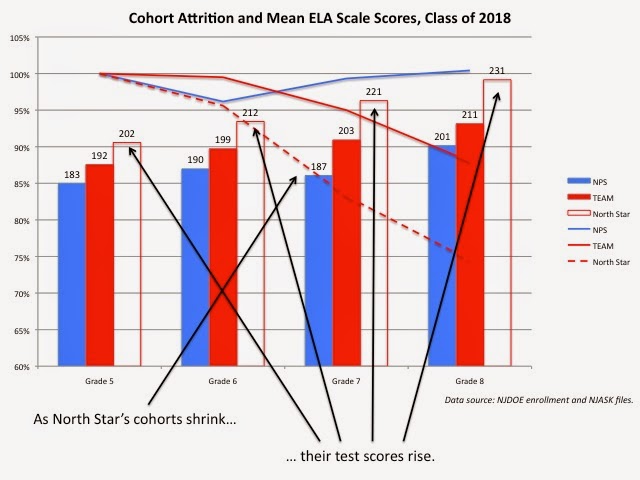


North Star's test scores tend to rise as their cohorts shrink. Now, what I've done here is actually a bit crude -- go to Baker's post to see a much more sophisticated version, which takes into account the shifting means year-to-year in test outcomes. Both graphs show the same thing: North Star's relative test scores rise as they shed students. Again, this is hardly definite proof of "cream skimming" -- the practice of cutting loose the students who struggle and then claiming superior results. It is, however, more than enough evidence to justify the release of student-level data (with the obvious privacy protections) to researchers to determine what might be going on at North Star.

What do you think the odds are that Chris Christie's NJDOE will do that?

Having botched up a defense of North Star's shrinking cohorts, Waters continues her missive with an attempt to explain away North Star's low special education and Limited English Proficient (LEP) rates. She claims, correctly, that there is great variety in NPS schools' LEP enrollment rates. But so what? Newark has several schools with high LEP rates; North Star isn't one of them. Isn't that entirely germane to any conversation about school costs and outcomes?

She then counters Rubin's correct assertion that North Star has a comparatively low special education classification rate with a few anecdotes from North Star parents which just happened to be published in the op-ed pages of the Star-Ledger, the state's largest newspaper. Let me be clear: these weren't letters to the editor; they were full-length opinion pieces.

One other story Waters links to is an NJTV news report that at least features a contrary point of view from the estimable Dr. Daniel Katz of Seton Hall. But the report also features Barbara Martinez, the Chief External Officer for Uncommon Schools, North Star's parent organization. According to Uncommon's tax forms (you can download them at Guidestar.org), Martinez is one of over a dozen managers at Uncommon making a six-figure salary.

For those of you (like me) who aren't up on your corporate-speak, a Chief External Officer is basically in charge of marketing and PR. Someone who knows how to work the press. Someone who culls the data to create a favorable picture of product. Someone who knows how to get info out to friendly outlets and have them push the organization's brand.

I ask again: where did Laura Waters get all of her data points?

Look, I understand that any school -- public, private, charter, whatever -- is going to try to present itself in the best possible light. But facts are facts: North Star does not have nearly the proportion of special needs students as NPS. Waters can regurgitate all the op-eds she likes, but that's simply the way it is.

I don't want to belabor this further, so quickly:

- No, Laura, it's not the case that "the most commonly accepted marker of poverty in schools is free AND reduced price lunch." Those of us who take this stuff seriously know that FRPL is set at 185 percent of the poverty line, so it is technically inaccurate to equate eligibility for FRPL with poverty status. See Bruce Baker for an informed discussion of why this matters.

By the way: Julia Sass Rubin never said "that reduced price kids don’t matter." That is yet another mischaracterization by you, Laura, of someone else's words. It's cheap and it's lazy and if Peter Cunningham, your patron at Education Post, really cared about having a "better conversation" he'd take you aside and tell you to stop.

Because it really is obnoxious.

- We have no idea how the children who stayed at Alexander School when North Star took it over may have improved on their test scores, because -- as I explained to Richard Whitmire -- North Star's test scores are reported in the aggregate and not by individual school. We further don't have any publicly available data on how many students stayed and whether the students who stayed differed from the students who left.

And no, I don't trust data released by North Star itself -- any more than I trust McDonalds to tell me how much better people like their burgers than Wendy's.


I've spent more time answering Waters' post than it deserves; however, I'm doing so this time for a reason. Chris Christie has proposed a radical change in school funding -- one that even Peter Cunningham agrees is pernicious for this state's neediest children. Yet how does Christie justify his plan? With stories of charter school "success." And who has sold this tale?

Laura Waters, Peter Cunningham, and the well-heeled charter school operators themselves. In their zeal to pump up charters and shoot down honest critics like Julia Sass Rubin, these fine, reformy folks have set up the students who attend New Jersey's urban, public, district schools for a huge cut in their schools' budgets.

I've said this before and I'll say it again: I don't ever pretend that I don't have a point of view. I'm a New Jersey public school teacher and I am damn tired of being blamed for things completely out of my and my colleagues' control. I think the celebration of charter school "success" is largely a pretext for beating up teachers unions, gutting teacher workplace protections, and cutting back even further on public school funding, particularly in urban districts. I think charter cheerleading keeps us from having a real conversation about the structural problems related to race and economic inequality in America.

But now we're seeing the consequences of unbridled charter love are even more dangerous than mere charter expansion. Charlatans like Christie are using the very arguments charter cheerleaders spout daily to make the case that we can simply turn our backs on urban schools and their students. So long as a few charter schools get better than average test scores -- by whatever means necessary -- it's perfectly fine to cut the budgets of urban district schools.

This awful rhetoric can be laid directly at the feet of the charter industry and their willing saps in the media -- and that includes the professional reformy propaganda machine that exists solely to counter informed critics like me or Bruce Baker or Julia Sass Rubin.

I won't speak for Bruce or Julia, but I'm pretty sure they'd agree with me when I say this: I am not against school choice or charter schools per se. I started my K-12 career in a charter school. I think there are worthwhile reasons for having charters and other forms of alternative schools. I have been teaching long enough to know not every kid is going to fit well in her neighborhood school, and that there are good reasons to offer other choices. I think there are charters that have practices that may well be worth studying.

So folks like me and Bruce and Julia may have a point of view our opinions, but we aren't questioning charter cheerleading simply as a reflex; our criticisms are reasonable and informed by the evidence. Do you disagree? Fine, I'm happy to debate.

But understand: your ill-informed, statistically-inept charter cheerleading is no longer simply about justifying your own school; it's now being used to excuse a wholesale defunding of our urban public schools.

Do you really want that on your hands?

Gimme a "C"!


More to come...

Sunday, July 3, 2016

Once Again, @GovChristie Shamelessly Twists Education Spending Facts

Governor Chris Christie's brazen disregard for facts in today's Star-Ledger is so utterly shameless that I have to respond immediately.

We've seen some truly awful arguments over the past few years from governors across the nation who want to slash state aid to the most disadvantaged school districts. But in the last few weeks, Chris Christie's defense of his "Fairness Formula" has reached new depths of dishonesty. Even the most conservative critics of school funding reform have balked at this plan.

And yet Christie plows ahead, making statements so outrageous it's stunning a public official would try to get away with them:
The Star-Ledger complains that the SDA [Schools Development Authority, the former Abbott] districts don't have the money in their property tax base to fund their schools. But let's look at the numbers. The average New Jersey town spends 52 percent of its property taxes on schools; the SDA districts just 26 percent. If the state blindly pays a disproportionate share of operating those schools, then why should SDA property tax payers feel any obligation to pay more? Yet, there is no mention from The Star-Ledger's editorial page about the failure to fairly fund these SDA schools with local property tax dollars. [emphasis mine]
This is transparently idiotic. While some of the SDA districts have gentrified since the original Abbott lawsuits, they generally are the least-affluent districts in the state. Which means -- as Ajay Srikanth and I pointed out in our report on the "Fairness Formula" -- that they don't have the capacity to generate the revenues they need to support their schools solely with local property taxes.


From our report (click to enlarge). DFG is "District Factor Group," a way of classifying districts by socio-economic status. "A" districts have the lowest SES and, naturally, have both the lowest property values per student and lowest taxable income per student.

The reason the state gives aid to these districts is simple: if they tried to raise the same amount of revenue as a property-wealthy "J" district, they'd have much higher property tax rates. Of course, since they get aid for schools, those districts can then put a higher percentage of their local revenues into other local services like police and fire -- duh.

Everybody who knows anything about taxes understands this. Everybody who is willing to be honest can figure this out. And everybody who follows this stuff knows that even with state aid supplied by a progressive income tax, overall state and local taxes are still regressive, as this report from the Institute for Taxation and Economic Policy shows.


Here are the lowest quintile taxpayers paying a higher tax rate than the top 1 percent! And yet Christie has the gall to say this:
It is often said that budgets are evidence of your priorities. In the SDA districts they speak loudly: Education is half as important as it is to the rest of the state (if someone else is willing to pay), and big local government is nearly twice as important as is it to the rest of New Jersey. Those are the numbers and they are beyond dispute.
What an outrageous assertion. Chris Christie is essentially blaming the poor for being poor, even though they pay higher overall rates in state and local taxes. Then he turns around and questions these communities' commitment to their children. It's sick...

But it gets even worse:
Liberals like the editorial board of The Star-Ledger continue to believe — 30 years of evidence to the contrary notwithstanding — that pouring money into a demonstrably failed system is an essential element to any salvation for our failed urban education system. They cite Newark charter schools' success sending Newark children to college. Yet they fail to explain how they do it at one-half to two-thirds the cost of the failed traditional public schools without the handcuffs put on them by the Democratic Legislature they endorse or the failed public educators they quote such as Newark Mayor Ras Baraka. Layoffs based on seniority rather than merit. A strangling tenure system that requires us to pay awful teachers in the SDA districts not to teach. And those are just two examples of the madness. [emphasis mine]
First of all, if you read our report, you'll find the notion that these districts have "failed" even though we've "poured money" into them to be completely refuted by the facts. To cite just one piece of evidence, here the renowned psychometrician Howard Wainer:
"New Jersey's black students performed as well in 2011 as New Jersey's white students did in 1992. Given the consequential differences in wealth between these two groups, which has always been inextricably connected with student performance, reaching this mark is an accomplishment worthy of applause, not criticism."
There's much more, but Christie, of course, couldn't care less.

Next, as I have pointed out repeatedly, even if you grant the many, many limitations on the studies showing the "success" of some of Newark's charters, it is quite clear even the "best performers" do not come close to matching the student outcomes of affluent suburban schools.

But let's set that aside and address the main point here: do, in fact, Newark's charters have budgets "at one-half to two-thirds the cost" of the Newark Public Schools? It's actually easy to check, using the state's own data from the Taxpayers Guide To Education Spending. Here's a comparison between NPS and the Newark charter sector.


In the aggregate, total spending per pupil in NPS was $22,013; for the charters, it was $18,692.* That means the charters are spending 85 percent of the total NPS is spending; Christie's "one-half to two-thirds" isn't even close!

But hold on! This is a completely invalid comparison. Don't take my word for it; NJDOE says the figure includes things like transportation costs for nonpublic and charter students. The truth is that public districts pick up the costs for things charters don't spend on, like out-of-district placements for students with profound special education needs, private school books, capital outlays for facilities used by the community outside of school, and so on.

The better comparison -- and again, NJDOE itself says this -- is Budgetary Cost Per Pupil. Newark spends $17,041 per pupil; the charters spend $15,336, which comes to 90 percent of NPS's costs. Chris Christie's assertion that Newark charters spend "one-half to two-thirds" what the public district schools spend is contradicted by his own government's data!

Hang on, it gets even worse. Yes, NPS spends more in the classroom, largely because their staff has more experience and, therefore, higher salaries. We know experience is correlated with teacher effectiveness, but we'll put that aside and instead note this:

Newark's charter schools spend far less on student services and far more on administration than the Newark district schools. Students services, as defined by NJDOE, include the following:
This indicator includes expenditures considered student support services under the National Center for Education Statistics (NCES) definition - services supplemental to the teaching process that are designed to assess and improve students' well-being.  It also includes expenditures for activities associated with assisting the instructional staff with the content and process of providing learning experiences. Attendance, social work, health and guidance services, educational media/school library services and child study team services are student support services under the NCES definition. This area also includes the costs associated with physical and mental health services that are not direct instruction, but are nevertheless provided to students, such as supervision of health services, health appraisal (including screening for vision, communicable diseases, and hearing deficiencies), screening for psychiatric services, periodic health examinations, emergency injury and illness care, dental services, nursing services, and communications with parents and medical officials. The expenditures of the guidance office includes counseling, record maintenance, and placement services.  The costs for the child study team include salaries and benefits for members related to the development and evaluation of student individualized education programs (IEPs).  Services provided as a result of IEPs are considered instructional costs and are included in the appropriate classroom instruction indicators. The school library services include books repairs, audiovisual services, educational television services, and computer assisted instruction services. The actual provision of computer assisted instruction is considered classroom instruction. [emphasis mine]
Now, many of these services would benefit any student -- but they are most critical for those students with a special need. Guess what?


Newark's public schools serve many more children with a special education need than the charter schools. As I've shown before, the classified students who are enrolled in the charters tend to have lower-cost disabilities: things like speech and specific learning disabilities (SLD), as opposed to autism or traumatic brain injury or emotional disturbances or physical disabilities.

So it's only natural that the district would have a greater cost load than the charters. You know who agrees with me? Chris Christie!
Of course, we will make sure that we have the aid for special needs students so that they may reach their potential too.  They are the exception though; the overwhelming majority of students deserve the Fairness Formula and we intend to pursue it for them. [emphasis mine]
It's hard to imagine any public official being as shameless self-contradictory as Christie is here.

As to administrative costs: it is clear that charters can't match their host districts on efficiency. There are also many incentives to jack up out-of-classroom costs built into the charter system. The bottom line: if you want to save money, having redundant systems of school governance is a bad idea.

Let's look at Newark's charter vs. NPS spending another way:


Again: comparing total spending is completely invalid -- but even if we did, the charters only spend about 15 percent less than NPS. The more accurate comparison is about 10 percent less, but that doesn't take into account that NPS has a greater proportion of special needs students (and at-risk and Limited English Proficient students as well). Much of the difference between the charter and NPS can be explained by the district's much higher spending on critical support services. Even then, the charters spend far more on administration, including administrative salaries.

All of the facts stand against Chris Christie and his illogical, cruel, and, yes, racist plan to gut the budgets of the schools that serve this state's neediest children.

There's no point in anyone treating this plan seriously; it's built on nothing but distortions, ideology, and lies. Chris Christie has now shown himself to be wholly irrelevant to any meaningful discussion about New Jersey schools or fiscal policies. Sadly, he will still occupy a place of prominence, but all serious stakeholders should immediately understand he has nothing constructive to contribute to the state's policy debates.

Irrelevant then; irrelevant now.

ADDING: I've been called out in the past for using the word "racist" too casually. I don't use it without pause... but read this again:
COMMUNITIES MUST MAKE A CHOICE
It is often said that budgets are evidence of your priorities. In the SDA districts they speak loudly: Education is half as important as it is to the rest of the state (if someone else is willing to pay), and big local government is nearly twice as important as is it to the rest of New Jersey. Those are the numbers and they are beyond dispute.
That is an incredible statement for a governor to make. I don't know if Christie added the "communities must make a choice" subheading, but it's a fair reading of what he is saying here: the SDA districts are "choosing" to shortchange their kids and instead lard their towns and cities with patronage jobs. And he's not even hiding behind a qualifier like "the governments in these communities" -- he talking about the communities themselves.

How can anyone not call that racist? How can anyone claim this is anything less than the worst form of divisiveness?

I refuse to play verbal games on this. It's well past time we started calling things what they are.


* Weighted per pupil average.

Wednesday, June 29, 2016

Christie Visits ANOTHER Gulen-Linked Charter School

There are times when I am astonished that the press doesn't pick up on a particular story. For example: according to activists on Facebook, Chris Christie is having a private meeting tomorrow, June 30, 2016, at Paterson Charter School for Science and Technology.

If this is the case, it will be the third time since this spring that Chris Christie has visited a charter school linked to the controversial Muslim cleric Fethullah Gulen, a Turkish expatriate living in seclusion in the United States.

On May 16, Christie visited Thomas Edison EnergySmart Charter School in Franklin. Two days later, he trekked to Bergen Arts & Sciences Charter School in Hackensack. Thomas EdisonBergen A&S, and Paterson Science & Tech have all been linked by the Gulen Charter Schools website to the Gulenist movement in the US.

As I've written previously, the proliferation of Gulenist charter schools is not some wild-eyed conspiracy theory: it's been reported on by CBS NewsThe AtlanticThe New York Times, and The Wall St. Journal. These schools, all linked to Gulen's movement, have been popping up all over the country and are the subject of concerns expressed by the federal State Department due to their use of H1B visas to admit Turkish nationals into the US.

Given how closely tied Christie is to Donald Trump -- who wants a ban on Muslims entering the country (although even he doesn't seem to understand his own plan) -- I can't understand why no one in the state press has pursued this story. Why is Christie praising so many Gulen-linked charters? Why is he visiting so many of them?

Back in 2011, Leslie Brody, when she was writing for The Record, broached the subject with the CEO of Bergen A&S:
In some states, such as Texas, charter schools led by Turkish immigrants have caused controversy, with critics claiming the schools were used to bring in teachers from Turkey and give contracts to Turkish businesses without fair bidding. In June, The New York Times ran a lengthy examination of these schools, citing some researchers' findings that many were inspired by the views of Fethullah Gulen, a Muslim preacher. Gulen, who lives in the Pocono Mountains, has promoted peaceful dialogue and tolerance but had critics who feared his influence in Turkish government. 
Guvercin said he admires Gulen — just as he admires Gandhi — but his teachers never talk in class about Gulen's philosophy. He stressed that charter opponents should visit before forming opinions. "Some people are not comfortable with any ethnic backgrounds," he said.
Sorry, but that's way too easy. The concern over Gulen-linked charters isn't about staff ethnicities or creeds; it's about transparency. The Ohio press has reported on Gulen-linked charters' use of H1B visas to import Turkish nationals as teachers. In 2011, the NY Times investigated how Gulen-linked charters in Texas made deals with Gulen-linked contractors. The Turkish government (admittedly, hardly an impartial party) recently filed a complaint in Texas related to this investigation. New Jersey taxpayers have every right to know whether there are similar issues with the Gulen-linked charters in this state.

Chris Christie recently proposed a radical transformation of the state's school aid system. Under his plan, aid would be slashed for urban districts -- but, supposedly, not for charter schools. If charters are going to get more state funding than their host districts, that's all the more reason to start asking how that money is being spent.


Here is comparative spending by category for the Paterson Public Schools and PCSST, according to NJDOE data. Yes, budgetary per pupil costs are higher in the public schools -- but much of that is driven by this:


The Paterson Public Schools enroll more students proportionally with a special education need than PCSST. Notice, in the spending graph, that PPS spends about $3,300 per pupil on support services: the services that are especially critical for special needs students. The charter, however, spends nothing on those services according to this data. Instead, they spend more on administration, and much more on their physical plant.

Where is that money going? The Gulen Charter Schools website has a detailed description of the byzantine financial transactions involved in the leases PCSST pays to Apple Educational Services, and how New Jersey Economic Development Authority Charter School Revenue Bonds were used to finance the deal. Apple ES is a foreign non-profit corporation registered in New Jersey. According to its 2014 tax forms (obtained at Guidestar.org), Apple ES controls $36 million in net assets, but also has $34 million in liabilities, primarily bonds issued by the NJEDA. It also pays out $738 thousand in compensation to its staff.

This sort of behavior is quite typical for the charter sector: taxpayer-backed bonds are being used to acquire property that is transferred to private, albeit non-profit, hands,and the bonds are paid off with public funds collected by charters from their host districts. The only way this works, of course, is for the charters to keep expenses low enough to divert enough funds into their lease payments. How does PCSST do this?


PCSST certificated staff have far less experience than Paterson Public Schools staff. And that helps keep costs low:


PCSST staff are actually paid slightly more than PPS staff when accounting for experience. But there isn't even one PCSST staff member with more than 10 years of experience according to staffing files -- and that keeps overall staff expenses low. The money can then be diverted into lease payments. Of course, the evidence continues to pile up that teaching experience matters, even in the later part of a teacher's career. PCSST's students are being denied the benefits of an experienced faculty, but there appears to be plenty of money for bond payments.

Now, all this might be acceptable if PCSST was getting far superior results. But when you account for different student populations as I do here*, it turns out the charter is doing OK -- but not much better than that (click to enlarge).

Compared to PPS, PCSST does relatively well on Adjusted Grade 5 math -- but it's not at the top of the pack.

PCSST's Algebra 1 scores are relatively weak.

PCSST does fairly well on adjusted Grade 6 English Language Arts scores.

Grade 10 ELA is average.

PCSST is, undoubtedly, full of hard-working, talented students and dedicated teachers. I congratulate them on their successes, but let's be clear: Paterson Charter School for Science and Technology is not far and above the Paterson Public Schools in terms of its test-based outcomes.

Why, then, should should PCSST be exempt from Chris Christie's budget slashing tax plan, but Paterson's public schools -- which serve more special needs and Limited English Proficient students -- have to suffer? Especially since there is so much about PCSST's governance and funding that we simply do not know?

I wish someone in the NJ press corps cared enough to ask these rather basic questions.

Fethullah Gulen? Never heard of him...

ADDING: By the way: 
PATERSON – The city school district is in the process of making as much as $20 million in last-minute spending cuts in its 2016-2017 budget, a belt-tightening that comes on the heels of $45 million in reductions made several months ago. 
Paterson Press reported two weeks ago that the district would have to make millions of dollars in extra cuts, but at that time officials had not disclosed exactly how much spending would have to be trimmed. 
Board of Education President Christopher Irving said state-appointed schools superintendent Donnie Evans informed him that between $15 million and $20 million must be trimmed from the district’s $468 million budget that takes effect on July 1. An extra $20 million in cuts would amount to about 4.2 percent of the budget. 
[...] 
Cuts imposed a year ago eliminated more than 350 district jobs, including about 170 teaching positions. The district struggled to recover from those reductions and had to use substitute teachers for some classes during this past academic year. Local education advocates say the relentless series of spending reductions will undermine the district’s moderately-successful efforts to improve graduation rates and student test scores. [emphasis mine]
Charter advocates are always making the case that parents are "choosing with their feet" when they enroll their children in charters. But if a parent has to choose between chronically underfunded public district schools and charters that serve fewer special needs children and are not transparently managed...

What kind of "choice" is that?


* I use a linear regression model to adjust scale scores on the 2015 PARCC exams. The model is:

ScaleScore = f(pctFreeReducedPriceLunch, pctSpecEd, pctLEP)

Free lunch and LEP are from 2016; there are some clearly misreported 2015 demographic figures for PPS, so I opted for more recent figures but matched them with 2015 test scores. Special education is a three-year average from 2012 to 2014. FL and SpecEd are significant at the p < 0.01 level. LEP significance varies; I decided to keep it in all models for consistency's sake.

Robust standard errors (N is between 1215 (Grade 5 Math) and 393 (Grade 9 ELA)) with typical colinearity checks (VIFs). 

Caveat regressor.

Tuesday, June 28, 2016

The Illogic and Cruelty of Christie's "Fairness Formula"

I'm working on an analysis of the "Fairness Formula" -- Chris Christie's regressive school funding scheme -- and will have it ready shortly. Until then, read my piece at NJ Spotlight on this awful plan.

And, for now, let me add this:

Christie's plan is not only divisive, destructive and, yes, racist -- it is also wholly illogical, for at least two reasons:

1) The plan will inevitably drain money from Christie's beloved charter schools, which rely on "pass-through" funding from the less-affluent local districts Christie is planning to screw over.

NJ charter schools get their funds from local districts, which pass on the state aid and local tax revenue they collect based on the number of students a charter enrolls, and whether those students are at-risk (qualify for free or reduced-price lunch, a proxy measure of economic disadvantage), are Limited English Proficient, or have a special-education need.

You'll often hear the NJ charter industry complain they don't get as much money per pupil as the public district schools. While it's true the law says they get 90 percent of the budgeted amount per pupil compared to the districts*, and while adjustment aid plays a role in some districts, the main reason for the disparity is that charters, on average, enroll fewer at-risk, LEP, and special education students compared to their host districts. The state's law says districts -- and charters -- get more money for these students, a policy based on reams of research. If you don't enroll them, you don't get the funds. It's that simple.

These charters are disproportionately concentrated in the districts that will suffer most under the "Fairness Formula": the "A" and "B" districts as designated by the state's District Factor Group (DFG) classification system. Which means that even though they enroll fewer at-risk students proportionally compared to their hosts, they still enroll many more than the 'burbs.

And that means the charters will also suffer under the "Fairness Formula," even with their different student populations -- if Christie really means what he says:
If we were to take the amount of aid we send directly to the school districts today (in excess of $9.1 billion) and send it equally to every K-12 student in New Jersey, each student would receive $6,599 from the State of New Jersey and its taxpayers.  Every child has potential.  Every child has goals.  Every child has dreams.  No child’s dreams are less worthy than any others.  No child deserves less funding from the state’s taxpayers.  That goal must be reached, especially after watching the last 30 years of failed governmental engineering which has failed families in the 31 SDA districts and taxpayers all across New Jersey.
OK -- then that means the charter students only get $6,599 each, right?
NJS: Would this hurt charter schools in these districts as well?
C: I’m open to talking to charters about a “pay for success” model. If you kept the charter law as it is now, you would have to go to a new way of funding charters. It couldn’t be tied -- and it shouldn’t be tied -- to funding a percentage of a district’s funding … It would have to change.
We would have to go back to a way of funding charter schools that is not tied to what a district gets. [emphasis mine]
Sorry, but it is impossible to reconcile these two statements. You can't claim the moral high ground in demanding that all children should get the same funding, then turn around and in the same breath add: "But not these children."

Increased per pupil charter funding either has to come either from local property taxes or from state aid. In either case, Christie would be drawing funds from one group of children to pay more to another. He's trying to have it both ways. No one should let him get away with this.

2) The plan will inevitably raise taxes on districts with low property values, in contradiction to Christie's stated preferences:
Governor Christie: No child in this state is worth more state aid than another. No family in this state should have to disproportionately pay- you’ve got a bigger house, you’re going to pay more in property taxes, you’ve got more land, you’re going to pay more in property taxes- that’s not what I’m talking about. We’re talking about 52% of your property taxes going to schools in 546 districts and 26% of your property taxes going to schools in 31 districts. We’re talking about 546 districts having to divide $88 billion over the last thirty years and 31 districts diving $97 billion. Where did the money go? And what did you get in return for it? But an even more important question than what did you get in return for it- what did those children and their families get in return for it? Underachieving schools that do not prepare them for the jobs of the future or the careers and college life of the future. We are paying a king’s ransom in those 546 districts but in most of them, we are preparing our students for the future. We now should share with each other the money that our state taxes. It can be fixed. We don’t have to rely upon the courts to do it. [emphasis mine]
As I will show in a bit, New Jersey's most underprivileged students have, in fact, made substantial gains during the period of school funding reform. But look at the bolded part of the statement: Christie agrees that property-wealthy school districts should pay more in taxes.

I can't stress this enough: even the most conservative education pundits agree that it's unfair to force property-poor districts to raise their tax rates relative to property-rich districts. In a recent piece at the very reformy The 74, two of the nation's biggest conservative critics of public school spending concede this basic point:
Even some conservatives say the new plan, an effort by Christie to lower property taxes, goes too far. Mike Petrilli, of the right-of-center Fordham Institute, told The 74 in an email, "Governor Christie may be right that property taxes are out of control, as is government spending in some municipalities. But taking it out on kids from poor families is like punishing a gambling addict by taking away his kids' lunch money.”
Christie’s argument that every student should get the exact same state resources may seem like common sense, but in fact it would strongly favor students from wealthier, mostly white communities. More affluent areas are better able to raise money for schools because their high income and property values creates a much larger local tax base. Equal state funding on top of unequal local funding leads to inequity overall. 
Virtually every state in the union recognizes that state funding must compensate for low property tax bases when local property taxes are a significant proportion of total funding,” said Hanushek. “Particularly given the large number and highly variable districts in [New Jersey], not recognizing differences in tax bases would introduce some very destabilizing impacts across districts.” [emphasis mine]
I don't much care for the undertone of Petrilli's metaphor (equating urban districts to gambling addicts is a form of dog-whistling, intentional or not). But he and Hanushek are correct in pointing out that when you shift more of the burden for funding schools on to regressive property taxes, you're going to wind up lowering the effective tax rates in wealthy districts while jacking up rates in property-poor districts.

Again, Christie can't have it both ways: you can't be for flat, let alone progressive, taxation and base a larger portion of school revenues on regressive property taxes while keeping state aid flat.

As I said in my last post, Chris Christie has a nasty habit of slapping together education policies whenever he needs a political boost. The illogic of the "Fairness Formula" is clearly the product of haste. Its self-contradictions betray Christie's complete lack of seriousness.

Maybe I should have thought this through a little more...


ADDING: Paul Mulshine, columnist for the Star-Ledger, has been a primary driver in the media of this cruel and foolish scheme. I can't claim to have read everything Mulshine's written on this (I have a pretty strong stomach, but even I have my limits), but his m.o. appears to be throwing out a-contextual anecdotes about things like pre-K truant officers in Elizabeth to make the case that state funding can be slashed in the cities without bringing harm to students or causing local urban property taxes to skyrocket.

Mulshine's conservative commenters then take these flimsy arguments and use them to justify their own greed. Case in point:


So many school districts, police depts. and municipal agencies in such a close space - all fully funded by John Doe the taxpayer - this is a recipe for disaster - can't wait for my last kid to finish school!!!!  Time to move...
Yes, please, keep your kid in New Jersey's high-performing schools, taking advantage of their rich resourcing and historical (if inconsistent) commitment to funding equity. Then, after they get great educations... get the hell out!

This cynicism is the product of decades where the likes of Paul Mulshine are given space in the press and our national discourse while the left is told to get stuffed. As Atrios has said: the only acceptable arguments in America are between New Republic and Free Republic. Far-right Randians like Mulshine get access to the op-ed pages of New Jersey's largest newspaper, "balanced" by anti-union neo-liberals like Tom Moran, who champion "market-based" reforms while ignoring all the evidence against them.

In this world, education isn't a public good or a universal right; it's a commodity to be purchased, like everything else. Appeals to the collective good are actually considered unpatriotic; the only virtue in Mulshine's America is self-interest. The less enlightened, the better.

Is it too early to start drinking?


* The ostensible reason for the 90 percent is that even the architects of NJ's charter funding law understood that public school districts have responsibilities that charters do not, and it would be unfair to give charters equivalent funds if they aren't doing equivalent jobs. Transportation, for example, is the responsibility of the districts; why should charters be paid for providing busing if they don't actually provide it?

Whether the 90 percent rule adequately addresses this difference is an open question. I think there's good reason to believe it's not an adequate equalizer.

Saturday, June 25, 2016

Once Again, @GovChristie Treats Education Policy Like a Joke

I have a piece over at NJ Spotlight about Chris Christie's insane school funding proposal. If there is an upside to this madness, it's that we just might finally have a serious discussion about how education funding really works in this state. Obviously, I'm going to have a lot more to say about this, so stand by.

But before I do, I want to remind everyone of one immutable truth: Chris Christie has never been serious abut education policy. If you doubt me, just look at the very first piece of propaganda he's put out in support of his "Fairness Formula."

Christie went to the home of a South Plainfield family and literally sat at their kitchen table and pitched his scheme. Toward the end, Christie spoke to the family's 10-year-old son:


Governor Christie:  Aiden how you doing man? You’ve been hanging in there during all this, is it all right? What are you doing over the summer? 
Aiden Carlisle: Summer baseball and summer soccer. 
Governor Christie: Great. Have fun this summer. You’ve earned it. You worked hard in school, earn your summer. It’s good. Enjoy it. [emphasis mine]
Really? Young Aiden here has "earned" his summer off? I seem to remember almost exactly three years ago that Chris Christie had some very different ideas about summer and school:
The governor told a friendly Bergenfield crowd Tuesday that Garden State students are in need of more hours in the classroom and longer school years in order to stay competitive. Christie blamed special interests with blocking those changes for purely their own personal interests.
They don’t want a longer school year, they like having the summer off,” said Christie, referring to the adults – not the students – who he accuses of blocking the reforms.
Christie argued longer school days and years are needed to ensure students are educated. [emphasis mine]
Why wasn't the governor telling young Aiden here that he wants him back in the classroom instead of playing baseball and soccer? Why wan't he trying to make the case to Aiden's parents that their son needs to spend his summer in the classroom to "stay competitive"?

The answer, of course, is that Chris Christie was never serious about lengthening the school year -- it was all a diversion from Bridgegate**. Christie never had a plan to pay for a longer year, never had a plan to upgrade all schools so they all had air-conditioning, and never even asked whether this was something New Jersey families actually wanted. It was all a cheap political ploy.

One more thing:
Paul Carlisle: That’s the deal. What’s the deal? Tell him what the deal is. 
Aiden Carlisle: School first and then sports. 
Governor Christie: Excellent. Well I’ll tell you, you can do it all the way through. My oldest son just graduated from college and he was baseball player in college, he played for Princeton and they just won the IVY League championship and went to the NCAA tournament. But he got his good grades and he graduated on time. So, you can play sports and do school but I had the same deal with him. School first, sports second. Grades aren’t good you can say adios to the coach. And it worked. He went all the way to college, he played baseball in college and it was a great time for him and it made his college even better. He made lots of great friends and had lots of great experiences. So sports is great and if you do that while getting good grades you’ll do really well. So good for you. Keep it up buddy. That’s really great. Thanks for letting me come to your house. [emphasis mine]
Yes, Christie's son did play high school baseball -- at a private school that currently charges $36,900 in tuition, far in excess of what any NJ public school spends per pupil (and tuition doesn't even cover the full expenses of the school). A school so big and beautiful...


... you could literally land a taxpayer-funded helicopter on its fields.*


Apparently, it's OK to spend that kind of scratch on school when you're Chris Christie's kid; not so much if you're a student in a school that serves many children in economic disadvantage. But don't point out this screaming hypocrisy to Christie:


Like I said: if Christie's insane "Fairness Formula" leads to a meaningful conversation about school funding in New Jersey, that's great. But let's not pretend for one minute that Christie has put forward a serious policy: he's never been serious about education. He is nothing more than a political opportunist, cynically chucking out incoherent and destructive policies to his political base like so much rancid red meat.

More to come...

Stop pointing out my incoherence and hypocrisy!
Shut up! Just shut up!


ADDING: Speaking of Chris Christie and school sports, this, from 2010, is worth pulling out of the memory hole:
Does it worry you that, as a result of your budget cuts, some districts are cutting back on sports or having athletes pay to join high school teams? 
It does. I don't think it should have to. We're looking at this all backwards. Teachers and administrators should be looking at what they're paid and what their raises are, and if they're really worried about the kids, sports are an integral part of a kid's education. When I see some people being restricted in any way from participating in that, it does concern me, because I was very involved in it as a kid at public schools here. I also know it's a false choice. They can make other choices and they refuse to.
Christie's point is quite clear here: greedy, overpaid teachers were keeping kids from playing sports.  Of course, the idea of overpaid teachers is a myth, and Christie had just refused to renew the millionaire's tax. But, hey, why pass up a chance at getting a few more cheap shots in at teachers, amiright?


* Just a reminder of why Christie had to take an expensive helicopter flight to go see his kid play baseball:
Like Daniels, Christie never offered proof. Like Daniels, Christie blew everything out of proportion. And, like Daniels, Christie has abused his office for personal uses. My personal favorite was when he got the state police to fly him in a helicopter to his son's private school to watch him play a baseball game, then ducked out early to meet with GOP bigwigs from Iowa.
Tell those damn teachers to get back to work!

That particular incident got a good bit of play in the press. What barely got mentioned, however, was that Christie also used those same helicopter privileges to fly to a state-funded "town hall" meeting in Nutley, where he proceeded to say New Jersey's teachers were "lying" to their students.

No, I am not making that up.

2018 can't come fast enough.

** To be clear: Christie made noise about extending the school day and year before Bridgegate. But he brought it up again, after having stopped talking about the idea for a while, in his 2014 State of the State address in a clear attempt to divert attention from the scandal.

Wednesday, June 8, 2016

Does Opting-Out "Punish" Schools? Not As Much As Serving High-Needs Students

The opt-out scolds -- those who spend their days tut-tutting at parents who've decided to take their children out of high-stakes standardized tests -- having been warning over and over that there will be serious financial consequences for schools that do not have high test participation rates.

Could they actually be right?
BROOKLYN — The state has penalized 16 high-performing city schools — potentially costing them each up to $75,000 in grant money — because of their exam opt-out rates, DNAinfo New York has learned.
These schools were on track to win recognition from the state as “Reward Schools" — an annual honor that makes schools eligible to apply for grants — but were not included in the list because they failed to meet a 95 percent participation rate on the exams, state education officials confirmed. 
“While U.S. Department of Education [USDE] guidelines allow states to impose sanctions on districts specifically for failure to meet participation requirements [of the tests], including the withholding of state funds, New York State has not taken such action against any district or school,” State Education Department spokeswoman Jeanne Beattie said.
“However, under New York’s flexibility waiver approved by USDE in 2010, a school must meet all applicable participation rate requirements to be designated as a Reward School and therefore eligible for a grant.” [emphasis mine]
Angry Andy Cuomo had said that districts wouldn't be punished for high opt-out rates. But it looks like schools that have significant numbers of kids who don't take tests are less likely to be eligible for these grants:
The city’s Department of Education declined to comment on schools losing the Reward designation, but noted that schools were informed of the state’s criteria in a DOE FAQ, updated in March.
“Regardless of the reason (i.e., absence or refusal), if fewer than 95 percent of a school’s students or one or more of its subgroups of students (e.g., less than 95 percent of black students, students with disabilities, etc.) take the math or ELA assessments, the school is designated having failed to make “Adequate Yearly Progress” for that school year,” the FAQ noted.
“Schools that do not meet the participation rate criteria are not eligible to be considered for ‘Reward School’ status,” the FAQ continued, “which highlights schools identified as demonstrating high performance or high progress relative to other schools in the state.”       
Last year, 143 city schools were selected as Reward Schools, according to the state, but only eight of them met the eligibility requirements for the grants. [emphasis mine]
Wait -- there's only a 6 percent chance of NYC schools actually getting money, even if they are "Reward" schools?  Doesn't seem like most of these schools were going to miss out on much -- but all this raises an interesting question...

If these grants only go to "Reward" schools, what does it take to get "rewarded"?

In other words: are there any characteristics that "Reward" schools, which get a crack at additional funding, share? To answer that question, let's compare "Reward" schools in New York State with "Priority" and "Focus" schools, which have been identified this way by the NY State Education Department (NYSED):
  • Focus Districts have schools with low academic performance on the Grades 3-8 ELA and Math Tests or low graduation rates for certain groups of students, such as those who are economically disadvantaged, students with disabilities, and English language learners. The performance of these schools is not improving.
  • Focus Schools are schools within Focus Districts that have low academic performance that is not improving.
  • Priority Schools are schools with the overall lowest student academic performance on state assessments and persistently low graduation rates.
I'll bet you already know exactly where this is going (click to enlarge)...


Want to become a "Reward" school in New York State, and avoid getting designated as "Focus" or "Priority"? First thing you need to do is make sure you keep your Limited English Proficiency (LEP) rate low; no foreign language students for you. Next, make sure you have small proportions of students of color, either black or Hispanic. Then stock up on Asian and white kids.

Bad as all that is, the two columns furthest to the right make the situation even more awful. Incredibly, the schools New York State punishes have many more students proportionally who have a learning disability (SWD) than the schools the state rewards. And "Focus" and "Priority" schools are far more likely to have large proportions of students who are in economic disadvantage.

Am I the only one thinks it's insane to make special grants, even if they are small, available to schools that serve fewer students of color, fewer students with special needs, fewer students who speak a language besides English at home, and fewer students who are in economic disadvantage?

New York State already engages in all sorts of stealth inequities when it comes to funding its schools, as this report by Bruce Baker notes.* A few $75K grants are small change compared to the literally billions have that have been denied to New York's neediest school districts. Still, it's amazing that a grant program like this, which rewards schools enrolling the least needy students, exists.

Just once, I'd like the opt-out scolds to acknowledge some of this. Just once, I'd like them to point out how illogical it is for politicians to simultaneously demand that schools meet new high standards while refusing to provide the money their own laws say is necessary to properly fund education systems. Just once, I'd like them to stop worrying so much about students who opt-out of tests, and start worrying about politicians who opt-out of funding the schools that enroll the neediest students.

But that doesn't tell the story the opt-out scolds' patrons want to tell, does it?


My new favorite cartoon. via Jeff Parker.


*As always, Bruce is my advisor at Rutgers GSE. He also diid a similar analysis of New Jersey's "Priority," "Focus," and "Reward" schools back in 2012.