I will protect your pensions. Nothing about your pension is going to change when I am governor. - Chris Christie, "An Open Letter to the Teachers of NJ" October, 2009

Sunday, May 22, 2016

Charter School Realities: Morris, NJ

I was fortunate to participate in a great academic conference at Rutgers this week: Education Reform, Communities and Social Justice: Exploring the Intersections. I'll try to get to some of my impressions later, but for now I want to thank Julia Sass Rubin for inviting me and congratulate her and her staff on doing such a wonderful job (looking forward to next year!).

One of the presenters was Paul Tractenberg of the Rutgers School of Law - Newark. Paul was a key player in the landmark Abbott v. Burke cases, which led to New Jersey's overhaul of its school financing system (sadly, the state has recently retreated from its commitment to funding equity). 

Paul Tractenberg, Rutgers Conference on Education Reform, 5/20/16
photo courtesy of Sarah Tepper Blaine

Paul's presentation was about the Morris, NJ school district, a textbook case of what happens when the courts order school desegregation. Paul wrote about Morris back in 2013:
If we could get beyond our fetishistic attachment to home rule, there are many ways to consolidate districts, either on an individual or statewide basis. Examples of both abound. The Morris School District was created in 1973 out of the adjacent Morristown and Morris Township districts, one increasingly black and lower-income, the other overwhelmingly white and middle to upper income. It was created primarily for racial balance and allied educational reasons. 
Despite initial start-up issues, 40 years later the Morris School District is an amazing success story. It may be the most racially and socioeconomically balanced district in the state, it sends 93 percent of its students on to higher education, and it is widely considered to have been primarily responsible for Morristown’s ability to flower as the state’s leading county seat.
Yet few New Jerseyans are even aware of the existence of the Morris School District, let alone its unique history. By the way, other urban districts sought to follow in Morris’ footsteps in the early to mid-1970s, and again in the mid-1980s, but they were denied that opportunity. 
The result is that today we have the Plainfield, New Brunswick, and Englewood districts standing in stark contrast to Morris as overwhelmingly minority and low-income districts with huge educational problems and in proximity to surrounding predominately white and upper-income districts that once sent their students to them when the urban districts were themselves more diverse.
One thing Paul pointed out during the panel is that Morristown has become one of the most desirable communities in the state, and its diversity is the primary reason. Walk down South Street on a Saturday night and you'll see that the place is hopping: new restaurants, a vibrant arts scene, lots of retail. People call it "Mo-Town" these days.*

During Q-&-A, someone Darcie Cimarusti, aka Mother Crusader, asked about the charter school in the area, and its impact on desegregation efforts. Paul expressed some concerns, but didn't go into details, saying he hadn't looked at the issue carefully yet.

Maybe I can help.

Last year, Unity Charter School applied for an expansion -- its third such application in five years. As is the case for all charters in NJ, expansions are granted solely at the discretion of the Commissioner of Education, David Hespe. The commissioner was clearly influenced by community opposition to Unity's expansion, led by a grassroots local organization, Morris Cares About Schools, and rejected the expansion.

I was following this saga and had planned to do an analysis similar to the ones I did for Red Bank and East Brunswick/Highland Park's charter school expansion applications. But when Unity's application was rejected, I figured I'd just move on.

Paul's presentation made me rethink my decision. Given Unity's tenacity, it's almost certain they will try yet again to get an approval for expansion. So let's get the data, courtesy of the NJDOE, on the record.

- Unity Charter School enrolls fewer free lunch-eligible students proportionally than the Morris School District.


Over the past five years, Unity has consistently served fewer students in economic disadvantage than its hosting public school district.

- Unity CS enrolls more white students and fewer Hispanic students proportionally than the Morris School District.


Year after year, Unity enrolls more white students and fewer Hispanic students than the Morris public schools.

-Unity CS enrolls a similar percentage of special needs students as the Morris School District; however, Unity's special need students have learning disabilities that are significantly less costly than Morris's special needs students.

In 2014, Unity CS has a district special education classification rate of 16.9 percent; Morris's rate was 18.8 percent. That difference is better than most comparisons between charters and their host districts in New Jersey. However:


According to a report commissioned by the NJDOE, Specific Learning Disabilities (SLD) and speech disabilities (SPL) are "low-cost" disabilities. Others -- including autism, emotional disturbance, visual impairment/blindness, mental retardation, etc. - are "moderate" to "high-cost" disabilities.

More than 70 percent of Unity's students have low-cost disabilities; the percentage is significantly less for Morris SD. Keep in mind that when funds are distributed to charters, they get more funding when taking more special needs students; however, the type of disability is only disaggregated by speech/non-speech. In other words, a charter gets as much for a student with an SLD as they get for a student with a traumatic brain injury. But charters don't generally enroll the students with higher-cost needs. Morris SD is likely paying a stiff fiscal penalty for enrolling the special needs students Unity does not enroll.

- When accounting for student population differences, Unity CS does no better than Morris SD on test-based outcomes. In fact, in many cases, Unity does worse than its host district.

As this article notes, Morris flat out beats Unity on several measures of proficiency. But let me take this further. What I've done here is use a simple regression model to adjust average school-wide scale scores on the 2015 PARCC exams:

ScaleScore = f(pctFreeReducedPriceLunch, pctSpecEd, pctLEP)**

This is just saying that I've taken every school's score in New Jersey and compared them all to find out how a school's percentage of free or reduced price lunch, special education, and limited English proficient students affects its average test scores in math and English language arts (ELA) at each grade. I then plotted these adjusted scores against the school free lunch percentage.

Here, for example, is how Unity stacks up against Morris's elementary schools in Grade 3 ELA when adjustments are made for student characteristics.


There's really no difference. But look at Grade 5 ELA:


In this model, a 10 point increase in a school's free or reduced-price lunch rate leads to a 4 point drop in its average scale score on the PARCC. Adjusting for that and other student characteristics: Unity is faring considerably worse than any of Morris's schools that report this test score.

Here's the same grade in math:


The differences in adjusted scores differ by grade and test, so I've put them all below. What's clear is that Unity Charter School can't make any case that it is getting results any better than Morris's public schools; to the contrary, their performance on many measures is considerably worse.

The state also measures "growth" in the form of Student Growth Percentiles (SGPs). I have my issues with SGPs, but it's worth looking at the adjusted scores (I use the 2014 SGPs here, as I haven't yet brought the 2015 SGPs into my databases).


Morris SD is subsidizing Unity to the tune of $1.3 million, an increase of $300K just this past year. That seems very hard to justify given these results.

Test scores, of course, are not the only measure of a school's effectiveness. I would, in fact, argue there are many other things we should look at when judging a school's worth. There may be things Unity Charter School is doing that benefit their students but have nothing to do with tests. Good for them -- but let's also be clear that the "choice" Unity's families enjoy comes at a heavy price.

Morris has worked hard as a community to integrate its school district; charters that enroll different student populations threaten that work. The fiscal consequences of having redundant systems of school management can keep necessary resources from reaching students. So when a charter school isn't really providing a "better" education for a community's children after paying this price... what's the point?

Unity's charter is up for its five-year renewal in 2017. Commissioner Hespe should ask himself some hard questions when considering whether Unity is really bringing value to the good people of Morristown and Morris Township. I don't doubt Unity is full of dedicated, hard-working educators who care about their students. I applaud Unity's students for their effort and success.

But is the cost of "choice" really worth it?


See you on the green.


Here are the other adjusted scores:


*A couple of years ago, I saw the great jazz guitarist Pat Metheny play at Mayo Center, and he said it was one of his favorite places to perform: "When you come here, you get all the New York City hipness without the New York City attitude."

** Robust standard errors (N is between 1312 (Grade 3) and 713 (Grade 7)) with typical colinearity checks (VIFs). Free lunch and LEP are from that same year (2015); special education is a three-year average from 2012 to 2014. FL and SpecEd are significant at the p < 0.01 level. LEP significance varies; I decided to keep it in all models for consistency's sake.

Caveat regressor.

Monday, May 16, 2016

Chris Christie LOVES Segregated Charter Schools

Chris Christie is back in Jersey doing what he does best: talking up charter schools.
Charter schools are growing rapidly in New Jersey, and one charter school is among the top in the state. Governor Chris Christie is meeting with students at the Thomas Edison Energy Smart School, a school where robots and high-tech are part of the everyday curriculum. 
[...]
Governor Christie is commending the school that ranks third out of ten in the state for high math and science test scores. 
"Every child has extraordinary God-given potential. It is our job to maximize that God-given potential. When we settle for traditional public schools, we settle for less for families. To me, that's immoral," said Governor Christie. [emphasis mine]
Oh, really? You know what I think is immoral, Governor? Setting up charter schools that don't enroll children with special education needs yet are held harmless in their funding -- all while leaving those children in underfunded public district schools.


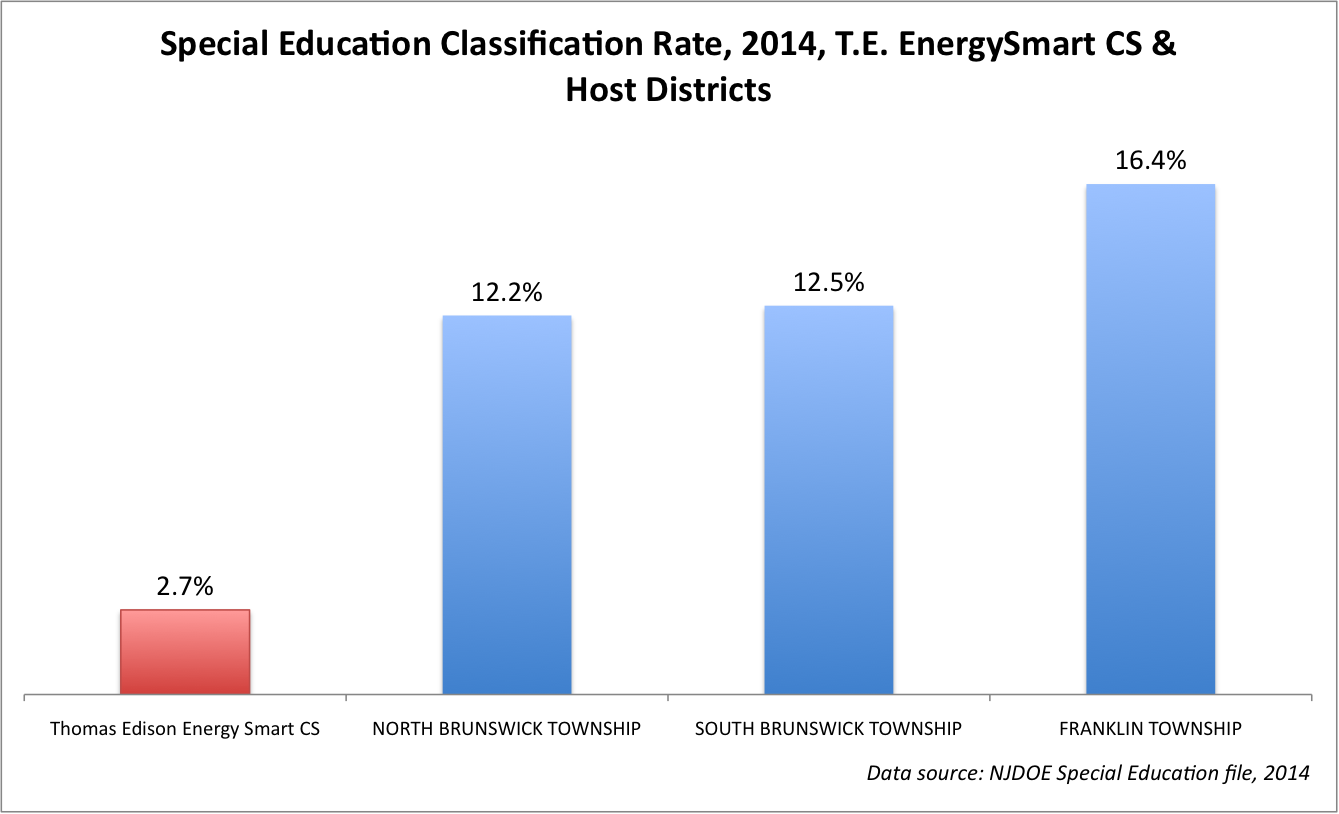
Here are the special education percentages for TE EnergySmart and its host districts. According to news sources, most of the charter's students come from Franklin Township, which has a classification rate of 16.4 percent. Compare that to TE EnergySmart's paltry 2.7 percent rate.

Hold on - it gets worse*:


The very few special needs students TE EnergySmart takes have low-cost disabilities: SLDs and speech impairments. The kids who are autistic, or have emotional disturbances, or are blind, or have multiple disabilities are educated by the district public schools.

It is immoral that Chris Christie refuses to acknowledge that the charter school he praises does not educate any significant share of special needs students.

And, yes, it does get worse:


TE EnergySmart's students are far less likely to live in economic disadvantage than the students in the charter's host districts. Keep in mind, most of the students at the charter come from Franklin Township, where the district schools have many more free lunch students proportionally.

Yes, it does get worse:


Franklin has many black students -- but they don't go to Christie's beloved charter school. So who does enroll at TE EnergySmart?


Over 70 percent of TE EnergySmart's student population is Asian, compared to less than 20 percent of Franklin's population. This is a stunningly segregated school: by class, by race, and by special education need.

But while TE EnergySmart, like all New Jersey charters, is "held harmless" in its funding, Franklin Township's public schools have had to suffer consistent underfunding for years.


From our friends at the invaluable Education Law Center. The state has failed to come through with adequate aid year after year, which has driven the local levy share up and up. Meanwhile, TE EnergySmart skims off the students who are cheapest to educate, leaving the most expensive students behind.

And yet here stands Chris Christie, mocking the local public schools for doing a job that the charters he praises can not and will not do. It's outrageous. 

One more thing: TE EnergySmart has been identified by people who track these things as a Gulen charter school. These schools are linked to a Turkish imam named Fethullah Gulen, who was profiled in this report on 60 Minutes:


The schools have been criticized for their employment practices, including exploiting H1-B visas to allow Turkish nationals to enter the United States and teach in charter schools.

I have to wonder: does Chris Christie know any of this? I wonder what Donald Trump would say if he found out...

Fethullah who?


* Graph edited 5/17/16 for clarity.

Sunday, May 15, 2016

The Dismantling Of Camden's School District Continues According To Plan

The way things are going, public schools in Camden will soon be extinct:
The Camden School District announced another round of layoffs and personnel moves Thursday, affecting 154 teachers and support staff.
The state-run district said it was laying off 22 teachers; 27 school staff, including custodians, security guards, and clerks; and 29 members of the central office staff.
A spokesman for Superintendent Paymon Rouhanifard said the cuts were needed to help plug a projected $39 million budget gap for the 2016-17 school year.
The cuts were announced Thursday night at the advisory school board's meeting at Dudley School. The district is required by the state to notify staff of any personnel changes by May 15. 
The district began the process of notifying those affected on Wednesday by distributing letters, spokesman Brendan Lowe said.
An additional 20 teachers and 56 student services staff will be fired for performance-related reasons, district officials said. These employees were also notified by letter of their dismissal.
Lowe said the changes were part of an "effort here to bring our staffing levels in line to where we need to be." In addition to the 154 affected employees, about two dozen other staff vacancies will not be filled.
"Our schools will still be well-supported, but we do need to make some reductions," Lowe said. "The superintendent made a lot of hard decisions." [emphasis mine]
Don't you just love how all these people are going to lose their jobs, but we're really supposed to feel bad for the guy who's firing them?

There's also grim humor to be found in Rouhanifard's excuse for gutting the district's staff:
Camden, with about 15,000 students, has a proposed $372 million budget for the coming school year. The state took over the district in 2013 because of the city's chronically failing schools, among the worst in New Jersey.
Rouhanifard, appointed by Gov. Christie to lead the struggling district, has said the district must cut spending to offset years of declining enrollment and financial mismanagement.
Despite the cuts announced Thursday, Rouhanifard said that because the district will have fewer students, most classrooms will have a 9-1 student-teacher ratio in the coming year, compared with 10-1 now.
"At the end of the day, we had to make these reductions," he said. "Not only were [the positions] not necessary instructionally, they are not sustainable financially."
Oh, please -- let's not pretend for one second that what's happening in Camden is inevitable. The dismantling of Camden's public school system was planned years ago, and that plan was funded by a California billionaire with an ideological agenda.

In many ways, the takeover and impending dissolution of Camden's public schools is a textbook case of how to privatize a district:

2006: The state appoints a fiscal monitor for the Camden district after members of the Legislature are shocked -- shocked, I tell you! -- that a city that has been under the thumb of a political machine for years might have some corruption.

2007: The board appoints a new superintendent with the monitor's blessing.

2008: The district cuts staff as part of a budgetary freeze.

2009: The district faces more staffing cuts.

2010: The city faces more layoffs.

2011: The district makes further cuts while simultaneously increasing the police presence at its schools. The district felt it had no choice but to pay for the police itself as half of the police force had been laid off in the previous year.

2013: The state takes over the district. Gov. Christie installs a very young superintendent, Paymon Rouhanifard, who has never run a school, let alone a school system.

2014: Rouhanifard announces another round of layoffs.

2015: Rouhanifard announces yet another round of layoffs.

2016: Rouhanifard announces yet another round of layoffs.

Understand: Rouhanifard's job at the NYCDOE was to go around New York and close neighborhood schools so they could be replaced with charters. Obviously, this is why then-Education Commissioner Chris Cerf and Christie picked him for the job: he knows how to dismantle a public school system and turn it over to privatizers.

Which has been exactly what has happened in Camden. Even as the state monitor, and then Rouhanifard, oversaw the systematic defunding of Camden's schools, the state allowed charter schools to grow with little to no oversight.

The state gave a charter to a school operator who pretty much destroyed the Chester, PA public school system while engaging in some highly questionable practices that resulted in sanctions against the school's officials.

The state allowed a charter to expand that also engaged in several highly questionable practices, yet always seemed able to draw more financing for its expansion. The lack of transparency about this school's operations is, in a word, stunning.

The state gave a plot of land that was supposed to be used for a new district public school to a charter operator that has dictated the terms of its enrollment, refusing to serve students in grade levels it doesn't want to enroll. This operator, incidentally, already tried and failed to run a successful charter school in Camden. It's also worth noting that when members of the Camden school board tried to stand up to this plan, they were summarily punished and removed.

The state allowed district buildings to be used to colocate charters, then stood by as the charters renovated only the parts of the buildings they occupied. Which meant the children enrolled in the charter had air-conditioning, while the children enrolled in the district school were stuck in dangerously hot classrooms.

Rouhanifard sadly lamented that there was nothing he could do:
(3:50) Guys, I want to respond to your questions and concerns; it's hard to do that when everyone's shouting over me. And I'm happy to let you all shout over me for 90 minutes straight if that's what you want to do.  
What I'm trying to communicate to you is that these are not easy decisions to make. And we're doing this because the district and their finances can't renovate this building the same way one of our partners can. And that's a financial decision.
Yes, it is: the people who actually run Camden decided that charter schools get financing and aid and support, while the public district schools go begging. Those who live in the city and object to this state of affairs are patted on the head and then promptly ignored.

So here we are in 2016: the parents of Camden can "choose" to send their child to an unsafe school with lead in the water, or they can "choose" a charter school that is not under democratic control, not subject to the same standards of transparency as public district schools, more likely to hire inexperienced teachers who are of a different race than their students, and abrogates the rights of students and families.

This did not happen by accident. Let's pull this post of mine from 2012 out of the memory hole:
A couple of bombshells dropped out of the NJ DOE yesterday. First, from Kevin Shelley at the Courier-Post:
CAMDEN — A secret Department of Education proposal called for the state to intervene in the city’s school district by July 1, closing up to 13 city and charter schools. 
[...] 
The intervention proposal, which was obtained by the Courier-Post, was written by Department of Education employee Bing Howell. 
He did not respond to a phone call and email seeking comment. 
Howell serves as a liaison to Camden for the creation of four Urban Hope Act charter schools. He reports directly to the deputy commissioner of education, Andy Smerick.
Howell’s proposal suggests that he oversee the intervention through portfolio management — providing a range of school options with the state, not the district, overseeing the options. He would be assisted by Rochelle Sinclair, another DOE employee. Both Howell and Sinclair are fellows of the Los Angeles-based Broad Foundation. [emphasis mine]
Kinda like Old Faithful at this point. The proposal calls for the usual round of school closings, because instability is just so freaking great for kids living in difficult conditions. But here's the part that's going to raise eyebrows:
• Control the school board by taking away members’ ability to vote for at least six months, plus adding three state-appointed members. Place all hiring and firing decisions in the hands of the state Board of Education
• If a superintendent vacancy happens during state intervention, the commissioner would recommend a replacement with confirmation by state board. 
• Increase charter schools and attract charter management organizations such as those run by the KIPP chain. Send Camden students out of district to choice and vocational schools. 
The proposal also calls for passage of the Opportunity Scholarship Act, a proposed corporate tax credit scholarship bill. This would be used to send children to religious schools and private schools, including boarding schools.

Howell also said the state should partner with Teach for America, Knowledge is Power Program and The New Teacher Project . The three programs have or had links to Broad Foundation board members Wendy Kopp (TFA), Richard Barth (KIPP) and Michelle Rhee (formerly of TNTP and a TFA alumna). [emphasis mine]
Let's reiterate this because it's important:

Years ago, the NJDOE, with funding from California billionaire Eli Broad, developed a detailed plan to privatize Camden schools. That plan has been methodically implemented. Nothing that is occurring in Camden's schools is happening by accident -- it was all planned.

And none of these plans were ever approved in a democratic process by the people of Camden.

Why is that, do you think?


In New Jersey, democratic control of schools is reserved for affluent, white communities. All others will have their "choices" made for them.

This is a brazenly racist state of affairs -- can anyone honestly say otherwise?

What worries me is that after this grand experiment in replacing democracy with market "choice" fails, someone is going to have to clean up the mess. Someone is going to have to provide all of Camden's children with an education. But the trail of destruction left behind is going to be so great that fixing Camden's public schools will be an even more massive challenge than it is right now.

Of course, by then Chris Christie will be gone, Eli Broad will have moved on, and Paymon Rouhanifard will be off to his next gig. They may by then have returned control of the district to the people of Camden...

But what will they leave behind? I'll leave the last word to Stephen Danley, who has come to know Camden as well as any researcher:
And this gets to the fundamental question. The choice that “No Excuses” schools, and that the Camden School District and wider political forces here in the city has made is this: it believes that schools which use disproportionate discipline upon poor and minority students are ok so long as their test scores improve. One injustice, that of mistreating students, is allowable being it serves a broader justice, that of increasing their scores. So even though many involved in this system of schools will profess privately that they are uncomfortable with the strict discipline enforced upon minority children, they are willing to use it if it increases scores at those schools. 
There are plenty of reasons to think it does not. But I want to point to my bigger issue with this strategy. It assumes that outsiders can create justice by mistreating a community. On issues of cultural competency and school discipline, we’re seeing progress in Camden. But that progress comes from a self-inflicted starting point. If progressive discipline was a priority from the start, these are not the schools that should have been chosen. If progressive discipline was a priority in schools, they would not be using a “No Excuses” ideology. It’s like Malcolm X says, “If you stick a knife nine inches into my back and pull it out three inches, that is not progress.
Amen.


Friday, May 13, 2016

Beating Up Schools With The College Remediation Club

Count on the NY Times Editorial Board to credulously accept any piece of education policy propaganda shoved into their hands:
The idea that schools in privileged communities are failing to prepare significant numbers of students is borne out in a striking new study showing that nearly half of the students who begin their college careers taking remedial courses come from middle- and upper-income families. Not only do remedial courses add more than $1 billion each year to students’ bills for tuition, but students who start out in these classes take longer to graduate and are far more likely to drop out. 
The study, by Education Reform Now, a nonprofit think tank...
OK, stop right there.

As Diane Ravitch correctly points out, ERN is in no way, shape or form a "think tank":
The editorial referred to Education Reform Now as a “nonprofit think tank.” ERN is nonprofit but it is certainly not a think tank. ERN is the nonprofit (c3) arm of Democrats for Education Reform (DFER), the organization of hedge fund managers that loves charter schools, high-stakes testing, and Common Core. It has a vested interest in saying that American public schools are failing, failing, failing so as to spur its campaign to privatize public education.

ERN sponsors “Camp Philos,” an annual affair where important political figures meet in the woods with hedge fund managers to figure out how to reform public schools that none of them ever sent their own children to. In 2014, its star education reformer was Governor Cuomo. At its 2015 meeting on Martha’s Vineyard, Mayor Rahm Emanuel was a keynote speaker, sharing his knowledge of how to reform public education by closing public schools en masse.

The staff director of ERN is Shavar Jeffries, who ran for mayor of Newark and lost to Ras Baraka. Jeffries was supported by DFER, which hired him after his loss.

Consider the board of directors. Every one of them is from Wall Street.

The authors of the report are staff members at ERN who come from public policy backgrounds.

Curiously, the editorial has a link to the words “Education Department,” but no link to the ERN policy brief.
Now, I'm not one to discount a piece of research solely on the basis of who funds it. But if this were a report funded by, say, a teachers union, there is absolutely no way the Times would simply say it came from a "think tank." It's absurd for the Times to pretend this report was not prepared in the service of a particular agenda.

But, again, I'm not prepared to discount it solely on the basis of who put up the scratch. So what does the report itself say?
Hundreds of thousands of American families across all income levels are spending billions each year in extra college costs because our high schools are graduating too many students unprepared for college.  That’s a fact most may not realize, because current discussions around postsecondary remedial education – prerequisite courses that carry zero credit toward a college degree and represent content and skills students should have learned in high school already – are often segregated to low-income students and community colleges. But in truth, many middle-class and upper-income families bear the brunt of extra costs that come with required remedial classes in all college sectors for students from all income levels. In fact, at private nonprofit four-year colleges and universities, the children of upper-income families are taking more remedial classes than students from low-income families.
I must say that the graphic arts department at ERN is quite good: they've decorated the cover with a winsome young undergrad, mouth slightly agape, staring straight at the camera as if to say: "I can't believe my high school failed me so badly!"

These days, college remediation is the reformster 5 iron: the club they seem to want to pull out of the bag first. Except this club is being used to beat up America's K-12 school system -- particularly suburban schools. Read the thing yourself, then see if you wind up thinking the same things I did:

- When did we decide that the K-12 system was solely responsible for our current college remediation rates? Don't the colleges themselves have some culpability here? Why are they accepting so many students if those students aren't up to their standards?

From the report (p.6):
There is a stark difference, however, at private nonprofit four-year colleges: there, remedial students from the top 20 percent of national family incomes report taking nearly three remedial courses, one more class than students from the bottom 20 percent of national family incomes: 2.7 vs. 1.6 classes. In other words, in the most expensive colleges and universities, the wealthiest students need more remedial education than the poorest ones.
Well, OK -- what's the point? Is ERN arguing that students from economically disadvantaged backgrounds get a better high school education than students at wealthier schools? Somehow, I doubt it.

Perhaps something else is going on that is a bit embarrassing for private colleges: maybe they aren't basing their admissions decisions entirely on merit. Maybe they're allowing more affluent students to trade in on social and cultural capital to gain access to their colleges. Maybe they're using things like SAT scores, which are highly correlated to income, as ways to convert class advantages into a phony notion of "talent." Maybe they're more in the business of credentialing than educating.

Maybe...

In any case: how is any of this the fault of the K-12 public school system? Are affluent suburban schools supposed to be preparing all of their students for admission into elite private colleges? Doesn't that directly contradict the notion of a true meritocracy? Or is everyone supposed to be above average?

In addition: don't students themselves have some degree of responsibility for whether or not they are prepared for college?


Are we ever going to allow for the possibility that students themselves should have to own their academic records?

- When did we decide that "ready for college work" was some sort of objective standard? Is it not possible that MIT has different standards for mathematics facility than some less well-known liberal arts colleges? Is it not possible some schools set the bar differently for writing than others?

There is no single, objective standard that constitutes "ready for college work." It's ridiculous to pretend otherwise -- and yet that's exactly what this report does.

- Does an analysis based on a dataset with student-reported survey responses and low response rates really justify the sweeping conclusions found here? The dataset used for the report comes from the National Center for Education Statistics' National Postsecondary Student Aid Study (NPSAS). Which is fine... so long as you acknowledge the limits of the data (p. 57):
4.4.2 Interview Response Rates
Some 85,000 students, approximately 69 percent of the eligible sample of 123,600, completed the NPSAS: 12 interview (table 21). Across institution level and control, response rates ranged from 55 percent for private for-profit less-than 2-year institutions to 82 percent for private nonprofit 4-year doctorate-granting institutions. Potential FTBs [first time beginners] were significantly less likely to respond than other undergraduates (60 percent compared with 73 percent) (χ2 (1, N = 105,931) = 2075.23, p < .0001). Graduate and professional students (83 percent) completed at a higher rate than undergraduate students (66 percent) (χ2 (1, N = 123,601) = 2013.63, p < .0001). [emphasis mine]
In other words: the first time beginners that this study relies on had a response rate of only 60 percent.  That alone ought to merit a few cautionary words in the report, don't you think?

- How many of the students enrolled in "remedial" courses are actually taking them for credit? From the data file documentation (p. G-34):
N12REMEVER (ABBREV)
Taken any remedial courses since high school
Since you completed high school [{if TB4JULY = 0} and through June 30, 2012, did you take {else} have you taken] any remedial or developmental courses to improve your basic skills in English, math, reading, or writing? (Remedial or developmental courses are used to strengthen your skills before you take your first college- level course in math, reading, or other subjects. Students are usually assigned to these courses on the basis of a placement test taken before the school year begins. Often, these courses do not count for credit toward graduation.) [emphasis mine]
In other words: maybe your remedial courses didn't count for credit... but maybe they did. The fact is that we just don't know, given the way this survey is worded. Is it really the worst thing in the world for an undergrad to take a "developmental" course and get credit for it?

- How many of the students enrolled in remedial courses speak English as a second language? This was actually one of my first thoughts as I started the report... and yet, nothing about English language learners is ever mentioned.

Here's a quick table I made at the NCES PowerStats website:

Of the students who speak English at home, 21.3 percent took at least one remedial course. 28.1 percent of Spanish speakers, however, took a remedial course; in other words, there is a significant percentage of students taking college remedial courses who are likely taking them because English isn't their first language. 

English language learners can take 4 to 7 years to achieve academic English proficiency. Did the authors of this report even consider this?

- If we're going to add up the cost of remedial courses (with a highly dubious method), shouldn't we also add up the savings of all the AP and IB courses for which colleges give students credit? Courses paid for by the taxpayers?

In 2014, 2.3 million students sat for 4.2 million AP exams; many more were in the International Baccalaureate program. I can't find (yet) statistics on how this translates into college credits, but it clearly must count for something.

I think it's ridiculous to count room and board toward the cost of remedial education -- people gotta eat, right? But if we're going to go all in, we'd also have to go in the other direction. According to the College Board, taking AP courses increases the chances of getting a degree on time. So how much money has the American K-12 public school system saved undergrads because they got credit for their AP and IB courses, which were paid for by the taxpayers?

Again: did the authors of this report even consider this?

 - Where is any evidence that the Common Core or its aligned tests will better prepare students for college? This part of the report is utterly laughable:
In fact, little noticed is that the price of opposition – and perhaps willful ignorance by some – to Common Core implementation includes how much more students and families across all socioeconomic backgrounds must pay for college due to inadequate high school preparation. At least among those students going directly to college, we find that rising college freshmen and their families are paying extremely high out-of-pocket expenses for prerequisite, zero-credit, remedial coursework that covers content and skills that students should have already learned in high school. [emphasis mine]
Oh, please. How do we know that implementing the Common Core leads to better college preparation? Show me any empirical evidence this is the case. Anything. I dare you.

You can't. As I've shown before, "high standards," by themselves, are not at all predictors of a state's academic outcomes. The so-called "honesty gap" is a fiction. Further: show me any evidence that a state's academic outcomes improve when they use standards-aligned, statewide end-of-course tests. Tennessee has had them for years, yet their college attainment rate is dwarfed by states like New Jersey.

Even if we accept the notion that college remediation rates are too high, the idea that simply implementing the Common Core and administering aligned standardized tests will solve the "problem" is not supported by the slightest shred of evidence.


There's one other thing that comes to my mind when I read a report like this: just how much money is currently being spent to find new and exciting ways to convince the American public our school systems suck -- especially in the suburbs? This report sports the Education Post logo, and we all know Peter Cunningham was given millions and millions of dollars to promote the notion that America's schools stink. How much of that money flowed to this report?

I don't know about the rest of you, but I'm getting sick and tired of this. Those of us who actually show up every day and do the job are being blamed for problems we didn't create and can't be expected to solve on our own. Then we're beat over the head with "research" that is regurgitated to the public via media outlets like the NY Times, which seems to have no interest whatsoever in thinking critically about what its reprints.

ERN's report implies that if we simply "raise" standards and make all students take more standardized tests, our college remediation "problem" will be solved. That argument is so stupid on its face I can't believe anyone would make it. Would you tell a pole vaulter he'll get better if we just raise the bar another few feet? Don't you have to come up with a plan to train him to improve?

Our schools are underfunded and segregated. We all agree that teachers are important, but those who choose to enter the profession pay a compensation penalty. We refuse to seriously address the consequences of our nation's economic inequity on the lives of our children outside of school. We allow the nation's conversation about education to be dominated by those who push for more "choice," when the evidence suggests "choice" creates, at best, extremely small positive effects and, at worst, causes real damage.

Maybe ERN can get their Wall Street patrons to pay for a report about that.

Yeah, that's not really our thing...

Wednesday, May 11, 2016

School Vouchers Are Not a Cure For Segregation: Part V, Washington DC

Here are links to all five parts of the series:

Part I

Part II

Part III : New Orleans

Part IV: Milwaukee

PartV: Washington DC and Conclusion

* * *

What do we know about the effectiveness of the Washington DC school voucher program? In June of 2010, the USDOE's Institute of Education Sciences released its evaluation:
  • The study found no conclusive evidence that the OSP [Opportunity Scholarship Program] affected student achievement overall, or for the high priority group of students who applied from “Schools in Need of Improvement.” On average, after at least 4 years, students who were offered scholarships had reading and math test scores that were statistically similar to those who were not offered scholarships (figure 1). The same pattern of results holds for students who applied from Schools in Need of Improvement (SINI), the group Congress designated as the highest priority for the program. Although some other subgroups of students (female and higher achieving students) appeared to have higher levels of reading achievement if they were offered a scholarship, those findings could be due to chance. (p.3)
The study did find a positive effect on graduation rates; however, the data was self-reported by parents, and the response rate was quite low.

As we've seen throughout this series, the case for school vouchers based on academic outcomes is very, very weak. Much as those who vouch for vouchers try, they simply can't pump up the small effect sizes enough to make the case that putting more public funds into private schools is worth the money.

In addition, and contrary to the implications of reformsters like Kevin Chavous, it appears that vouchers are anything but "color blind." The segregative patterns I've shown in Milwaukee, home of the nation's largest and oldest voucher system, suggest that vouchers are not ameliorating school segregation; to the contrary, they actually appear to be making it worse.

Now that we know DC's voucher program isn't doing much for test scores, lets see how it might be affecting school segregation. The OSP started in 2004, was suspended in 2009, but then was reinstated in 2011. Its current status is up in the air; The DC Trust, the group in charge of administering the OSP, is currently bankrupt due to mismanagement and apparent self-dealing (it's all about the kids...).

The OSP, however, was still going strong in the 2011-12 school year -- the year of the data I use from the NCES's Private School Universe Survey. I merged that data with this list of OSP schools from the same year to create the following graphs.

Let's start by looking at how segregated DC's other publicly-funded schools are:


Again, what I've done here is create 10 "bins" along the horizontal axis. Each bar is a "bin" representing schools, weighted by student population, that serve different percentages of black students. The bar at the far left, for example, represents all of the students who attend a publicly-funded (district school or charter) DC school whose student population is between 0 and 10 percent black. The next bar represents students who are in a school that is between 10 and 20 percent black, and so on.

The red line is the percentage of black children (under 18) in the entire city according to the American Community Survey of the Census Bureau: about 62 percent. The segregation of DC's publicly-funded schools (charter and district) is striking: 55 percent of DC's students attend a school whose student population is at least 90 percent black.

How do the private schools compare?


80 percent of Washington DC's private school students attend a school that has a student population that is under 30 percent black. That is a strikingly high figure for a city with such a large population of black children.

But hold on -- look at the far right bar. 13 percent of DC's private school students attend a school that has a student population that is over 90 percent black. In other words: there are a substantial number of private schools in DC that are just as segregated as the majority of the District's public schools.

Are they voucher schools? Well...


Compare the OSP schools to all of the private schools in DC, and one clear truth emerges: the voucher schools are just as segregated as all of the private schools in the city. Washington DC's voucher schools are doing little to nothing to help the city address its pronounced school segregation.

Considering how weak these schools' effects are on test scores, we're back to the question I've asked repeatedly in this series: How can anyone justify continuing to fund school vouchers when they do little, if anything, to improve either student outcomes or school segregation?

* * *

In the landmark school voucher case, Zelman v. Simmons-Harris, Justice David Souter writes a stinging dissent, calling the majority's decision "doctrinal bankruptcy" (we do well to remember that the decision was only 5-4; it easily could have gone the other way). For Souter (and, for that matter, me), giving public monies to a religious school is a clear violation of the First Amendment.

But the majority convinced itself that, so long as there were a few school choices that were not religious, and so long as the parents of students made a "true private choice," the establishment clause wasn't germane. As you read the decision, it becomes apparent that the majority's justification for ignoring the First Amendment was based on their perception that the Cleveland schools were in "crisis":
"For more than a generation, however, Cleveland's public schools have been among the worst performing public schools in the Nation. In 1995, a Federal District Court declared a "crisis of magnitude" and placed the entire Cleveland school district under state control. See Reed v. Rhodes, No. 1:73 CV 1300 (ND Ohio, Mar. 3, 1995). Shortly thereafter, the state auditor found that Cleveland's public schools were in the midst of a "crisis that is perhaps unprecedented in the history of American education." Cleveland City School District Performance Audit 2-1 (Mar. 1996). The district had failed to meet any of the 18 state standards for minimal acceptable performance. Only 1 in 10 ninth graders could pass a basic proficiency examination, and students at all levels performed at a dismal rate compared with students in other Ohio public schools. More than two-thirds of high school students either dropped or failed out before graduation. Of those students who managed to reach their senior year, one of every four still failed to graduate. Of those students who did graduate, few could read, write, or compute at levels comparable to their counterparts in other cities."
I'd be the last to argue that this was acceptable; however, the Court never bothered to ask why Cleveland's students might be underperforming.


Data from 2002, the year of the decision in Zelman. Cleveland's schools were full of students in economic disadvantage. And yet, despite their great need, the district had less revenue per pupil than most of the surrounding area's more affluent districts.

School vouchers, then, were just another way to pretend to address the real problems that lead to inequitable educational outcomes: economic inequality, poverty, segregation, and inadequate school funding.

Installing a program of school vouchers -- like charter school proliferation, or standards obsession, or high-stakes testing, or merit pay -- allows policy makers to pretend they are actually doing something meaningful to help the most needy and the most deserving children in our country when, in reality, they are doing nothing.

The problem for the folks who push these "reforms" while ignoring reality is that their own data inevitably comes around to bite them in the ass. The evidence makes clear that vouchers are, at best, a weak response to a serious problem. What's worse, there's good reason to believe vouchers are actually contributing to segregation -- one of the reasons that we're in our current, inequitable education mess.

Look, I understand that not all schools work for all kids. I'm actually sympathetic to the idea of having some sort of "choice" as part of our school system, especially in larger districts that can support a choice system without having redundancies that lead to inefficiency.

But it is getting harder and harder for anyone to make a case for private school vouchers: they don't have strong positive effects, the legal argument that supports them is very weak, and now it appears they actually perpetuate school segregation.

Why in the world, then, would anyone support school vouchers? Is some vague notion of "choice" really worth it?

Sorry The 74 -- vouchers are not "color blind."

Sunday, May 8, 2016

School Vouchers Are Not a Cure For Segregation: Part IV, Milwaukee

Here are links to all five parts of the series:

Part I

Part II

Part III : New Orleans

Part IV: Milwaukee

PartV: Washington DC and Conclusion

* * *

Are America's private schools -- particularly the ones enrolling students using school vouchers -- "color blind"? Those who vouch for vouchers, like Kevin Chavous, seem to think so. But as I've shown in this series, America's private schools are highly segregated; that likely means school vouchers are expanding segregation, rather than ameliorating it.

To determine whether vouchers are "color blind," let's take a look at the oldest large-scale voucher program in the county: Milwaukee's Parental Choice Program (MPCP), now 25 years old. Just how big is MPCP?
It was the fall of 1990 when the national precedent-setting Milwaukee Parental Choice Program came to life, with participation of seven nonreligious private schools and 337 low-income students. There were a lot of limitations on who could take part. Total public spending in the first year: $733,800. 
It's a vastly different picture now. 
Many of the limitations are gone; an estimated 26,900 students who live in the city of Milwaukee are using vouchers to attend 117 private schools, the vast majority of them religious. Public spending for the current school year will exceed $190 million.[emphasis mine]
And what has that meant for educational achievement?
The overall success of vouchers has been far from what backers hoped for in 1990. Milwaukee's experiment was touted as a big breakthrough in urban education.

In reality, the outcomes for voucher schools overall are about the same as those for Milwaukee Public Schools, which is to say, they're not so good.

Building up quality doesn't seem to link to building up one sector over another.
Even the University of Arkansas' Department of Education Reform -- as reformy and choicy an outfit as you will ever find -- could only come up with the weakest of evidence in support of the MPCP:
When similar MPCP and MPS students are matched and tracked over four years, the achievement growth of MPCP students compared to MPS students is higher in reading but similar in math. The MPCP achievement advantage in reading is only conclusive in 2010-11, the year a high-stakes testing policy was added to the MPCP (Report #29).

When a snapshot of all MPCP students who took the state accountability test is compared to a snapshot of the performance of MPS students with similar income disadvantages, the MPCP students are performing at higher levels in the upper grades in reading and science but at lower levels in math at all grade levels examined and in reading and science in 4th grade (Report #32).
Ouch. And as I noted before, the National Education Policy Center has pointed out even this weak endorsement doesn't really hold up to the results of U-Ark's analysis. For example, attrition out of the MPCP is substantial:
Regarding the study comparing graduation and post-secondary enrollment and persistence rates of MPS and MPCP students (No. 30), Cobb raised methodological concerns.
By 12th grade, he notes, roughly three out of four of the original 801 MPCP 9th graders were no longer enrolled in a participating private school. The sample attrition “severely clouded” the inferences that could be legitimately drawn about MPCP’s real impact on graduation rates.
Additionally, only one of the findings in the study’s most carefully controlled analytic models was statistically significant by conventional measures. Both limitations, Cobb writes, prevent broad conclusions about whether MPCP really improves graduation and higher education continuation rates over MPS. [emphasis mine]
These weak results are supported by other research. In a much older study published by the National Bureau of Economic Research, there was no effect on reading scores, and the effect on math is, at best, a few percentage points.*

So it's very difficult to make a case, based on the data, that MPCP is doing much of anything to improve academic outcomes. Which may be why voucher supporters are turning their arguments away from academic outcomes and toward things like segregation. The question, however, is whether school vouchers are as ineffective at desegregating schools as they are at raising test scores.

Let's do some simple descriptive statistics to explore this question. We'll start with the public schools: what is the racial profile of Milwaukee County's publicly-funded schools, both charter and district but not private?


Again, what I've done here is create 10 "bins" across the horizontal axis; the height of each bin represents a percentage of the total student population. Each bin represents the percentage of a school's students who are black. In this histogram, for example, about 34 percent of Milwaukee County's students, enrolled in a publicly-funded school, attend a school whose student population is between 0 and 10 percent black. 19 percent attend a school that is 10-20 percent black, and so on.

The red line represents the percentage of children in the county under age 18 who are black: 34.7 percent (data from the Census Bureau's American Fact Finder, 2014 American Community Survey, 5-year estimate). Clearly, very few schools represent the racial profile of the entire county. Most Milwaukee County schools have far fewer black students, proportionally, than the entire area.

There are, however, many schools that enroll a student population that is almost entirely black (90 percent or higher, the bin furthest to the right). What we've got, then, is what we have throughout America: a highly segregated school system, reflecting highly segregated housing patterns throughout the region.

Now, one might argue that private schools could buck this trend, because they are not bound to enroll their students according to where those students live. In other words, a private school could, theoretically, draw students from both majority-white and majority-black neighborhoods to create a more integrated student population. So let's look at the NCES Private School Survey data and see whether the private schools are any less segregated.


In the public districts and charters, very few schools enrolled an integrated student population. But the trend toward segregation is even more pronounced in Milwaukee's private schools, even though they do not have to enroll students according to housing patterns.

If you compare the two histograms, you'll notice the bins furthest out -- representing schools with 1-10 percent black and 90-100 percent blacks student populations -- are even higher for the private schools than for the public schools. As bad as the segregation is in the public schools, it's arguably even worse in the private schools.

But hold on -- not all private schools are necessarily MPCP schools. Maybe the voucher schools are reversing the trend compared to the non-voucher schools. How can we check?

I've used this list of MPCP schools to create a database from the NCES data of just the vouchers schools. How do they compare to the public schools, and the total number of private schools?


Be careful reading this: Stata (my statistical program) changes the y-axis scale on each histogram. About 45 percent of the private schools in Milwaukee County have student populations that are less than 10 percent black. In the voucher schools, almost 30 percent are less than 10 percent black.

But in all the private schools, about 22 percent of the students attend schools that are 90 percent or more black; in the voucher schools only, about 28 percent of students are in similarly segregated schools.

In other words: In Milwaukee County, voucher students are more likely to be in a nearly all-black school than either public school students or the entire population of private school students.

There is very little evidence that Milwaukee's voucher program is helping to desegregate the area's schools. Why, then, should public money be used to help perpetuate a system that is anything but "color blind"?

I'll finish this up by looking at Washington, DC next.

Color blind?


* A running pet peeve of mine is how econometric research on the effects of education policy, such as  this study, will casually throw out the word "large" to describe an effect size without putting it into an actual educational context. Since when is a 5 to 6 percent change in a test score "large"? Especially when there is a high likelihood of unobserved variable bias in your model?

I get into this idea more here.