I will protect your pensions. Nothing about your pension is going to change when I am governor. - Chris Christie, "An Open Letter to the Teachers of NJ" October, 2009

Wednesday, May 8, 2013

Charters = Wal-Mart

Laura Waters - a local school board president herself - does not want to give local boards veto power over charter schools expanding into their districts. To make her case, she badly mangles a metaphor:
Education Sector notes that school boards “are often hostile to charter schools, which compete with them for students, funds, and prestige,” adding that “state charter laws that allow only local school boards to authorize charters,” with no appeals process, “can result in very few charter schools in that state.” A cynic would say that this is Assemblyman Diegnan’s intention. After all, giving school boards sole authority to grant approval for new local charters is like giving Wal-Mart sole authority to grant approval for new local merchandisers. Taking it one step further -- consigning such approval to a local referendum -- is a political calculus, not an educational one. [emphasis mine]
Let's take a moment to appreciate how Waters has actually flipped the Wal-Mart analogy on its head. Because it's not local school boards that are most like the big box retailer; it's the charter schools.

There's a lot of controversy about the actual effect of Wal-Mart on a local economy, but there's little debate that an effect actually exists. You simply can't put a huge national retailer into a community and not expect changes, good or bad, to happen.

It's the same with charters. Their cheerleaders will try to convince you that charters have no impact on local public schools because education funds are "dedicated to children, not districts." But charters are, in fact, funded by their sending districts. And because those districts have fixed costs, and because charters tend to not take the children who are most expensive to educate - ESL students, special education students, children in poverty, etc. - the revenues that local districts must give to charters have an impact on the feeding schools. It's foolish to pretend otherwise.

Given that, who else beside the local schools authority should have the final say about charters? Who else has the responsibility to protect the interests of the children in their schools? And why should local school boards have to sit by and dish out money to support schools over which they have no say?

The notion that Wal-Mart makes local businesses better through competition is simply silly; same with the effect of charters on public schools, which, unlike charters, must take all comers. Waters has this totally backwards; yet she seems to think the policy allowing charters to be granted without consent of local school boards is grounded in research:
Critics of our 14-year-old charter school law are buttressed by various national research organizations that evaluate state charter school legislation and find ours lacking. The National Alliance of Public Charter Schools (NAPCS), for example, ranks New Jersey 31st out of 42 states with charter school laws.
We lose points on funding inequities between traditional (district) and independent (charter) public schools and a certain lack of transparency. Most critically, New Jersey relies on a single entity to authorize new charters (the education commissioner), despite mounds of data that proves that effective laws invest “multiple authorizers” with approval authority. [emphasis mine]
"Mounds of data"? From whom? From NAPCS, which is basically a charter industry shill? Hunt around the website for a while and see if you can find "mounds of data" that confirm a positive benefit for multiple authorizers of charter schools. The best I could find was in the charter school "model law" created by NAPCS; however, it contains no research backing up the contention that multiple authorizers lead to better educational outcomes.

Now, I suppose we could debate what makes a charter law "effective." It seems to me an "effective" law would be one that produces better academic results, for charters and for the total public school population. The NAPCS "model law" report cites Alexander Russo, Nelson Smith, The Fordham Institute, Louann Bierlein Palmer, and others: but none show any positive outcomes that come from denying local school districts the authority to have veto power over charters. (In fact, glancing at these policy briefs, I get the sense that the case they make for charter expansion is rather weak.)

In truth, the NAPCS Model Law Database is like so many other think-tanky education policy "report cards": the rankings are based on what the think tank wants, but not on what they can show actually works with research. So let's not pretend for a second that there are "mounds of data" that show authorizer expansion will be great for New Jersey; those mounds are a figment of Waters' imagination. That includes her citation of the Center for Education Reform: they make the case that multiple authorizers lead to more charters, but they don't show that the charters - or all of the schools - do any better.

Which is the entire point of giving local school boards veto power over charters: they are best positioned to understand whether a charter is needed in their school district. As I've said many times, I am not against all charters: I started my career at a charter. But no one should expect a school district to allow a charter to come into their community to the detriment of the students who will not be attending the school.

And if you think your school board is too anti-charter, there's a simple solution: run yourself. Why, you could even run in Lawrence, NJ - where Laura Waters serves - and explain to your constituents the many benefits of having a charter in your community...

Coming soon to Lawrence, NJ?

Sunday, May 5, 2013

Jazzman Takes 5

Musical and teaching obligations, folks. No blogging this weekend; light blogging for the coming week, most likely.

Enjoy the many fine blogs to your left until that that time when St. Digby, Patron Saint of Snark, releases me from my real life.

Friday, May 3, 2013

Every NJ Teacher MUST Read This

You may want to send the kids out of the room before you click on this link: intellectual beat-downs like this can be frightening to small minds:
I was reviewing the past few days of news coverage on NJ teacher evaluations and came across the following quote, which was not-so-amazingly left unchallenged:
Cerf said research shows test scores are “far and away” the best gauge of teacher effectiveness, and to not use test score data would be “very anti-child.”
Here’s a reporters’ guide to follow up questions….
Mr. Cerf… can you show me exactly what research comes to that conclusion? (this should always be the immediate follow up to the ambiguous “research shows” comment)
Exactly how is “far and away” measured in that research?
And what is meant by “best gauge of effectiveness?”
That is, what is the valid measure of effectiveness against which test scores are gauged? (answer… uh… test scores themselves)
That is, of course, Professor Bruce Baker deconstructing the latest pile of cant from NJDOE Commissioner Chris Cerf. You owe it to yourself to read the entire thing, and then ask yourself a question:

Why would any New Jersey educator or parent or elected official or journalist or citizen believe anything that comes out of the NJDOE these days?

Oh, golly, do I sound overheated? Gosh, forgive me. It's only my freakin' career...

Accountability begins at home.

Computerized Testing Disaster Preview

It's going to be so freakin' awesome when we finally get all the kids taking all those Common Core and PARCC and state-level standardized tests on computers! Because - considering they must all take them at the same time - what could possibly go wrong?
School testing came to a halt statewide early Monday because the CTB/McGraw-Hill testing company servers in New Jersey crashed around 9 a.m., state education officials said.

In the last week of Oklahoma's April testing window, the outage has raised rescheduling concerns among school officials across the state.

"We're working with (McGraw) very closely" to resolve the problems, said Sherry Fair, spokeswoman with the state Department of Education.

School districts were advised to cancel online testing because of the server crash, although some students in a few schools somehow were able to complete tests.

The outage affected Oklahoma Core Curriculum tests for grades three to eight and end-of-instruction tests for students up to grade 12, officials said. [emphasis mine]
Golly, a computer problem caused by thousands of users accessing servers at the same time. Who could have predicted?
A few online tests have alternates available. But a state Education Department official told schools most incomplete tests will be invalidated and require pencil-paper testing.

Educators have little faith that McGraw could get paper tests to schools by Friday, particularly since the company was late in providing them before testing in the first place.

"I think it goes without saying that a company bidding on high-stakes testing should have the technology infrastructure to avoid outages such as this," said Joe Slitzker, information technology director at Sapulpa Public Schools. 
Read the whole thing. McGraw-Hill sounds like a clown show operation. And what happens when the problems are at the client end - when the schools' computer network is the problem?

Here in New Jersey, the DOE is pushing on-line testing hard. They seem to think it will work just fine; but how would they know? And where is the backup plan when something like what happened in Oklahoma inevitably happens here? Because there's no doubt what happened in Tulsa is not an isolated incident:
School districts across several states are rescheduling high-stakes tests that judge student proficiency and even determine teachers' pay because of technical problems involving the test administrators' computer systems.
Thousands of students in Indiana, Kentucky, Minnesota andOklahoma have been kicked offline while taking tests in recent weeks, postponing the testing schools planned for months and raising concerns about whether the glitches will affect scores.
"There's been pep rallies and spirit weeks all getting ready for this. It's like showing up for the big game and then the basketball is deflated," said Jason Zook, a fifth-grade teacher at Brown Intermediate Center in South Bend, Ind.
Many frustrated students have been reduced to tears and administrators are boiling over, calling the problems "disastrous" and "unacceptable" at a time when test results count so heavily toward schools' ratings under the federal No Child Left Behind law. In places such as Indiana, where former Gov. Mitch Daniels approved changes tying teachers' merit pay to student test scores, the pressure is even greater.
Nice job, Mitch: enjoying your new office, you massive, wimpy hypocrite? Of course, it was just so absolutely critical that teachers' pay get tied to test scores, even if the incompetent Daniels and his minion, Tony Bennett, couldn't set up a system that works. Now Bennett's gone and Glenda Ritz has to clean up his mess.

She won't be alone for very long, though: these thoughtless decisions will plague our schools for years - and that plague has already spread to states all over the country. The reformies' blind faith in technology isn't going to save their agenda; it's actually going to make things far, far worse.

I'm sorry, Dave, but I'm afraid I can't administer these tests...

Thursday, May 2, 2013

Cerf and NJDOE: In Way Over Their Heads

I'm searching around for a word that best describes my reaction to the latest bit of cant from NJ Education Commissioner Chris Cerf; my best response is "pathetic":
After first proposing that scores would amount to 35 percent of a performance evaluation for math and language arts teachers in grades 4-8, Cerf yesterday said that total would be trimmed to 30 percent for next year.
In addition, he said only the scores of students who had been enrolled with a given teacher 70 percent of the year would be applied to his or her rating. The previous level was 60 percent. [emphasis mine]
Seriously?

The notion that this little bit of mucking around with percentages makes up for the vast, serious problems with AchieveNJ, the new teacher evaluation system, is an act of enormous self-deception on the Commissioner's part. Does he really think this matters? Does he really think his critics will pipe down after being thrown this crumb?

As I've explained many times, it just doesn't matter if the test scores count for 50% or 10% or 90% of a teacher's evaluation: some of the evaluation, all of the decision. The NJDOE has tried to gloss over this inconvenient fact, but playing with numbers isn't going to make the problem go away. Cerf's silly proposals only serve to highlight, once again, that no one in charge of making New Jersey's education policies under Chris Christie seems to have any idea of what they are doing:
“There was a feeling that 35 percent was too much, and reducing it by 5 percent made sense,” said Arcelio Aponte, the board president, after the meeting. “Based on the many discussions we had on this, I think 30 percent is a fair number.” [emphasis mine]
Oh, I see: we're now making decisions based on our "feelings." Gosh, how nice. But maybe we should also consider the "feelings" of the teachers who will have to labor under this innumerate, illogical system of evaluation, huh? Or the students who will have their teachers' livelihoods in their small hands?

Of course, the NJDOE has a defense they use when caught making policy based on their "feelings"; they whip out the Gates MET study:
The only dissent on the board came from Ronald Butcher, who ended up abstaining in the otherwise unanimous vote. He said afterward that the research backing the use of student test scores in general and “student growth percentiles” in particular was inconclusive.
Cerf and others on his staff have repeatedly pointed to a recently completed Measures of Effective Teaching (MET) Project that tracked more than 3,000 teachers and backed the use of test scores in measuring their practice, along with classroom observations and student surveys
But that project has its detractors as well, and Butcher after the meeting said he hopes there will be a further airing of the different points of view.
”This is not just about New Jersey, but in other states, too, where there are concerns,” he said. “If you look at the research, there are some issues with it. The MET study is just one study, and there is a lot of research calling it into question.” [emphasis mine]
That's exactly right - it's ONE study. I'll spend some time soon looking at the critics of MET; however, even if it was universally well-regarded, ONE study is hardly enough evidence to make wide-scale policy changes that force high-stakes personnel decisions for schools.

But there's an even bigger problem with NJDOE constantly referring to MET: it says nothing about Student Growth Percentiles (SGPs), the method used in AchieveNJ! The MET report looks at Value-Added Models (VAM) in teacher evaluation, but we aren't using VAMs in New Jersey; we're using SGPs. Using MET to justify their policies is an indication of gross ignorance or willful deception from NJDOE.

I'm sorry to have to report this, but AchieveNJ is a disaster in the making. Of course, it was doomed from the start: appointing unqualified people to a task force on teacher evaluation while ignoring the voices of educators and researchers is a sure way to develop a system that lacks any credibility with the stakeholders. But this is what Chris Christie wanted, and Chris Cerf is going to give it to him. Cerf can make a feeble attempt to change the numbers and try to cover up the stench, but it won't help; the rot runs down to the core.

At some point, Cerf's NJDOE is going to have to deal with the pitiable truth that they are in way over their heads. We can only hope that the damage these sadly ill-informed bureaucrats do to the teaching profession isn't permanent.

Accountability begins at home.

Wednesday, May 1, 2013

NJDOE Brings Segregation, Attrition, High-Spending to Camden

UPDATE: Howdy, Ravitch readers! Note I wrote this in May of 2013, before the latest NY State test results came out. I'll try to have an update on this soon. Also, note a formatting change to make things more clear below.

NJDOE Commissioner Chris Cerf has made no secret of his wish to bring more charter schools to New Jersey. Less well known is his desire to bring in national charter management organizations (CMOs) to take over locally-run charters. This happened before at Paul Robeson Charter in Trenton; now he's bringing a New York CMO into Camden:
When Freedom Academy Charter School was put on state probation last year - its charter was in jeopardy because of poor academic results - it hired a New York charter management organization as an academic consultant while continuing a partnership with a local group to oversee its finances. 
Eventually, both of those groups submitted bids to run the troubled Camden school as it came up for a five-year charter renewal this year. 
On Thursday, the state Department of Education renewed Freedom Academy's charter after asking for and receiving a management agreement between Freedom and Democracy Prep Public Schools, the New York charter school network that recently received a $9 million federal grant to expand its footprint. 
The choice, however, was shrouded last week in a fog of confusion. 
Freedom Academy's board initially chose the local group, Foundations Inc. of Mount Laurel, to run the school. 
Foundations was the lowest responsible bidder for the management contract at the grade 5-8 school, board president Keisha Usher-Martin said. It came in at less than half of Democracy Prep's $585,000 bid. 
But then "there was an uproar within the school and the state" over the choice of Foundations, she said. 
"Then Foundations withdrew its bid," Usher-Martin said, adding that the board was left with no option but to hire Democracy Prep. She called it a "touchy subject." [emphasis mine]
I'll bet it was "touchy." But as we found out earlier, dissent is no longer tolerated in Camden; not on the city's school "advisory board," and not on charter boards:
"We brought in Democracy Prep knowing of their work in New York," Usher-Martin said. 
But Democracy Prep's methods gave some pause. It brought in its own school leaders, which some on the board said was inappropriate because they were not certified as principals in New Jersey. 
"They were conducting one-on-one interviews with all teachers without approval of the board," said Maurice Suggs, a former teacher at Freedom Academy who was appointed to the board of trustees in May. "The whole situation was shady from the beginning." 
Suggs was voted off the board in August, along with Nilsa Gonzalez, a parent who also had raised questions.
Oh, my. And this is being aided and abetted by the USDOE, which, again, gave Democracy Prep a multi-million dollar grant for expansion. Yes, your federal tax dollars are being used to force local charters to accept national-level CMOs while dissenters are forced off of their boards. Everyone OK with that?

If this is the m.o. of the NJDOE, than I have to admit that Democracy Prep is actually the best possible candidate for a hostile takeover of a "failing" charter. Not only does DP have lots of powerful friends; they also have plenty of experience in charter vulturing:

[Update: to be clear, this is from March of 2012, not "yesterday." The source is Leonie Haimson writing at the NYC Pubic School Parents blog, but she herself is quoting from the NY Times. I indented the graph that comes from the NYT, and kept the rest of Haimson's post unindented. Hope that clears up any confusion - JJ]
This is how NYT/SchoolBook reported it yesterday: 
Mayor Michael R. Bloomberg is speaking at a benefit on Tuesday night for Harlem Prep Charter School — a formerly independent charter school called Harlem Day that had its charter revoked for poor performance. In an unusual arrangement, the state allowed Democracy Prep, a charter management organization that oversees several other schools, to reopen the school with the same students and a new staff. The event is being held at a restaurant on the Upper East Side and top flight tickets go for $15,000 — the cost of educating five Harlem Prep students for one year. 
Now that is NOT really the cost of educating five Harlem prep students in one year, of course.  Actually, the city provided $16,660 per pupil in charter schools housed in public school buildings in 2009-2010,  considerably more just in public funding per student than regular public schools receive, according to the Independent Budget Office.  
The IBO also concluded that the disparity between the public funding that co-located charter schools receive for each student compared to district public schools would likely be increased over time. 
But that obviously doesn't stop Bloomberg from making sure that charters can raise even more private money to spend on their students, rather than the schools that he is supposed to be responsible for -- whose school budgets he has cut four years in a row.  Even without that extra subsidy of free space and services -- which we believe is illegal in state law -- the city is spending $737 million on charter schools this year alone. [emphasis mine]
So Democracy Prep came into a "failing" school in Harlem, took it over, and jacked up the per pupil spending. As Bruce Baker points out, that extra funding is a big help:
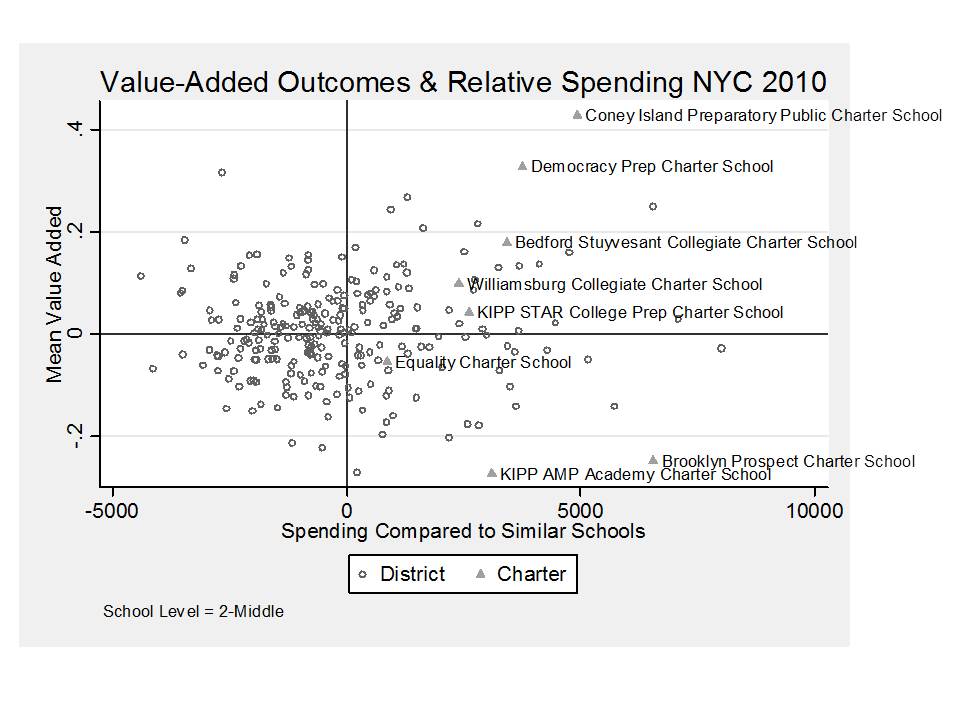
Figure 7 again shows that in New York City, charters tend to significantly outspend district schools with similar populations – well except Equality charter which is somewhat closer. On average, the average gains are indeed higher in these higher spending charters – actually moving upward in sort of a pattern. But remember, the peer groups in these schools also aren’t particularly comparable. KIPP AMP and Brooklyn prospect, however, don’t do so hot.  But, if there’s any case to be made here with these charters, resources just might matter. Not the same kids. More money. Some reasonable outcomes. 
Clearly, some deeper investigation is warranted. But, in each case there are also district schools, including lower spending district schools that outperform most of the charter schools. 
Figure 7. New York City Value-Added
There's Democracy Prep, spending more than $4,000 more per student, and getting better value-added scores for its teachers.

But what about the student population? Is Democracy Prep teaching "the same kids" as other schools? Well, here's a comparison to the public school Democracy Prep is co-located with in New York, the Academy of Collaborative Education:
Taking a closer look at Democracy Prep’s enrollment in comparison to ACE specifically (as we did in 2010) shows that other than the first year ACE opened, these patterns have been true throughout both schools’ existence. In addition, though Democracy Prep no longer publicly reports the type of services its Special Education students receive, evidence from 2008-09 showed that only 18% of its students with IEPs were mandated to be in self-contained classes, compared with 50% of Special Education students at ACE.
SchoolYear
% Free Lunch
% Limited
English
Proficient
% Special Ed
Academy of Collaborative Education2008
79
4
10
Academy of Collaborative Education2009
71
8
13.4
Academy of Collaborative Education2010
83
10
21.6
Academy of Collaborative Education2011
82
10
21.7
Democracy Preparatory Charter School2008
64
7
11.6
Democracy Preparatory Charter School2009
64
6
no public data
Democracy Preparatory Charter School2010
66
5
11.9
Democracy Preparatory Charter School2011
66
6
11.5
Sources: NY State Report Cards; NY State Charter SPED Invoices; NYC CSC Database
Fewer Special Ed children, fewer LEP children, fewer children eligible for Free Lunch. How does Democracy Prep make that happen? Well...
Tucked away in the middle was the notice that Democracy Prep was “working to open a new elementary school in the fall…”, neglecting to mention that this new school did not come out of the blue, but rather from the frequently pissed-on ashes of Harlem Day. Still, if you fire the staff, dump the administrators and redesign all aspects of structure and curriculum from scratch, it’s essentially the same thing. 
Then I took a poll, in each class, of the students who received such a letter. To a man, all the students—and ONLY the students—who received passing grades of Level 3 or 4 on their state English Language Arts (ELA) and Math exams in 4th grade were recruited by Democracy Prep. [emphasis mine]
OK, that's just one teacher's report. What else do we know about Democracy Prep's practices?
At Democracy Prep Harlem Middle School, a sixth grade math teacher started her class by giving her students exactly four minutes to solve a problem involving ratios. When her watch beeped, homework was collected and all eyes turned to the front of the room. 
“Pencils in the groove and you’re tracking me in three, two, one and zero,” she said, using a term common among charter schools where students are frequently instructed to “track” a speaker with steady eye contact and full attention. 
Almost everything on a recent visit to a Democracy Prep charter was highly disciplined. Students spoke only when their teachers allowed them. They could lose points for talking out of turn, or chatting in the halls between classes.
And what does this harsh environment lead to?
The “no-excuses” culture at Democracy Prep could explain why one of its schools had a high attrition rate, according to data obtained by Schoolbook and WNYC. The data only included the network’s oldest middle school, where more than 23 percent of the students left during the 2010-2011 school year. That’s higher than most charters, although some regular district schools in Harlem also have equally high attrition. [emphasis mine]
Except those public schools don't claim to educate "the same children" as Democracy Prep, do they?

To recap: Democracy Prep's practices include more spending per pupil, a rigid "no-excuses" culture, high rates of attrition, and segregation by poverty, special need, and English proficiency.

This is your future, Camden - imposed on you by state-officials and outside CMOs. Don't even think about fighting back.

Resistance is futile.