I will protect your pensions. Nothing about your pension is going to change when I am governor. - Chris Christie, "An Open Letter to the Teachers of NJ" October, 2009

Wednesday, October 24, 2012

A Newark Teacher Speaks

I received an email from a teacher in Newark today. It was so well-written and so powerful that I asked for permission to share it.

I'm omitting the first paragraph, as it details this teacher's particular salary situation. Suffice to say the teacher, with more than ten years of experience, will take a significant hit on pay - and that's not even counting the new state-mandated contributions to benefits, which will quadruple over four years.

None of the teachers I know are happy with this.  It has been the consensus that we would all vote NO.  Having peer evaluators has the potential advantage of us having empathetic people helping to decide how "effective" we are.  The more likely scenario, however, will be that they pay retired teachers to do this ("When I was in the classroom, I had 40 kids in there...") , and drain the Zuckerberg money in those consultant fees.  Or, they will pull teachers that are known to be mediocre at best out of the class to evaluate us.  They will be bloated with their sense of importance and their revisionist memory of how THEY ran a class.

Also, there is a fair amount of bitterness over the whole compensation and future earnings issue.  We are not happy.  Add to that, it would seem that our own union might be trying to bully/scare us into ratifying this contract.  My building rep had a meeting this morning.  I did not make it because it was last minute and I had given 5 students passes to come in early for tutoring.  From every account I heard, however, our rep told those who were there that if we don't vote for this proposal, the only thing left will be to strike - with no income, no benefits, etc.  Now several people who were firm NO votes are concerned.  They are waffling.

I am so saddened by all of this.  I love my job, and I love my kids.  I take a good deal more grief than my friends who teach in other districts take.  I am [xx], and have never done anything but teach.  What can I do?  I have a lot of faith in my abilities in the classroom, so I am left seriously considering leaving Newark.  My stomach aches at the thought of leaving.  I would never claim to be the best teacher out there, but I am very good.  I see significant growth in my kids every year, and I see where they go after a year with me.  I have pride, and am very tired of being so disrespected by my government.  If this passes, I think the odds will go sharply up, in favor of me leaving a district I really love.  It makes me want to cry.

Thank you for continuing your honest analysis of the current state of public education.  We appreciate it.


"... I had given 5 students passes to come in early for tutoring." Says it all, doesn't it? Even when it came to matters of grave personal concern, this teacher put his/her students first.

I don't know if this is the best deal Newark's teachers can get, but I do know one thing for sure: they deserve much, much better than what they are being offered. No one - not Chris Christie, not Cory Booker, not Chris Cerf, not Eli Broad, not Cami Anderson - will ever convince me otherwise.

We're pulling for you, teachers of Newark. Follow your hearts, and we'll take care of your backs.

Newark Teachers Contract Under Fire From Rank-And-File

Looks like the Newark teachers contract, agreed to by the union leadership and the district, is under attack from members of the rank-and-file:
Leaders of the Newark Teachers Union faced a barrage of criticism from rank and file members tonight over the historic three-year contract signed Friday that, for the first time, will offer annual bonuses of up to $12,500 to top teachers.
Many of the teachers and school employees who spoke during the meeting at the New Jersey Performing Arts Center urged fellow members to reject the contract when it is voted on by the union’s 3,300 members on Monday.
"It’s not everything I wanted, and it’s not everything you deserve," union President Joseph Del Grosso told the 1,000 people who gathered tonight. "You’re going to vote on it, so it’s in your hands."
That is, of course, as it should be. Labor unions are democratic institutions, and collective bargaining only works if the majority of the collective supports it. Del Grosso should bring this to his members; if he feels this is the best deal the district/state is willing to give, it's best to put it in front of the rank-and-file and let them have their say.

A quick point about bargaining: in these situations, the local chooses a bargaining committee, composed of several rank-and-file members. This group goes into negotiations, but they keep the terms of the bargaining secret from the rest of the local. The idea is that bargaining in public is always a disaster: better to put a fully-formed proposal before members so they can vote.

The problem is that negotiations can drag on for years, as they did in Newark. Members feel left in the dark, grow fearful of what will happen, trade in rumor-mongering... and then, out of nowhere, an agreement is dropped into their laps. It's frustrating for members, exasperating for leadership, and lousy for morale.

It's also great for the district's negotiators: as long as the schools are open and functioning normally, the public doesn't much care whether the teachers have a contract or not. Only the threat of work actions will make the public pay attention, which, of course, causes them to resent the teachers.

It's a terrible system for unions... but I can't think of a better one. Can you?

Anyway, back to Newark:
Teachers complained the $5,000 annual bonuses offered for teachers rated ‘highly effective’ according to a new four-tiered evaluation system will be impossible to attain. Others expressed fears that merit pay would pit one teacher against another and diminish the overall quality of education.
"It’s going to be all about me now because money talks," said one teacher. "If it’s between her and I, I want that money for myself, I want it in my pocket."
Not only that: errors are inevitable. If anyone could show that student achievement will increase thanks to merit pay, it might be worth it. Of course, they can't. So why do it?

There is a group of Newark educators resisting the contract called the NEW Caucus; they have a Facebook page that links to their analysis of the contract. They correctly point out that the contract moves the membership back on to the traditional step-guide - but that move comes at a price. Are the teachers of Newark willing to pay that price? We'll see.

Oh, there's one more thing in this article that makes me insane:
Union member George Worsley said he worked for non-profits before becoming a social worker in the district six years ago and does not expect the same regular raises his fellow teachers clamored for.
"At my old job, we had no contract, and we took what we were given," Worsley, 60, said. "I know everyone is frustrated, but we have to look at the economy and think about how much extra money is really available to give."
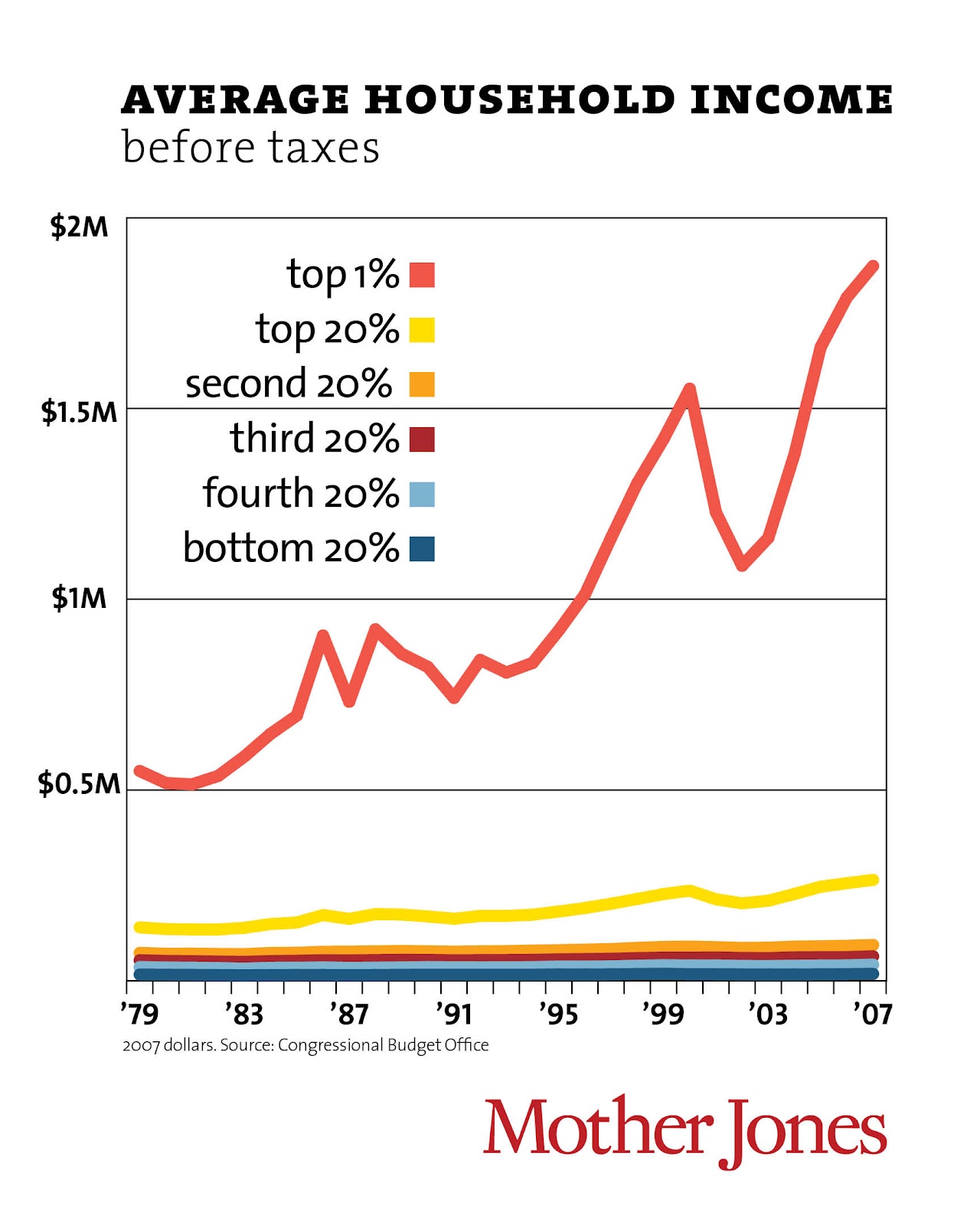
OK, look: we all know it's bad out there. It's not like teachers, with our salaries that haven't kept pace over the long haul with the private sector, don't feel the strain. But the problem isn't that teachers have it so good; it's that so many people in the private sector now have it so bad. And, if we are going to be honest with ourselves, it's obvious why that is:

Of course, it's "class warfare" to point this out. But teachers beating up their colleagues over five-figure salaries? Yeah, no problem...

Tuesday, October 23, 2012

No Matter What You Call It, It's Still Merit Pay

Folks, considering my record on merit pay, I think I have been more than fair regarding the Newark contract. I've been laying out the facts and what I believe are the long-term consequences - that's it. While I believe this contract has ramifications for every teacher in New Jersey, I haven't called for rejecting the deal outright because it's not my place to make that call. And I understand as well as anyone that in negotiations you sometimes have to take what you can get.

I also appreciate the work AFT president Randi Weingarten and Newark Teachers Union president Joe Del Grosso did to get this deal done. I am a union guy - I am on your team.

But this is not helpful:
“This is not a merit pay system,” said Weingarten. “This is a full compensation system where the work you do and the compensation you have are tied in together.” She said the new contract is “aligning the evaluation system with experience” while offering “significantly higher salaries for teachers all throughout their experience. … When you have all of those components, that’s a professional compensation system." [emphasis mine]
I'm sorry, but there's just no way you can call this anything but a "merit pay system." From the NTU's own joint statement with NPS:
The agreement includes rewards as well. In addition to step movements for teachers rated "effective" or "highly effective," the new universal salary scale offers ways to earn annual bonuses funded through philanthropic monies. For example,

- A teacher can earn a bonus of up to $5,000 annual for receiving a High Effective rating on their annual evaluation.
Of course that's merit pay. Of course teachers will be paid for what the district and the state considers "merit." Everyone knew that Mark Zuckerberg's money would come with strings attached: this is one of them. Teachers get the money if they play by the district's rules. Del Grosso admits it:
The Newark deal was also shaped by a $100 million donation from Facebook founder Mark Zuckerberg designated for Newark schools. Under the tentative agreement, step increases will be paid for with taxes, but the performance bonuses will be paid for with Zuckerberg cash. Del Grosso said that at first the Zuckerberg money “didn’t really motivate me, because they offered it in the way of ‘merit pay’…I said well keep the money.” But on reflection, “I said what happens if I don’t use the money? I bet some charter school will take it.” Instead, with the new contract, said Del Grosso, “I figured out a way” to put it to use.
Well, OK then: it's merit pay. Maybe NTU negotiated some other aspects to it, but it's still merit pay. Why deny it? In fact, I applaud NTU and Del Grosso for bringing this deal to the teachers: it should be their decision. If they think there is enough money in play that it's worth it to take their chances with merit pay, they will. They certainly understand that this may be a "use it or lose it" situation; let them make the choice.

But don't tell them this deal is something that it's not. It's merit pay - end of story.

I ain't the "Full Compensation System" Fairy, for cripes sake!

ADDING: Read the whole article. I think Diane Ravitch has a good take on the entire deal:
Ravitch, a prominent critic of the mainstream education reform agenda, offered a mixed take on the deal’s reported contents. She said there’s “a very good possibility that the Newark Teachers Union, and Randi Weingarten, is taking Chris Christie to the cleaners,” in that “a lot of money is going to flow to the teachers in Newark.”
Ravitch also described the introduction of peer review as a union victory, and as the best way of actually evaluating teachers’ effectiveness. She said that the union appears to have extracted hefty raises from the school district as the cost of introducing performance pay: “The ideologues win one thing, and the union wins $100 million dollars.” [Emphasis mine]
I think that's exactly right: this is a deal. The teachers are giving up something and getting something else in return. The only question is whether it's a good deal.
But Ravitch expressed concern that, once the state law requirement that test scores shape evaluations kicks in, this contract will mean that test scores play a role in shaping teachers’ pay. Paying teachers in part based on test scores, said Ravitch, is “treating them like donkeys rather than professionals.” She cited a three-year study by Vanderbilt University and the RAND Corporation that showed no difference between teachers paid under merit pay and a control group.
Ravitch, who keynoted AFT’s national convention last year, said she’s already heard from teachers in other school districts who say, “How are we going to be able to fight this off if they agreed to it in Newark?” In cities without Zuckerberg philanthropy, or in future Newark contracts, Ravitch noted, performance pay is more likely to come at the expense of other raises. She also faulted NTU for not taking a page from the Chicago Teachers Union and using their contract fight to push broader education issues like class size and integration. 
Well, Chicago had an advantage: they could go on strike. For all intents and purposes, striking is illegal in Jersey (I'll save the explanation for later). It's hard to know if NTU could fight the same fight as CTU.

In any case: if anyone tries to bring merit pay into any other district in Jersey, I think the local there is well within its rights to say: "Show us another check from a West Coast billionaire, and we'll talk."


Fact: Some Newark Merit Pay Will Go To the Wrong Teachers

The teachers of Newark have a decision to make: they can accept a large sum of private money and settle their contract... but only if they adhere to a merit pay program.

I am not about to tell anyone what to do, but I do feel compelled to lay out the facts. And one fact is for certain:

If the merit pay bonuses are based on the state-mandated four-tier evaluation system, at least some of the merit pay will go to the wrong teachers.

How can I be so sure of this? Because the state law requires "student achievement" - in other words, standardized test scores - to be used in teacher evaluations. And in any system where student scores are used to determine teacher evaluations, there will be errors.

But don't take my word for it; talk to the people who actually advocate for using Value Added Modeling (VAM) in the use of teacher evaluations. Every one of them admits that there will be errors; they understand it would be ridiculous to imply that there won't be any. For example, here's Dan Goldhaber, an economist and big VAM cheerleader:
We do believe it makes sense for policymakers to be transparent with stakeholders about how teacher rankings can be affected by model choice. This is important, for our findings show that models that, broadly speaking, agree with one another (in terms of high correlations) can still generate, arguably, meaningful differences in teacher rankings that correlate with the type of students they are serving. Moreover, some models that could be seen by researchers as providing more accurate estimates of true teacher performance (i.e. school and student fixed effects specifications) generate effectiveness estimates that are far less stable over time than less saturated specifications. And, issues like intertemporal stability, or the transparency of a measure, may also influence teachers’ perceptions of the measure. [emphasis mine]
In other words: this stuff is subject to noise and bias - there will be errors. How about Raj Chetty and John Friedman, authors of the (in)famous study about the economic value of teacher effects?
More generally, we should recognize that value-added data can be a useful statistic even though it’s not perfect, just like performance measures in other occupations. The manager of a baseball team pays attention to a player’s batting average even though it too is an imperfect statistic that bounces around over time. If a new player gets no hits in his first month, one option is waiting to see whether he is just in a temporary slump. Another is more coaching. But on occasion, the best option may be to let that player go and call up a replacement. [emphasis mine]
That's what I love about these guys: they soar over schools at 30,000 feet, conjecturing about "options," seemingly oblivious to the idea that it may only take a few isolated cases of getting a high-stakes decision wrong before teachers turn against the system.

(The baseball analogy is also not great. It's not my batting average; it's my students'. And there's no error involved in measuring batting: either you hit the ball or you didn't. Standardized tests are poor proxies for judging the learning we should care about the most.)

Now, in New Jersey, the DOE has pretty much stated that we're going to be using Student Growth Percentiles (SGPs) to come up with teacher ratings based on test scores. How does the guy who developed SGPs, Damian Betebenner, feel about using them to identify teachers in a high-stakes decision like merit pay?

Professor Baker emphasizes this with SGPs:

Again, the whole point here is that it would be a leap, a massive freakin’ unwarranted leap to assume a causal relationship between SGP and school quality, if not building the SGP into a model that more precisely attempts to distill that causal relationship (if any). [Emphasis in original]

We would add that it is a similar “massive … leap” to assume a causal relationship between any VAM quantity and a causal effect for a teacher or school, not just SGPs. We concur with Rubin et al (2004) who assert that quantities derived from these models are descriptive, not causal, measures. However, just because measures are descriptive does NOT imply that the quantities cannot and should not be used aspart of a larger investigation of root causes. [emphasis mine]
By "not causal," Betebenner means that SGPs don't even try to tease out the cause of a student's test score. Well, if they don't, how can they possibly be used to determine merit pay, which will require very fine judgments at the cut level between those who get it and those who don't?

Betebenner's comment here is in response to Bruce Baker (here's Baker's reply to the reply). Baker has said that using SGPs to determine a teachers effect on test scores is like trying to fly a plane with a saxophone: it's the wrong "instrument" for the job.

I'll say this again: these are smart guys, way above my pay grade. But that may be the problem: they are so wrapped up in the technical side of what they're doing, they can't see the larger picture. As Matt DiCarlo has pointed out, saying you want to improve teacher quality is not an actual policy; you have to actually put a real plan on the table and evaluate its total effect.

So, yes, VAMs and SGPs may tell us something about teacher quality, but tying them to merit pay is a whole different ballgame. We really have no idea how many "wrong" merit pay decisions it will take before teachers change their behaviors - for better or worse. We do know, however, that merit pay has never worked every time it's been tried. And we know that there will most certainly be inaccurate teacher evaluations in Newark over the next three years. So, if merit pay is enacted, there is good reason to believe it won't help test scores, and there may be negative consequences arising from the "inaccurate" distribution of the bonuses.

Newark teachers, you have to ask yourselves: are you willing to take this risk? Are you willing to be subjects in an experiment that doesn't have much evidence to support its underlying theory? Is the money worth it?

I can't answer that for you. I know many of you are frustrated by working without a contract for so long. I know you need those step increases. I know many of you think believe you're not going to get a better deal than this one, and you may actually wind up doing worse if you fight it.

Those are all legitimate considerations. But understand the trade-off. Understand what you will signing on to if you agree to this package. And understand that the rest of us may see things differently - especially since we won't have private money attached to our deals.


ADDING: Let's please put aside this "multiple measures" argument once and for all, OK? The one where testing cheerleaders say: "Well, test scores are only part of the evaluation."

Say it with me: "Some of the evaluation; all of the decision."

ADDING MORE: Bill Ferriter has three things you must know about merit pay before you approve this deal.

EVEN MORE: The Carnegie Foundation has some very good briefs on VAM; I'd encourage you to read them (h/t Matt DiCarlo). From the first one, by Stephen W. Raudenbush:
Imprecision is present in any personnel evaluation system. Standard statistical procedures help us cope with it. One rule is that we should examine confidence intervals rather than point estimates of teacher-specific value-added scores. On purely statistical grounds, it’s hard to justify publishing point estimates of teachers’ value added in local newspapers, especially without including any information regarding the margins of error. Even if the estimates are free of bias, the current level of imprecision renders such point estimates, and distinctions among them, misleading. A second rule is that administrators who want to use value-added statistics to make decisions about teachers must anticipate errors: falsely identifying teachers as being below a threshold poses risk to teachers, but failing to identify teachers who are truly ineffective poses risks to students. Knowing the reliability of the value-added statistics and, in particular, estimating their correlation with future gains in student learning, allows us to quantify the likelihood of making those errors under varied scenarios. These well-known techniques work when we assume that the measures of teachers’ value added are unbiased, and managing the problem of bias is important. [emphasis mine]
Make no mistake: there will be errors.

Sunday, October 21, 2012

Whitty Nails "Won't Back Down"

Stephen Whitty of the Star-Ledger has Won't Back Down all figured out:
The far gentler "Won't Back Down," seems to be an upbeat story about a single mom and a dedicated teacher who band together to reform a failing school. "It's about making people aware of the problems with our education system and trying to inspire people to get active," says star Maggie Gyllenhaal. "I mean, whatever your politics are, how can you not support that?"
Except that the film's also a carefully contrived critique of teachers' unions. Backed by billionaire Philip Anschutz, it's designed not just to sell tickets, but to present a point of view.
His production company, Walden Media, had previously produced the pro-charter advocacy film "Waiting for Superman," too, but was disappointed when the movie failed to draw large audiences.
We "realized the inherent limitations of the documentary format," Walden CEO Michael Bostick told the New York Times.
Far less honest, though, is the fictional "Won't Back Down," which while purportedly "inspired by a true story" is actually inspired by something its backers would like to see come true, the national adoption of "trigger" laws that allow parents to take over failing schools and institute wide-ranging changes. It's already drawn fire, particularly, predictably from teachers' unions.  And so this time they decided to use fiction — a spoonful of sugar to make the medicine go down.
[...]
"I think a lot of the criticism is coming from people who haven't seen the film yet," insists Gyllenhaal (who has a child in private school). "When they do, I think they'll embrace it, and teachers will ultimately get behind it. It's about making people aware of the problems with our education system and trying to inspire them to get active. ... The film really has such good intentions."
But what really are its intentions?
Anschutz, its prime backer and a reclusive oilman, has not only donated money to support the charter movement, but also to oppose gay marriage, collective-bargaining rights and environmental initiatives. The media holdings he's added to his portfolio, including the Weekly Standard, are one way to get those conservative messages out.
Get them out and keep them in theaters, too. Although "Won't Back Down" flopped in its opening weekend, it's still running full-page ads in papers, and appearing on a number of screens — although all of the New York and New Jersey theaters advertising shows are part of the Regal chain, another Anschutz holding.
Until recently, though, Anschutz's movie company was content to turn out apolitical — and quite well-made — family films, with uplifting stories and strong characters. Even when there was the chance to proselytize — as in its excellent productions of the "Narnia" films -- Walden Media generally preferred letting the allegory speak for itself.
 With "Won't Back Down," though, all subtlety has been abandoned. Some facts are invented; some are ignored. Anything that might suggest there are any other causes for failing schools besides unions (or any other solution beyond busting them) isn't brought up. The film doesn't want to begin a debate on public education, but conclude one.
[...]
And that's what the producers of films like "Won't Back Down" count on — that in between the smiles or tears, they can sneak in a sectarian message or a political attack. That we won't notice, that we can't tell the difference between art and propaganda.
Unlike the original Won't Back Down, my sequel has all of its facts cited. Phil, baby, call my agent, and we'll do lunch.

The MASSIVE Failure of Jonah Edelman

I just can't let this go without comment:
Less than two months into a new school year, teacher strikes have popped up in Chicago and four suburbs — with a handful of potential walkouts on the horizon — despite a new state law that was expected to make it harder for work stoppages to occur.

Similar themes have surfaced in each district — the latest during last week's one-day strike in Highland Park's North Shore School District 112 — but officials on both sides agree that often, the issues go beyond disputes over raises. Before this year, there had been only one Chicago-area strike since 2009.

[...]
District 112's brief strike ended after 17 hours of negotiations. Chicago Public Schools and districts in Lake Forest, Evergreen Park and Crystal Lake have largely settled on new contracts after walkouts. Meanwhile, unions in Carpentersville, Geneva, Grayslake and Huntley each have authorized strikes while continuing negotiations. [emphasis mine]
But wait a minute: the plutocrats who run the New Chicago Mob hired Jonah Edelman to make sure this would never, ever happen. He told them strikes were now impossible in Illinois:
With the unions then on board, the IEA and the IFT were relieved to have a deal. They came out strongly in support of this agreement, which was this wholesale transformational change, and with that support there was no reason for any politician to oppose it. So the Senate backed it 59-0, and then the Chicago Teachers Union leader started getting pushback from her membership for a deal that really probably wasn’t from their perspective strategic. She backed off for a little while but the die had been cast – she had publicly been supportive – so we did some face-saving technical fixes in a separate bill – but the House approved it 112-1. And a liberal Democratic governor who was elected by public sector unions – that’s not even debatable – in fact signed it and took credit for it. So we talk about a process that ends up achieving transformational change – it’s going to allow the new mayor and the new CEO [of Chicago schools] to lengthen the day and year as much as they want. The unions cannot strike in Chicago. They will never be able to muster the 75% threshold necessary to strike. And the whole framework for discussing impact – you know, what compensation is necessary – is set up through the fine print that we approved to ensure that the fact-finding recommendations, which are nonbinding, will favor what we would consider to be common sense. [emphasis mine]
Talk about a complete failure. If a teacher was as bad at her job as Edelman is at his, she wouldn't last even one school year.

I'll say it again: why do these extremely wealthy "reformers" keep hiring people who are really, really bad at their jobs?

In New Jersey, Peter Denton has been funding an effort to bring vouchers to the state: but after 14 years, vouchers are still seriously dead. David Tepper gave boatloads of money to B4K to change teacher tenure; it turns out the union got most everything it wanted, while B4K's proposal was basically ignored. Michele Rhee is rolling in reformy dough, but can't even put forward a cogent argument when challenged by an articulate labor leader.

You know what, though? Maybe all that doesn't matter. Maybe the reformies know they just need to keep spreading out into the political world and buying up elections all over the country. Maybe the game is so rigged in their favor that they can hire the incompetent.

Of course, that only works if we don't fight back, right?

TFA Is a POLITICAL Organization

Leonie Haimson points us to a paper by the reformy Alex Russo, edited by the reformy Fredrick Hess, and published by the reformy American Enterprise Institute.

That's a whole lotta reformy.

For edunerds, Russo's paper is actually very interesting: it chronicles the political rise of Teach For America, the "training" program for teachers. It seems that Wendy Kopp's merry band wasn't always the darling of the Beltway; according to Russo, TFA was ill-prepared to lobby Washington when it first came on the scene. But it turns out TFA had laid the roots for "saving" itself:
Still, it probably did not hurt that Senate Majority Leader Harry Reid’s education aide was Jason Unger, a TFA alumnus, or that TFA had recently opened a site in Las Vegas, his home state. Alexander’s former education aide, Kristin Bannerman, was a TFA alumnus also. Harkin’s top teacher quality person was Michele McLaughlin, who had until May been TFA’s vice president for federal and state policy. Senator Michael Bennet’s (D-CO) education staffer, Joy Silvern, would soon leave the Hill to join a TFA spinoff.
Well, isn't that convenient?

Of course, we could go right down the list these days to find lots of TFAers who gave up five-figure salaries and the hard work of teaching for more lucrative and glamorous careers in education "leadership." 

John White, the education commissioner in Louisiana, is a TFA alum and worked in its offices - as if that's an acceptable substitute for real education experience. Charles Glover, Dallas's new Chief Talent Officer, is TFA; so are Tennessee's commissioner, Kevin Huffman, and DC's chancellor, Kaya Henderson. Wikipedia has a partial list of TFAers who hold prominent positions in education, including Newark superintendent Cami Anderson.

But getting alumni into education positions is only part of the plan:
When Teach for America alumnus Bill Ferguson took on six-term incumbent George Della for a Maryland Senate seat two years ago, he benefited from the energetic support of his fellow Teach for America alumni -- but he had to overcome the strident opposition of the teachers' unions.
Ferguson upset Della in the Democratic primary and went on to win the general election, making him only the second Teach for America alumnus to secure a seat in a state legislature -- following Mike Johnston, who joined the Colorado Senate in 2009.
Johnston and Ferguson aren't likely to be alone for long: At least six TFA alumni are running for state legislatures this year, and many others are running for boards of education. Like Ferguson and Johnston, most of these former teachers likely will have to overcome union opposition to win.
It's not like TFA is shy about admitting that one of their goals is to get their people into "leadership" positions; they actually brag about it.

So let's call TFA what it is: a political organization. It's created a network to influence policy in both the political and education spheres. These are not people who have vast experience running schools, being administrators, or teaching: they are tourists in the world of education. Teaching for two years was an annoying prerequisite before moving on to bigger and better things; it certainly was never a real career choice.

In a real profession, people build up credibility by demonstrating competence over the long term; that credibility then leads to opportunities to become leaders. TFA is bypassing this antiquated notion, getting its people into authority positions without the messy step of having to prove competence in the field.

Its ambitions, like those of the Broad Superintendents "Academy," are nakedly political, and have very little to do with improving teaching or administrative practice. Let's not pretend otherwise.

ADDING: Have to add De’Shawn Wright, Deputy Secretary of Education for the state of New York, to the TFAer list.

Test Scores and the Newark Teachers Contract

It's a fact: test scores will be used to determine who gets merit pay bonuses in the proposed Newark teachers contract. From the new TEACHNJ Act, which sets out criteria for teacher evaluations:
Standardized assessments shall be used as a measure of student progress but shall not be the predominant factor in the overall evaluation of a teacher.
As I've said here many times, it doesn't matter if tests are the "predominant factor" or not when used to make a high-stakes decision like granting a bonus: some of the evaluation becomes all of the decision. If two teachers have the same observation scores, the one with a better test-based rating is going to get the money. Period.

Now, we all know this will change what is taught in the classroom: teachers teach the test when the test tests teachers. And don't let know-nothings like Michelle Rhee try to convince you that teachers won't drill-and-kill because the research shows that doesn't work: the truth is, it shows no such thing. We also know these tests are unvetted, often poorly constructed, often poorly graded, and quite often harmful to kids. In addition, recent cost-benefit analysis suggests the price for implementing these tests far exceeds any real or perceived benefit.

But let's put all that aside for the moment and ask the fundamental question: will test-based evaluations do a good job at identifying who is a "highly effective" teacher, and who is not? Luckily, Newark's teachers don't have to guess: there have been many experiments across the country with using student tests to evaluate teachers. So how have they worked out? (all emphases mine)

Florida:
Geoffrey Robinson is a National Board certified teacher at Osceola High School in Pinellas County who says 60 percent of his upper-level calculus students last year tested so well they earned college credit.
But this week Robinson received his teacher evaluation, based on a controversial new formula being rolled out statewide.
He was shocked to see how poorly he scored in the "student achievement" portion: 10.63 out of 40. 
[...] 
"It's hilarious," said Michael Rush, a math teacher at New Tampa's Wharton High School. "The first year my (student achievement) score was a 17-point-something and this year it was a 25-point-something."
That's a 50 percent increase, though his teaching methods are more or less the same. "You cannot deviate that much as a teacher," he said. "It's all voodoo math."
[...]
What aggravates teachers most is that 40 to 50 percent of their evaluation is based on "student achievement" — but it's not always their own students who are being measured.
For example, fourth- and fifth-grade teachers are rated partly on their students' FCAT scores. But the FCAT is not given until third grade. So if you teach a lower grade, then your "student achievement" score is based on the scores of older students at your school. Similarly, teachers of subjects that don't even appear on the state's standardized test are being evaluated, at least in part, on FCAT scores. Eventually, the newer end-of-course exams will be counted into the equation.
Kim Musselman teaches kindergarten at Clearwater's Eisenhower Elementary, where children's families tend to move a lot, she said. So she likely will be evaluated on the scores of older children whom she never taught.
When the evaluations are used to determine raises, "my pay is going to be based on kids that I've never had before," Musselman said.
Tennessee:
The state of TN paid millions to the Milkin family of Wall St fraud for their TAP/TEAM evaluations system that scores teachers on a 5 point rubric. The national trainers indoctrinated, I mean, trained all evaluators that a score of (3) is "rock solid". If there are "too many" high scores the trainer asserted that evaluators were gaming the evaluation tool. 

TN Commissioner of Education, TfA grad Kevin Huffman bloviates to media outlets that previous teacher evaluations inflated the scores and that "too many teachers were overrated. 

The Milkins have a fix for that problem. Since the scores of TEAM/TAP teachers follow a Bell-shape distribution (according to their non-peer reviewed research), only 15% of teachers will achieve scores above (4) or significantly above (5) expectations and 85% will perform at or below expectations. 
More Tennessee:
At the end of the school year, districts with observation scores that don’t closely align with value-added growth scores could penalize principals by taking 10 percent off their own evaluations, Barton said. For now, the state focus is that educators continue to get used to the new evaluations and that teachers get constructive feedback.
Even more Tennessee:
For 15 percent of their testing evaluation, teachers without scores are permitted to choose which subject test they want to be judged on. Few pick something related to their expertise; instead, they try to anticipate the subject that their school is likely to score well on in the state exams next spring.
Several teachers without scores at Oakland Middle School conferred. “The P. E. teacher got information that the writing score was the best to pick,” said Jeff Jennings, the art teacher. “He informed the home ec teacher, who passed it on to me, and I told the career development teacher.”
It’s a bit like Vegas, and if you pick the wrong academic subject, you lose and get a bad evaluation. While this may have nothing to do with academic performance, it does measure a teacher’s ability to play the odds. There’s also the question of how a principal can do a classroom observation of someone who doesn’t teach a classroom subject.
 New York City:
But this new analysis shows that a teacher teaching the same grade, the same course, with the ‘same students’ does not get consistent results.  It is truly like weighing yourself on a scale, getting off the scale and then one second later getting on the same scale, and having your ‘weight’ change by twenty pounds.
 More New York City:
In one extreme case, the formula assigned an eighth-grade math teacher at the prestigious Anderson School on the Upper West Side the lowest possible rating, a zero, even though her students posted test scores 1.22 standard deviations above the mean — normally good enough to rank in the 89th percentile. Her problem? The formula expected her high-achieving students to be 1.84 standard deviations higher than the average — roughly the 97th percentile.
Not all teachers who work with the city’s better-off students can be “above average,” said Sean Corcoran, an associate professor of educational economics at New York University who has written about the city’s scores, developed through a system called value-added modeling.
Los Angeles:
Next, they developed an alternative, arguably stronger value-added model and compared the results to the L.A. Times model. In addition to the variables used in the Times’ approach, they controlled for (1) a longer history of a student’s test performance, (2) peer influence, and (3) school-level factors. If the L.A. Times model were perfectly accurate, there would be no difference in results between the two models. But this was not the case. For reading outcomes, the findings included the following: 
• More than half (53.6%) of the teachers had a different effectiveness rating under the alternative model. 
• Among those who changed effectiveness ratings, some moved only moderately, but 8.1% of those teachers identified as effective under our alternative model are identified as ineffective in the L.A. Times model, and 12.6% of those identified as ineffective under the alternative model are identified as effective by the L.A. Times model. 

The math outcomes weren’t quite as troubling, but the findings included the following: 
• Only 60.8% of teachers would retain the same effectiveness rating under both models. 
• Among those who did change effectiveness ratings, some moved only moderately, but 1.4% of those teachers identified as effective under the alternative model are identified as ineffective in the L.A. Times model, and 2.7% would go from a rating of ineffective under the alternative model to effective under the L.A. Times model. 
[Adding] Louisiana:
An increasing number of educators say Louisiana’s evaluation system makes it more likely teachers at high-achieving public schools will get poor reviews, threatening their job security. 
“You are looking at trouble,” Norma Church, principal of top-rated Westdale Heights Academic Magnet School in Baton Rouge, said.
Superintendent of Education John White said the concerns are mostly misplaced, and teachers at the best schools are better positioned to get good reviews.

The issue surfaced earlier this month when a state lawmaker said South Highlands Elementary, Louisiana’s highest-rated elementary school, was seeing teachers rated as “ineffective” even though students had some of the state’s best test scores.

The problem is that when high-scoring students fall off a bit from the previous year’s performance teachers can be rated as ineffective.

[...]

Erin Darwin Pizarro, who taught at highly ranked Caddo Middle Magnet School in Shreveport last school year, said that while almost all of her gifted students scored in the highest levels on their sixth-grade iLEAP exam, one dropped a notch and some fell slightly.

The result, Pizarro said, was that she received a 40 percent rating on a 100 percent scale.

She said that while she loves teaching, evaluation worries have “made me consider quitting forever because of an assessment which could eventually label me ineffective and cost me my job.”

To me, the evidence is quite clear: test-based teacher evaluations are not accurate enough to make high-stakes decisions. There really is no debating this.

So Newark's teachers have a choice: they can accept a boatload of private money they wouldn't otherwise get, distributed based on teacher "effectiveness."

But - unless the negotiators of the contract can present evidence otherwise - they can be assured that the money will not be distributed with a reasonable level of accuracy if standardized test-based evaluation is involved.

Again: the argument that the tests only represent "some" of the evaluation is not compelling. The tests become what Bruce Baker calls the "tipping point," because it is the part of the evaluation that varies the most. Say it with me: some of the evaluation; all of the decision.

Speaking of Baker: we haven't even addressed the subject of New Jersey's use of tests through Student Growth Percentiles (SGPs). As bad as my above examples were, at least they attempted to tease out teacher effect; we're not even going to try to do that in Jersey. More to come...

ADDING:
As a parent and a teacher, I feel strongly that teachers need guidance. We need to always be striving. We need to be energized by thoughtful analysis of our successes and failures. But we need to devise a way of measuring teacher-effectiveness that provides teachers with meaningful data — and yearly progress on state exams just isn’t it. Teachers’ unions are right to resist any increase in the weight of this unreliable measure. I’m not sure what the solution is, but if twin studies are the gold standard for sciences like behavioral genetics, perhaps they could help in education reform as well. This is our family’s small contribution.
Yep.

ADDING MORE:

He currently attends an elementary school in a very rural county that prides itself on its school rating. When he entered first grade, they were an “A School.” Honestly, rather than seeing this as a plus, it made me uneasy.
At the end-of-the year student awards ceremony, the only subjects that the principal mentioned were math and reading. He announced that the school had the highest FCAT score for 3rd graders in our state. I noticed, however, that very few students made the all-subject honor role (all As and Bs). After speaking with teachers, it became apparent that all emphasis was on math and reading and, as a result, enthusiasm and achievement in other subjects suffered. Luckily, his own teacher rebelled and actually read the class Isaac Asimov. My grandson now loves science fiction and believes science is important.
This school philosophy, however, is seriously hurting him now. His current teacher has announced that his entire class will not have recess until their AR (Accelerated Reading) scores improve. It turns out that their school declined to a B school, and current scores indicate that they are not improving. Mind you, they have only been in school for 6 weeks.
Imagine how an active, imaginative, and very verbal 7 year old boy will function during a school day that does not include an outlet for him to express himself or learn to socialize with others in an unstructured environment.
Campbell's Law in action. If the tests scores determine a teacher's pay, the teacher will do whatever it takes to raise them.

Everyone OK with this?


Saturday, October 20, 2012

What a Teachers Union Should Be

Given the last couple of days, I thought this would be appropriate. Here's Karen Lewis, President of the Chicago Teachers Union, talking to her members:

allowscriptaccess="always" allownetworking="all" allowfullscreen="true" src="http://cdn.abclocal.go.com/static/flash/embeddedPlayer/swf/otvEmLoader.swf?version=fw1000&station=wls&section=&mediaId=8812091&parentId=null&cdnRoot=http://cdn.abclocal.go.com&webRoot=http://abclocal.go.com&configPath=/util/&site=">

God bless the teachers of Chicago's public schools.

More On the Newark Contract

Lou Caruso makes a very good point about the tentative Newark teachers contract:
This agreement exemplifies the power of philanthropic foundations which causes concerns of sustainability. The hope is that funds will continue to be available to payout incentive structures. The goodwill built into these new structures will erode if funding cannot be maintained. This agreement reflects though how philanthropic foundations have to power and ability to help provide incentives to produce less restrictive policies in bargaining agreements. Keep in mind, time will tell whether the agreements within this contract reflect an authentic commitment to providing incentives to attract quality teachers or reflect a coercive tactic to use short term funding to initiate structural changes. [emphasis mine]
That's the billion dollar question with the entire corporate "reform" movement, isn't it? When Gates or Broad or the Waltons or Zuckerman or the new Chicago mob or Murdoch or Tepper or any of these insanely wealthy people fund a "reform," is it reasonable to think they will continue to do so in perpetuity?

Sure, Zuck's bucks will pay for merit pay right now... but what happens at the next contract? As the Newark union president, Joe Del Grosso, says:
Still, the extent of the performance bonuses beyond this contract remains an open question. The drying up of funds has led to the demise of pay-for-performance plans in other states, and both Anderson and Del Grosso said that will be determined in the years ahead.
“Let’s pray there is another Zuckerberg out there for the next contract,” Del Grosso said.
But prayer is not a plan. What happens when Zuck's bucks dry up? What happens if Newark's schools can't find another sugar daddy? Does anyone think Newark or the state will be willing to go backward on merit pay at that point?

Property tax caps and the politics of SFRA will make it nearly impossible to raise the extra funds needed to continue merit pay bonuses without affecting the entire district budget. So where will the money come from? Inevitably, it will be raised by cutting overall teacher pay. That, by the way, means capping the number of teachers who will get merit pay (more on this later).

I'm starting to see the Newark contract as a trade-off:

Newark's teachers can have a big chunk of private money right now. But there will be a long-term consequence. This question is: which is better for teachers?

Wish I knew, but I'll keep trying to hash it out here. Again: I'm not here to tell Newark's educators what to do; I'm just laying out the issues.

Stand by...

ADDING: Go back and read Lou's entire post - he makes several other really good points.