I will protect your pensions. Nothing about your pension is going to change when I am governor. - Chris Christie, "An Open Letter to the Teachers of NJ" October, 2009

Sunday, March 4, 2012

Corporate Media Can't Wait to Humiliate Teachers!

The vultures in the corporate media have been looking at how the NY Daily News, the NY Post, MSNBC, and the LA Times are trashing teachers. And they are so jealous - they can't wait to join in the fun! Take, for instance, the folks at Gannett, which owns the Asbury Park Post:

Everyone agrees that the teacher evaluation system in New Jersey is due for an overhaul as part of comprehensive education reform.
But it is important to make sure the instruments used for those evaluations are themselves up to the job. That is why it is gratifying to see the state Department of Education has contracted with Rutgers University to review the new teacher evaluation system being tried out in 10 school districts across the state.
This should be done in the interest of fairness and to blunt the inevitable criticism from the New Jersey Education Association that some of the methods Gov. Chris Christie is pushing are unproven.
Acting Education Commissioner Christopher Cerf says the findings by a review team from the Rutgers Graduate School of Education will be used to guide implementation of the new system in the 2013-14 school year. Once an adequate system is in place, individual teacher evaluations should be made public as they were last week in New York City.
I don't know who is going to be on the Rutgers review team, but let's be clear: any objective assessment is going to find huge margins of error in these evaluations, which renders them effectively useless as teacher evaluation tools (in fact, here's a Rutgers professor who shows exactly this - will he be part of the review team? I'm not holding my breath).

It would, therefore, be completely irresponsible to publish these ratings; there's simply no point in it. Do they expect parents to storm principals' offices and demand their children be assigned to the "best" teachers? Does that sound practical at all?

Gannett loves to humiliate teachers and all public workers, which is why they publish a database of their salaries (I will never publish that link), lamely claiming "The public has right to know!" The real goal, of course, is to suppress public worker wages, which helps keep all middle class wages low. That is, of course, what so many American corporations want.

So you'd better believe that Gannett will tie a teacher evaluation database to their salary database. "How dare that 5th Grade teacher make $75,000/year when she's rated 'Not Effective'! It's an outrage!" There will be no context, no subtlety, no attempt to discern the truth; just a relentless bashing of teachers and their "outrageous" salaries.

NJ teachers, this is coming. You'd better step up now and stop it, and that means legislation that keeps these ratings from being published. That must be a necessary precondition of any changes in teacher evaluation going forward.

NYC Teachers Strike Back

But will anyone listen? Here's NYC teacher William Johnson in today's NY Times:
Like most teachers, I’m good some days, bad others. The same goes for my students. Last May, my assistant principal at the time observed me teaching in our school’s “self-contained” classroom. A self-contained room is a separate classroom for students with extremely severe learning disabilities. In that room, I taught a writing class for students ages 14 to 17, whose reading levels ranged from third through seventh grades. 
When the assistant principal walked in, one of these students, a freshman girl classified with an emotional disturbance, began cursing. When the assistant principal ignored her, she started cursing at me. Then she began lobbing pencils across the room. Was this because I was a bad teacher? I don’t know. 
I know that after she began throwing things, I sent her to the dean’s office. I know that a few days later, I received notice that my lesson had been rated unsatisfactory because, among other things, I had sent this student to the dean instead of following our school’s “guided discipline” procedure. 
I was confused. Earlier last year, this same assistant principal observed me and instructed me to prioritize improving my “assertive voice” in the classroom. But about a month later, my principal observed me and told me to focus entirely on lesson planning, since she had no concerns about my classroom management. A few weeks earlier, she had written on my behalf for a citywide award for “classroom excellence.” Was I really a bad teacher?
Reformy types keep telling us that teacher evaluations have to mirror the "real world." Let me ask them: if you were evaluating a manager, and one of his employees started cursing and throwing things at work, would you blame hat manager? Especially if the manager hadn't hired the employee? Or would you escort the employee out of the building immediately and call the police?

Human interrelationships are complex; they are exponentially more complex when they involve children, and it's yet another quantum leap when they involve children who are emotionally disturbed. Anyone who thinks teacher's worth can be boiled down to a number is a fool.

Here's another NYC teacher, Julie Cavanagh, in the NY Daily News:
Since the reports were released last week, the debate has been raging about whether a formula prone to as much as 53% in margin of error is the best way to judge the effectiveness of teachers. Self-proclaimed reformers say yes; those who understand teaching say otherwise.
There is no question that teachers are responsible for the learning and growth that take place inside of their classrooms. However, standardized tests are just not a reliable measure of learning. If we are truly interested in increasing the quality of education, the conversation surrounding accountability must shift.
Imagine if doctors were held accountable based on the death rate of their patients, regardless of environmental factors and whether prescribed treatment was followed.
Imagine if firefighters were held accountable based on fire injuries and deaths, even though they didn’t start the fires, their budgets had been cut and most of the homes in their district didn’t have fire alarms.
That would be unreasonable. So why do we only apply this impossible standard to teachers?
Because this has absolutely nothing to do with teacher "effectiveness," and everything to do with intimidation and union busting. The wide variation of scores year-to-year and arbitrary nature of the evaluation process - which Gary Rubinstein has documented brilliantly here and here -  is a feature, not a bug. The corporate reformers want teachers scared and humiliated; that way, they're less likely to stand up and demand decent middle-class wages and benefits.

Don't believe me? Look at this editorial in the very same edition of the NY Daily News:
Case One in point: Eric Windley, interim acting principal of Brooklyn’s Intermediate School 318, the school with the city’s highest proportion of low-rated teachers — fully 58.3% of the faculty.
Called upon to explain, Windley blamed dismal staff performance on disproportionate budget cuts — an out-and-out falsehood.
He told parents in a letter:
“Schools in economically disadvantaged areas get financially tortured, whereas schools in areas where there is no poverty do not receive any cuts in their school’s budget.”
The truth is that every school suffered budget cuts this year that averaged 2.4%. The hit to IS 318 was slightly less than typical. The truth also is that the school’s teacher ratings were perfectly in line with with the poor achievement gains scored by its students.
Principals like Windley must come to terms with their duty to raise teacher performance. Weak instructors must go, and, honestly, a good administrator does not need test data to know which teachers aren’t making the grade.
Case Two in point: The Harlem Children’s Zone Promise Academy One, a charter school that has wide latitude in hiring and firing staff. Two teachers lagged badly in the ratings, but by time the numbers were released, those instructors were long gone.
That’s how it should be done in all the schools, IS 318 included.
First of all: only an idiot sitting at an editor's desk would think that the interim acting principal of a school was responsible for hiring or firing staff. When did he start his job? Was he going to fire people in the middle of the year, before the ratings came out? Should he fire them now mid-year and create chaos in the classroom? On the basis of an inaccurate bubble test? Whoever wrote this dreck should be embarrassed on this basis alone.

But there's more: they compare this interim acting principal to a HCZ school; hey, they fired the teachers! Hooray! Of course, Geoffrey Canada, head of HCZ, also fires students when he thinks they can't cut it. Is the News endorsing that? Maybe this interim acting principal needs to let the students go if they aren't pulling their weight, huh?

Did it occur to the News that maybe there is an interim acting principal at this school because Tweed figured out the school needs new leadership? Shouldn't the interim acting principal be given a chance? Ot maybe we should wait to see who the non-interim, permanent principal is?

But that wouldn't give the News the chance to deflect blame away from school funding, would it? Because it's never, ever about money; if it were, insanely wealthy people like Mort Zuckerman, the publisher of the News, might actually have to start ponying up their fair share. Can't have that, can we?

This whole thing is beyond stupid. Morons running a tabloid that spills more ink on Christie Brinkley's marriage and celebrities in bikinis than explaining the teacher evaluation process are now pointing fingers at teachers and principals. They never bother to explain who they are going to get to replace these "bad" educators, as if there is an inexhaustible supply of qualified teachers just waiting to be judged by arbitrary measures and then humiliated in the Post and the News.

As for those of you currently on the job: don't fool yourselves. This is coming to your city and your state. They can't wait to humiliate you and denigrate you and disenfranchise you, all while saying how much they admire and respect the "good teachers."

We all need to get together now, stand with our brothers and sisters in NYC and LA, and tell these people we've had it.

Saturday, March 3, 2012

The Reformy Dr. Steve Perry Show - Part III

When we last left the very reformy Dr. Steve Perry, he was in the throes of a Twitter spasm, denigrating teachers while extolling his own moral superiority. In Part I and Part II of this series, I took a look at the student population of his school; turns out he has far fewer students in poverty at his magnet school than the neighborhood schools of Hartford surrounding him.

Sometimes, when I look at these celebrity reformy types, I have to dig deep to find out what they're all about. But not this time: it turns out Dr. Perry has been out pushing his brand across the country - hard. This past September, when most principals were up to their ears with the start of the school year, Perry was launching his book with a star-studded party; guests included Diddy, Chris Rock, Geoffrey Canada, and Joel Klein.

What has this man learned from hanging out with the stars?
I'm at a party and Kev Liles, I met him at the premiere of "Black in America 1." Soledad said I should meet this cat. He had an engagement party, a small affair, but Diddy was there, Jay, Andre Harrell. I'm walking out and Diddy says 'Whaddup Ni**a"(laughs). He said, "Good shit, I like what you do," and I replied, "Good shit, I like what YOU do." And then Jay told me that there are some things that he wants to do, and he would really like to talk about it. He clowned me for driving my kids to school.  Before I left he let me know that he was serious and really wanted to do something, still I'm just like whatever. I don't go out and make beats, you know, so if they want to do what I do, then you have to be real.
Just another day for a humble Connecticut principal, right? Except I don't know many principals who've been sponsored by Verizon, and have regular gigs on CNN, and who have their own publicists, and are registered with a speakers bureau.

Yes, it's true: you can get Dr. Perry to show up at your school or corporate event for a reported mere $10,000. What do you get for your money?
I’m here to discuss Dr. Perry. He recently visited my school and gave a very interesting talk. Notice that I didn’t say a “talk on [insert topic].” That’s kind of important to remember.
He began with an anecdote detailing his most recent Christmas Eve experience. On that day, his younger son had a particularly intense seizure that really shook up his family, especially him. According to Perry, while his son was unconscious, he felt a deep regret for all the nights and moments where, instead of being with his wife and kids fulfilling his role as a husband and father, he was fulfilling his duties  as a principal and/or mentor to his students. His son survived, thankfully, but Perry was shaken up. This experience led him to later reject a lucrative job offering that would have required even more time away from his family.
A moving story, right? Sure. Inherently, I think it’s a pretty interesting story, but my transcript of it and his execution of it are two very different things. His presentation of it was very dry and unmoving. While telling it, he frequently paused or stared blankly into the crowd or stammered over his words with an indifferent grin. These sound like symptoms of someone telling a painful, personal story, but in all honesty, he was just unprepared. I know that criticizing how he presented his sad little story seems really anal and nitpicky, and on some level, it probably is, but when someone visits my school at the expense of 10K +, mountains of stress on multiple people and organizations and sheer nonsense (SGA meetings are fascinating in the worst ways), I expect that person to do with words what Scorsese does with a camera. Thus, when he used to 20 minutes of his limited, costly time to give an unmoving, poorly prepared and ultimately pointless anecdote, I was annoyed. [emphasis mine]

Oh, dear. Well, maybe he was off his game that day; what does this diarist from DailyKos think about a visit to her school by Dr. Perry?
Everything went well until the end of the day. I was not present, but heard about it immediately after the fact.
CNN cornered our students and demanded to know if they thought they were learning anything. How did they know? How can they prove it?
The teacher was given the same in-her-face treatment and questioned along the same lines. She was informed that, "Some teachers need to be fired here."
She came out of that room shaking, extremely upset - and knowing her reaction to Steve's rudeness will be seen coast to coast.
Wonderful.
Dr. Steve Perry is a strong advocate of personal responsibility in all aspects of life. As a motivational speaker he emphasizes the social issues in the community with messages that aim at building up both the individual and the community so that our children can be better contributing members of society. His calls to action, personal responsibility and solutions. Man up Nobody is Coming to Save Us
Dr. Perry is a social worker with no administrative certification or teaching background. I suggest he 'man up' and obtain the same certification and experience as the public school teachers he assails in order to promote both himself and CNN.
Until then, he's just an attack journalist - with no cred.
OK, that's just two people's opinions. Let's ask some folks from Connecticut, where Perry works; they would know him best, right?
As Perry’s star rose, talks persisted. Parents complained that Perry kicked their children out of school, that Perry had a 100 percent success rate because he picked bright students, and he had fewer than 50 students graduating each year. So, they argued, it would be baffling if he had failed to graduate only a few students.
Recently, I watched the controversial 2009 CNN special that featured Perry. On the surface, his message is inspiring and instructive: You can achieve if you work hard, overcome obstacles and be persistent. However, the subtext is familiar yet disturbing: Yeah, there’s racism. But get over it.
Perry’s principal message is at the crux of the local backlash.
That’s because blacks in Connecticut have been trying to get over slavery and its long-term effects since 1638. And the state has responded by enacting laws to prevent them. Take for example the Tanya McDowell incident in Norwalk. Norwalk officials arrested the 33-year-old, homeless woman because of a law that has its genesis in the 1830s.
In April 1833 a white teacher named Prudence Crandall opened a school for black girls in wealthy Canterbury. The state responded by enacting a law that banned blacks from traveling into the state for an education. In April 2011, McDowell’s decision to put her six-year-old in the Brookside Elementary School in a high-achieving and wealthy school district exposed that lingering custom. She was arrested and charged with a felony for stealing a quality education. She faces 20 years.
Slavery and racism perfected for almost five centuries cannot be over within five decades. Today, like the 1830s, a convicted white man has a better chance of getting a job than a black college graduate with no criminal record. Black unemployment rate today is the same level as it was in the 1960s. Blacks with credit scores of 750 and a graduate degree are subjected to predatory lenders and collectors. They also face discrimmination when seeking loans and apartments.
And Perry’s Washingtonian message that blacks should get over racism has rightfully rubbed some the wrong way — as it should.
Racism is not an obstacle to get over like a hurdle on a school playground. It’s a systemic problem to confront.
Well, that's just some people's opinion. Let's ask an educator; what does a veteran teacher think about Perry's book?
Throughout, Perry spews unsubstantiated pearls of wisdom that he appears to pull straight out of his asterisk. That is if there were asterisks; the book is largely devoid of footnotes or citations. This is the world according to Perry, where coaches and attractive people make the best teachers. It’s also a world of mangled metaphors: “Urban schools are America’s canary. The shafts are dangerous. Traveling them will cost more than money.” Perry cultivates a maverick image, peppering his speech with colloquialisms like “piss-off,” “hell yes” and “hell no,” “silly-ass,” “raggedy ass,” “sorry-ass,” “dumb ass,” and several other variations on the ass theme. He may be keepin’ it real for the ’hood, or just swapping brazen rhetoric for substance. It’s hard to say. 
[...] 
Perry takes us through most of the hot-button topics in education today: failing schools, teacher pay, school vouchers, parenting, teacher accountability, No Child Left Behind, tenure, and so on. What he serves up in response is a warmed-over casserole of premasticated ideas: authentic assessments, learning styles, the importance of safe and happy environments, relevant lesson planning, and so on. He expounds at length on “good” and “bad” teachers, then—as if to nullify his own views—he boasts that his staff was drawn entirely from failed schools. “But when they were put in a better system, better things happened.” I couldn’t have said it better. 
But things are not as they seem at Capitol Prep. Perry hints at this periodically: “I’ve seen the right students and the wrong studenwts come to Capitol Prep.” Elsewhere he says it’s “excruciating” when a student is in “the wrong school.” So what happens to these “wrong students?” Capitol Prep is without doubt an excellent magnet school. But parents elect to send their children there. Perry defensively responds to those who presume that he must “cream” the best students from the system, declaring “untrue!” Consider this, though: it’s a college preparatory school. “If you don’t want to go to college,” says Perry, “go somewhere else.” Capitol Prep is a year-round school where uniforms are required and discipline is stressed, attracting parents who demand more of their children. Students for whom the school is not a “good fit,”—i.e., they are not doing well—are “counseled” out. In one recent year forty-three percent of the enrolled students left before graduation. This is not just cream, it’s extra heavy whipping cream. Of the fifty-seven percent of students remaining, all go on to four-year colleges, Perry’s claim to fame. 
Regular public schools must accept the “wrong students,” along with many other kids for which Capitol Prep would not be the “right school.” Principal Perry must know he has a good deal going. In any other situation he would likely be just another anonymous struggling educator.
Oh, my. I've been wondering how this man managed to find the time to be an author, a speaker, a broadcaster, a Twitter-holic, and a celebrity... and still find the time to run a school. I guess it's easier when your attrition rate is so high.

I'd be happy to correct the statistic alleged in this report, if Dr. Perry will simply release his attrition rates. Perhaps he can find some time in his busy, busy schedule to do so.

Data Abuse in New Jersey

We've now had over a year of ACTING Commissioner Chris Cerf's reign at the NJ DOE. Looking back, one overarching theme emerges:

Data abuse.

Cerf likes to present himself as a wonk, despite the fact that he is a lawyer by training and holds no advanced degrees in education. He love charts, graphs, figures, and "factesque" data. The problem is that he seems to believe the role of research is to support his ideology, rather than guide him to the truth.

Unfortunately for him, highly qualified education researchers have been watching the NJDOE. And their examinations of Cerf's presentations are quite damning.

Let's begin with Cerf's latest focus: poverty and student achievement. Bruce Baker of Rutgers takes down a particularly brazen bit of Cerf's mendacity:
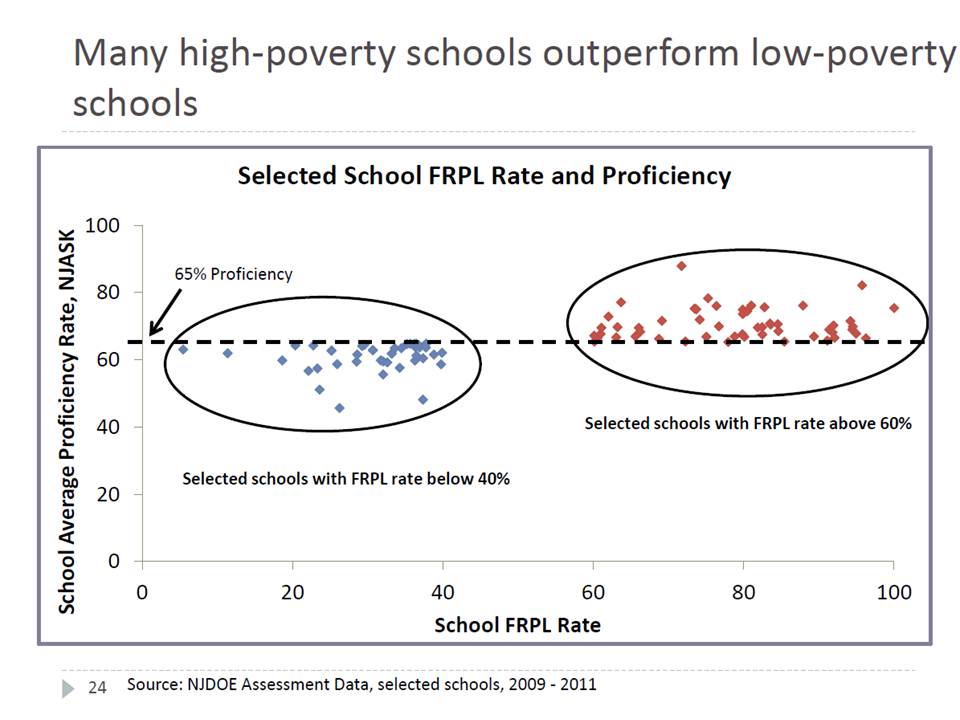
I just couldn’t pass this one up. This is a graph for the ages, and it comes from a presentation by the New Jersey Commissioner of Education given at the NJASA Commissioner’s Convocation in Jackson, NJ on Feb 29. State of NJ Schools presentation 2-29-2012
Please turn to Slide #24:
The title conveys the intended point of the graph – that if you look hard enough across New Jersey – you can find not only some, but MANY higher poverty schools that perform better than lower poverty schools.
This is a bizarre graph to say the least. It’s set up as a scatter plot of proficiency rates with respect to free/reduced lunch rates, but then it only includes those schools/dots that fall in these otherwise unlikely positions. At least put the others there faintly in the background, so we can see where these fit into the overall pattern. The suggestion here is that there is not pattern. [emphasis mine]
Cerf seems to think that just because there are some schools that "beat the odds," poverty is nothing more than a pesky excuse. It would be like my telling Mrs. Jazzman that the gallon of ice cream I eat every night isn't causing me to gain weight, because there are people in the world somewhere who eat ice cream and never gain weight; also, there are fat people who never eat ice cream. QED.

What's slick about this is that what Cerf puts out there may, in fact, be true - but it's so twisted and removed from context that it actually conveys a falsehood. Matt DiCarlo takes Cerf to task for doing just this when dissembling about the "achievement gap":
The existence of a gap only tells you that there are differences in outcomes (e.g., scores) between two groups, which are almost always defined in terms of income or race. States and districts could have a large achievement gap, but still contain a relatively high proportion of students reading at grade level. For instance, a relatively affluent district could see virtually all third graders reading at grade level, but still have a significant achievement gap – with one group (e.g., high-income students) performing much higher than the other. Conversely, one could imagine a struggling district with a much smaller gap, but where virtually all students still scored below grade level. 
If the NJDOE wants to make the (perfectly compelling) case that something should be done to help the 40 percent of third graders who it says cannot read at grade level, then those are the statistics they should cite. But it’s a little perplexing to use these figures, by themselves, as a justification for their focus on race- and income-based achievement gaps, which are a different type of measure. The better argument would have been to simply say that the state’s overall scores are quite high, but that this masks the fact that many students are still struggling. Differences in scores between subgroups are usually an underlying component of overall performance, but the latter might be obscured by the former, and vice-versa. It’s critical to examine both.* [emphasis mine]
But there's a reason Cerf focuses so much on the "gap": it allows him to casually dismiss the fact that New Jersey's students do exceedingly well. And, as DiCarlo points out, the state is moving in the right direction:
The simple table below compares the change (between 2005 and 2011) in average NAEP scale scores for NJ students who are eligible for free/reduced-price lunch (lower-income) versus those who are not eligible (higher-income). I want to quickly note that these data are cross-sectional, and might therefore conceal differences in the cohorts of students taking the test, even when broken down by subgroups.*** 
 
This table shows that, in three out of four NAEP tests, both low- and higher-income cohorts’ scores have increased substantially, at roughly similar rates. In fourth grade math, students eligible for free/reduced-price lunch scored six points higher in 2011 compared with 2005, the equivalent of roughly half a “year of learning,” compared with a similar, statistically discernible five point increase among non-eligible students. The results for eighth grade math and fourth grade reading are more noteworthy – on both tests, eligible students in NJ scored 12 points higher in 2011 than in 2005, while the 2011 cohorts of non-eligible students were higher by roughly similar margins. 
In other words, achievement gaps in NJ didn’t narrow during these years because both the eligible and non-eligible cohorts scored higher in 2011 versus 2005. Viewed in isolation, the persistence of the resulting gaps might seem like a policy failure. But, while nobody can be satisfied with these differences and addressing them must be a focus going forward, the stability of the gaps actually masks notable success among both groups of students (at least to the degree that these changes reflect “real” progress rather than compositional changes).
So, compared to similar children across the nation New Jersey has high-performing kids who are both poor and not-poor. And, as Howard Wainer points out, the same phenomenon occurs when looking at race:
But focusing on the difference blinds us to what has been a remarkable success in education over the past 20 years. Although the direction and size of student improvements are considered across many subject areas and many age groups, I will describe just one -- 4th grade mathematics. In the figure, the dots represent the average scores for all states that are available for NAEP's 4th grade mathematics test (with New Jersey's dot labeled for emphasis). These are shown broken down by race (black and white students) as well as by year (1992 and 2011). We can see that there have been steep gains for both racial groups over this period (somewhat steeper gains for blacks than for whites). Of course we can also see the all-too-familiar gap between the performance of black and white students, but here comes Achilles. New Jersey's black students performed as well in 2011 as New Jersey's white students did in 1992. Given the consequential differences in wealth between these two groups, which has always been inextricably connected with student performance, reaching this mark is an accomplishment worthy of applause, not criticism.


The last thing that we see is that the performance of New Jersey's students was among the very best of all states in both years and for both ethnic groups. [emphasis mine]
Bruce Baker goes into this further, and knocks down the "solution" proposed by the Christie administration to the "gap": take more money from poor schools and give it to not-poor ones (yeah, that makes perfect sense...).

It's worth noting that these are three distinguished scholars who are relying on standard statistical and research techniques, using commonly available data, that they have published publicly so as to invite scrutiny. This stands in stark contrast to the secretive, ideological "research" put out by Cerf's DOE, which is produced by highly-paid hacks and stands as an embarrassment to the state.

I know that it's easy for some to be deceived by Cerf's apparent love of data. He is a charismatic speaker and clearly an intelligent man. He has a grasp of the basic language of statistics. He talks about wanting to help disenfranchised children with great sincerity.

But there is little doubt that he is twisting the data for his own ends - probably knowingly. Everything coming out of his office these days needs to be examined very, very carefully.

Friday, March 2, 2012

Bad Cup of Joe, Part II

This is, in a word, unbelievable:


I don't think I've ever seen anything like this. 15 straight minutes of bashing on teachers unions, and no one - NO ONE - from the union itself is there to respond. No one from the NEA; no one from the NJEA; no one from the local union in Fort Lee; not even a MEMBER of the NJEA - a teacher! - appeared in this segment, or afterward (the teacher who showed up later is in Newark, and therefore not represented by NJEA, but by AFT).

I'd like you to imagine, for a moment, a segment on this show where some politician decides to lay into the AMA. Does anyone believe the doctors wouldn't get a chance to respond? Wouldn't there be an uproar if they were denied a chance to talk?

My question stands: did Chris Christie make it a condition of his appearance on Morning Joe that no member of the NJEA would be allowed on the show? If he did, that's scandalous. If he didn't, MSNBC then has a clear bias and should be shunned.

Now that I think about it: how do Rachel Maddow, Lawrence O'Donnell, and Ed Schultz feel about this? Apparently, Al Sharpton is fine with it, as he didn't say crap during his appearance. What about the rest of you? Do you subscribe to this kind of nonsense? What are you prepared to do to stop it?

A Bad Cup of Joe

UPDATE: If you want to see what a courageous educator looks like, scroll to the bottom.


FURTHER UPDATE: I have confirmation that there was NOT a threat of a written reprimand to teachers if they attended the Morning Joe program in Fort Lee on Friday.

I have neither the time nor the stomach to take on all the mendacity and stupidity that spewed forth from MSNBC's Morning Joe during their education "town hall" on Friday. But I will point out a few low lights. Let's start with this:

There were two New Jersey superintendents on the show: Interim Superintendent Steven Engravalle of Fort Lee, and Cami Anderson of Newark. Engravalle was appointed just this last November: he's been on the job four months, but the show ran a piece about how he's changed the "culture" of the schools, and test scores are up. Yes, that's right: four months, when there hasn't been even one administration of the NJASK. That's even faster than Michele Rhee claimed success.

Engravalle replaced outgoing super Raymond Bandlow, who left for a gig in New York, which doesn't have a cap on superintendent pay - a cap that was put in place by Chris Christie and has led to a brain-drain in school leadership across the state. Christie loves the new guy though, because he toes the company line; in this clip, he bad mouths the union:

So, the NJEA should return some dues money to teachers, because first year teachers don't make enough. Of course, the reason they don't is that Chris Christie is cutting their benefits and pensions while telling taxpayers to vote down school budgets if teachers don't open their contracts and take pay freezes cuts. Forgot to mention that, didn't you?

Cami Anderson has been the super in Newark since last May. In that time, she's managed to enrage entire neighborhoods with an ill-conceived school closing plan that looks like it was hatched on the backs of cocktail napkins. She loves to talk about "leadership," yet she appeared to be completely clueless when discussing the student populations of her district's schools and how they affect test scores. Maybe that's because, when other school leaders were actually leading districts, she was spending her days running Teach For America.

Look, I don't want to bust too hard on either of them. Engravalle is a young guy - 33 - and this is probably his first time on national TV. He may well grow into the job, and I wish him the best (for the sake of the children and teachers of Fort Lee). I've said before that Anderson may well turn out to be the best super Newark ever had; I wish her the best as well.

But dear lord: they barely have a year's worth of superintendent's experience between them. There are dozens of superintendents with decades of knowledge in New Jersey; did no one think to call them up? Why is it that the media seems to love superintendents who haven't accumulated track records of success - like Janine Walker Caffrey in Perth Amboy, darling of the Star-Ledger, and on the job less than a year herself?

Note to the media: Michelle Rhee didn't stay in Washington, DC long enough to get anything serious done. She is not a good role model for picking superintendents to speak about education, because she never put in the time, as a superintendent or as a teacher. Stop talking to neophytes like her, and start taking to the veterans.

Its clear that Chris Christie got to pick the supers he wanted for the show. I guess that's how the "news" is run these days. But if the folks at MSNBC really wanted to inform their viewers, maybe they could have interviewed this guy:


Nearly a decade leading New Jersey schools... but he actually bothers to think about this stuff and challenge reformy orthodoxy. Guess he doesn't quite fit Christie's MSNBC's bill.

ADDING: Obviously, I can't confirm this, but one of my commenters leaves this note:
Jazzy:

A friend of mine who works at Fort Lee told me that when they found out that their school had been chosen for the TV show, they were warned to stay away...any employee who showed up at the gym was going to receive a WRITTEN REPRIMAND!!
Holy cats! Can someone from Fort Lee confirm this?


I have heard from a teacher in Fort Lee that there was no threat of a reprimand if teachers attended the Morning Joe broadcast on Friday. Glad to hear that.

ADDING MORE: Oh, my:
Sporting his now trademark Superman socks, which he proudly showed off when asked to do so, Engravalle talked about how Fort Lee schools have improved in the past couple of years.
Well...

ADDING EVEN MORE: Well, looks like there was a reason the local union for Fort Lee wasn't allowed to have their president appear on the show. Turns out the president of the local, Gary Novosielski, doesn't drink the Christie Kool-Aid:
Is it a rumor that Christie cut millions from Fort Lee’s budget, then restored only thousands? If a burglar stole a thousand dollars from me, then returned a hundred dollars of my own money, I doubt that I would thank him. Is it a rumor that the cuts to state aid were matched almost dollar-for-dollar by a cut in taxes for millionaires? Is it a rumor that his proposed budget once again includes windfalls for the rich and crumbs for working men and women? Is it a rumor that Christie has capped growth in school spending at 2 percent per year while, over the period since his inauguration, tax payments of the average property owner have risen by over 20 percent? With friends like the governor, who needs enemies?
In that same time period, the Fort Lee Education Association agreed to give-backs, saving the district and its taxpayers over $8 million over the course of our current contract. This dwarfs any rumored enhancements promised by the governor. And unlike the governor’s seeming largess, our contributions came directly from our benefits, not from some other tax source.
If Chris Christie was really the blunt-talkin', straight-shootin', man's man that Joe Scarborough seems to think he is, he would have gladly met this courageous teacher and union leader and debated him in an open forum. But he never, ever engages his critics unless he controls the mic.

Mr. Novosielski, you are a man of principle and a true educational leader. Every teacher deserves a representative like you.

MSNBC: Worse Than Fox

MSNBC had yet another one of their "town halls" on education this morning. I could only watch a little as Mrs. Jazzman and I were busy getting the Jazzboys out the door and on the bus before I got in the car and drove to my job where I work daily to destroy America.

From what I saw, this was yet another vacuous gab session which ignored actual teachers in favor of pundits and politicians. But they did seem to amp up the propaganda even more this time around: both Chris Christie and Michelle Rhee were given a platform to spew their anti-union, anti-tenure, and anti-teacher rhetoric with no challenge whatsoever.

Now, Rhee is a demonstrated failure, both as a teacher and as a superintendent; no one who knows anything about education takes her seriously anymore. And Christie has already shown he is incapable of winning a debate with anyone informed on education where he doesn't control the mic (that link still cracks me up - @stopthefreezeNJ completely embarrassed the guv). Which leaves me to wonder...

Was it a condition of their appearance on Morning Joe today that they would not have to face hard questions from competent adversaries? Is that why there were no representatives from the NJEA on today's show? No education researchers who challenge the NJDOE's misuse of data? No reporters who have questioned Christie's orthodoxy on education? No parent advocates who have documented the abuses occurring under ACTING Commissioner Cerf's watch? No teachers who are critics of Christie's and running for political office?

For that matter: no smart-ass teacher-bloggers?

Did anyone from MSNBC think to ask any of these folks if they would like to come on the show and force Chris Christie or Michelle Rhee to answer some hard questions about their reformy agenda? Or was this simply a piece of political theater, engineered to sell the public on the ridiculous idea that America's problems can be traced back to a handful of "bad" teachers who have tenure?

There's one way to find out: MSNBC needs to come clean about today. Was anyone from the NJEA asked to be on the show? Did the NJEA contact MSNBC and ask to participate? What were they told?

Did any of the producers of Morning Joe even try to get someone on the show who could competently present an opposing point of view?

You can tweet these questions to the following folks:
@Morning_Joe 
Joe Scarborough: @JoeNBC 
Mika Brzezinski: @morningmika

And here's the Morning Joe Facebook page. You can also contact them through the MSNBC page.

The question is simple: did you attempt to contact the NJEA or any other critic of Chris Christie and/or Michelle Rhee to appear on this show?

If you didn't... well, we may as well just watch Fox. At least we know where we stand with them.

Look at Mika's expression: awkward...

Thursday, March 1, 2012

Once Again, NBC Ignores Teachers

So there's another one of these big reformy lovefests on the "liberal" (ha!) MSNBC tomorrow. And, oh, huzzah - this one's in Jersey:
New Jersey Gov. Chris Christie will be at Fort Lee High School for a “special town hall meeting” Friday morning as one of many guests on the live broadcasts of MSNBC’s Morning Joeand Way Too Early, according to producers.
Gov. Jack Markell, D-Del., Gov. Dannel Malloy, D-Conn. and Students First founder Michelle Rhee, among others, will join Christie on the live broadcast from the high school gymnasium.
The discussion will focus on education reform.
No, the discussion will focus on how "bad" teachers are destroying America and the only solution is to eliminate their job protections on the basis of inaccurate and arbitrary testing. There will also be plenty of discussion about how we just don't have any more money to pay teachers decently (bull) or keep promises that politicians have already made to them.

I will guarantee you there will be no discussion about income inequity or solving childhood poverty or the tax schemes this country perpetuates to keep the wealthy from paying their fair share. But I'm sure Joe will make time for the fabulously wealthy people who sit around his table to complain about public workers being able to go to the dentist without running up their credit cards; he and Christie love singing that song when they get together.
According to the Morning Joe website, guests will also include Mike Barnicle, Harold Ford Jr., Rev. Al Sharpton, Mike Allen, Howard Dean, Jon Meacham, Cami Anderson, Randi Weingarten, Deborah Kenny, Elaine Wynn, Melissa Harris-Perry and Jose Diaz-Balart.
Gosh, I'm sure it's just an oversight that no actual working teachers, or education researchers, or officials from the NJEA, or parent advocates, or (heaven forbid) students are on the panel. I'm sure NBC will fix it the next time...

I and thousands of other teachers would have loved to participate, but:
Attendance at the live broadcast at the high school is by invitation only.
Of course it is; can't have the rabble asking inconvenient questions, can we? Besides, we'll be busy getting ready to go to our schools and actually teach the kids. It's a job that all of these fine folks keep telling us is terribly important - just not important enough that teachers should take airtime away from them.

Useless, Reformy Polls

While I'm sure the corporate reformers here in Jersey will be jumping up and down, this question in the latest Qinnipiac poll is basically meaningless:

32. Governor Christie wants to limit teacher tenure. Do you think this is a good idea or a bad idea?

Tot    Rep    Dem    Ind    Men    Wom


Good idea            60%    79%    45%    63%    62%    59%
Bad idea             32     13     46     29     31     33
DK/NA                 8      8      9      7      7      9


                     Union  HAVE KIDS....                      Philly
                     HsHlds <18    PubSch Urban  SbUrbn ExUrbn land   Shore


Good idea            53%    64%    68%    47%    55%    81%    57%    66%
Bad idea             40     30     25     46     35     16     35     26
DK/NA                 7      6      7      7     10      3      9      8

If we interpret this question literally, the NJEA "wants to limit teacher tenure" as well, as they have proposed extensive reforms to the current law. Given that, I'm amazed 32% are against "limiting" tenure.

Tenure is about due process - period. Teachers can and are removed from the classroom regularly under tenure, and at rates that are comparable to other professions. But Christie and far too many in the press have convinced the public that the Tenure Boogeyman is coming to eat their school.

We've seen this far too often in polling on education issues, like vouchers: phrasing the question differently can lead to dramatically different results. The only thing polls like this tell me is that teachers and their unions have not done a very good job of explaining to the public what exactly tenure is. Of course, it's tough to cut through the scary stories the corporate reformers tell every day about the Tenure Boogeyman...

I'm gonna eat your school! Yarrggghh!

ADDING: Have I mentioned lately how much I loathe Blogger? I'll try to fix it later.

Don't Hold Your Breath

ACTING Commissioner Cerf is on the case! Eventually...
State acting Education Commissioner Chris Cerf said Wednesday he would review the impact of the new superintendent salary caps to see whether districts had lost talent at the top. 
Cerf’s comment came as he addressed about 500 superintendents at a meeting of the New Jersey Association of School Administrators at Jackson Liberty High School. During the question-and-answer period, two superintendents won long applause when they said the year-old caps caused a brain drain. 
“The best I can tell you on the superintendent cap is you have been heard, you have been heard by me,” Cerf said. “I am not in a position to give you the change or the comfort you want. … This is something worthy of a look based on data.”
I wouldn't stay up late waiting for Cerf's review. 360 days ago, Cerf promised a report on charter schools that took a look at their claims of superior results "as soon as is humanly possible"; we're all still waiting for that one. I have a feeling this review will rank even further down on his to-do list.


By the way, NJ superintendents: if you think limiting pay results in brain drain, what do you think Christie's assault on benefits, pensions, and pay has done to the teaching corps?